



Featured Stories
Brad Mehldau as Religious Experience

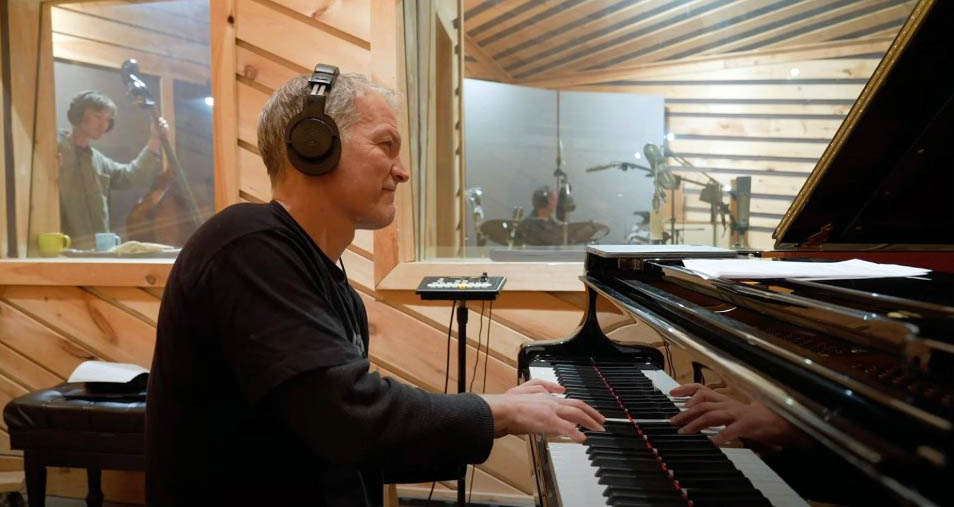
Released in August of last year, Brad Mehldau will be presenting his Grammy-nominated Ride into the Sun live in concert on August 27 at the Balboa Theatre.
Brad Mehldau
If Brad Mehldau were just another nationally touring musician passing through town on his way up to LA, his gig later this month at Balboa Theatre wouldn’t merit the fanfare of being mentioned here for the second time in as many issues.
But there’s simply nothing ordinary about how Mehldau’s mind processes melody, rhythm, and harmony. Nor is there anything commonplace in the way his masterful manipulations of the piano’s full range of dynamics—wringing every last half-shade of emotional meaning from a piece of music—appear to be second nature.
Through gangly limbs, using the piano as an inhibition-circumventing bypass, Mehldau, a soft-spoken, anonymously handsome guy (in the manner of Paul Rudd and the male lead from CBS’ “Yes, Dear), reveals the contours of his soul and the limitless idiomatic musical touchstones of his vast consciousness more completely, more generously than just about any musician working today.
In a now-immortal essay for the New York Times Magazine, the late David Foster Wallace described the feeling of watching Roger Federer play tennis at Wimbledon as “religious experience.” That’s how I feel when I listen to Mehldau. It’s been that way for me since an overly trusting acquaintance loaned me all five volumes of The Art of the Trio without a specified return-by date. That seven-CD box set comprising Mehldau’s early-career recordings (1996-2001), with bassist Larry Grenadier and drummer Jorge Rossy, is one of just a half-dozen albums I return to whenever I feel an urgency to remember who I really am.
Those albums, along with contemporaneous recordings from like-minded peers The Bad Plus, radically expanded the possibilities of what a piano jazz trio could be in the new millennium, most notably by taking a sledgehammer to the old walls of music’s grandest estate—the Great American Songbook—and laying the foundation for necessary new wings.
With a genius for counterpoint and a master impressionist’s gift for elegantly extrapolating previously unperceived harmonic depth from the work of the Beatles, Radiohead, Joni Mitchell, Nick Drake, Jeff Buckley, and, most recently, the late melancholy indie rocker Elliott Smith, Mehldau makes musical miracles happen.
And he does so humbly, with real reverence for his musical muses, bringing colors to the fore with so much respect for the source material that he makes you believe they’d been there the entire time, dormant, waiting to be unlocked. But Mehldau doesn’t extract blood from stone; he trusts his massive ears, hearing what’s not quite there but could be; he hears the ghost notes and feels the unexpressed emotional contours of a piece of music—and then he re-animates them.
In the 25 years since The Art of the Trio’s last volume, Mehldau has only added to a legacy that already places him among the pre-eminent musical re-engineers or optimizers of his time (and maybe of all time). Because his catalogue of thematic variations and adapted works is so prolific, his original compositions and song cycles are often given short shrift.
But his bop-oriented originals written for both early (1994’s Consenting Adults) and later (2024’s Solid Jackson) iterations of the eponymously acronymized MTB quintet (Mehldau, Mark Turner, and Peter Bernstein) are tailor-made burner launchpads for Bernstein, the master guitarist and Mehldau’s college classmate at the New School.
Then there’s his solo piano work—2003’s Live in Tokyo and 2006’s Live in Marciac—which is every bit as best-in-class as those from fellow masters Fred Hersch and Alan Broadbent, who are much more readily associated with their solo virtuosity.
It doesn’t end there—not by a long shot. His ensemble albums with horns and strings—2002’s Largo, 2009’s Highway Rider, 2019’s Finding Gabriel, and last year’s Ride into the Sun—speak to Mehldau’s ambition to go for Baroque and write/arrange multi-layered pieces for increasingly large chamber orchestras that temper his more more maudlin sensibilities with a characteristically light touch.
And his duo collaborations with Joshua Redman, Pat Metheny, the late Charlie Haden and Chris Thile—to say nothing of MoodSwing (1994), RoundAgain (2020), and LongGone (2022), the three landmark quartet albums with Redman, Christian McBride, and Brian Blade—reveal his ability to dialogue with the most idiomatically fluent musical conversationalists of the last 40 years.
Name me two musicians in the world who can play “St. Thomas” — the late Sonny Rollins’s anthem—alongside Joshua Redman, Brian Blade, and Christian McBride like this:
…AND original variations on Bach like this:
And this:
A few months back, a friend got me a ticket to see Lang Lang — the biggest draw in classical piano today — play at Jacobs Music Center, and he was every bit as captivating as his reputation would suggest. But you can’t tell me he does as much as well as Brad Mehldau. I simply won’t hear it. Which is why the conversation shouldn’t be whether Mehldau is the world’s greatest living jazz piano player; it should be whether he’s the greatest living piano player period.
I feel duty-bound to inform you, dear reader, that I have no financial, social, professional, or personal incentive to sell you on seeing Brad Mehldau present his latest album Ride into the Sun in concert later this month at the Balboa Theatre, where he’ll be joined by Thile on mandolin and vocals, Blake Mills on guitar, Matt Chamberlain or drums, John Davis on bass, and backed by the 17-piece USC Thornton Chamber Virtuosi. It’s also none of my business whether you believe in or have any curiosity about forces or phenomena that might exist outside of our capacity to perceive them, i.e. a higher power, so to speak. But consider this quote from the aforementioned Wallace essay on Federer:
“Genius is not replicable. Inspiration, though, is contagious, and multiform—and even just to see, close up, power and aggression made vulnerable to beauty is to feel inspired and (in a fleeting, mortal way) reconciled.”
If you’d ask me, I’d put it this way: In Brad Mehldau’s music, I hear the voice of whatever the hell God is or is supposed to be.
And just in case you’re one of those San Diegans who need a local connection, no matter how attenuated, dig this: The first record Mehldau ever played on—he was 20 years old at the time, still an undergrad at The New School—was a 1991 RCA release titled The Natural Moment. The leader on that recording date? San Diego’s own alto saxophone virtuoso Christopher Hollyday!
Hope to see some of you at the show. Tickets: https://theconrad.org/events/ride-into-the-sun/

