




SUE'S SPOTLIGHT: Women in Blues and Jazz
Tailgate Queens: Women Who Play Trombone

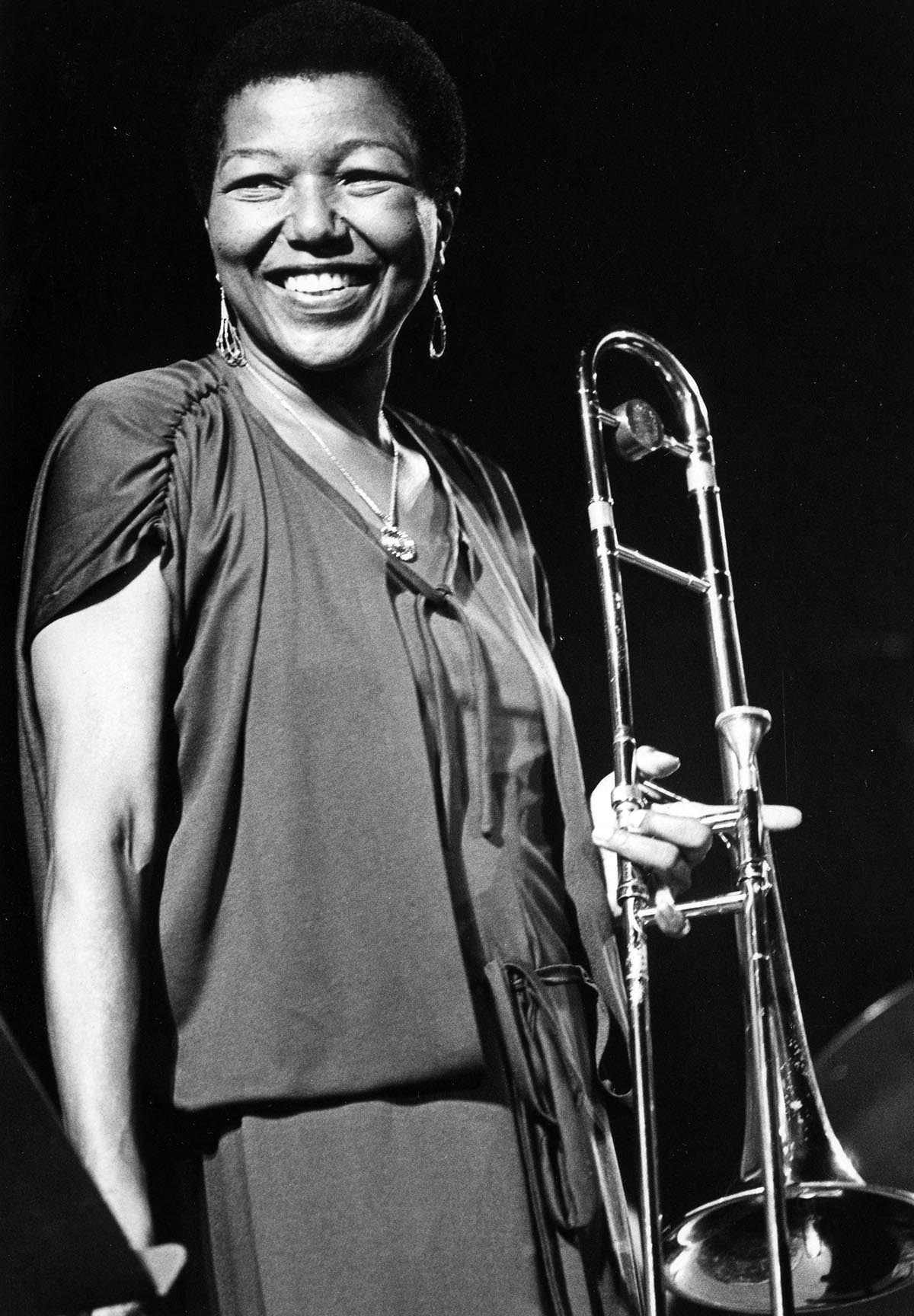
Melba Liston
Melba Liston (1926-1999) For many years, the only female trombone player I had ever heard of was Melba Liston. That was true until I began playing with trombone player April West, in San Diego, in 1980. A singular figure, Melba was the only woman horn player who worked regularly, leading and being part of orchestras throughout the ’40s, ’50s, and ’60s. Melba lived in Kansas City until she was 10 years old. Kansas City has always been a very musical city, and her parents were avid music lovers. They recognized her talents early on and, when she asked, they bought her a trombone. Due to the Depression, they moved to Los Angeles in 1937. There, she was lucky enough to meet up with one of the great music teachers and circles of musicians in the country. Alma Hightower had a music studio in the ’20s-’60s, and many of the students at Melba’s Jefferson High School, were taught by her (see San Diego Troubadour, October 2025 (https://sandiegotroubadour.com/women-in-blues-and-jazz-ruth-brown-blanche-calloway-vi-redd/) re: Vi Redd (alto saxophonist). Some of them included jazz and blues greats Dexter Gordon (who remained a good friend and with whom she later recorded), Charles Mingus, Clora Bryant, Big Jay McNeeley, Vi Redd (she was also Alma’s grand niece), Sonny Stitt, Roy Ayers, and many more.
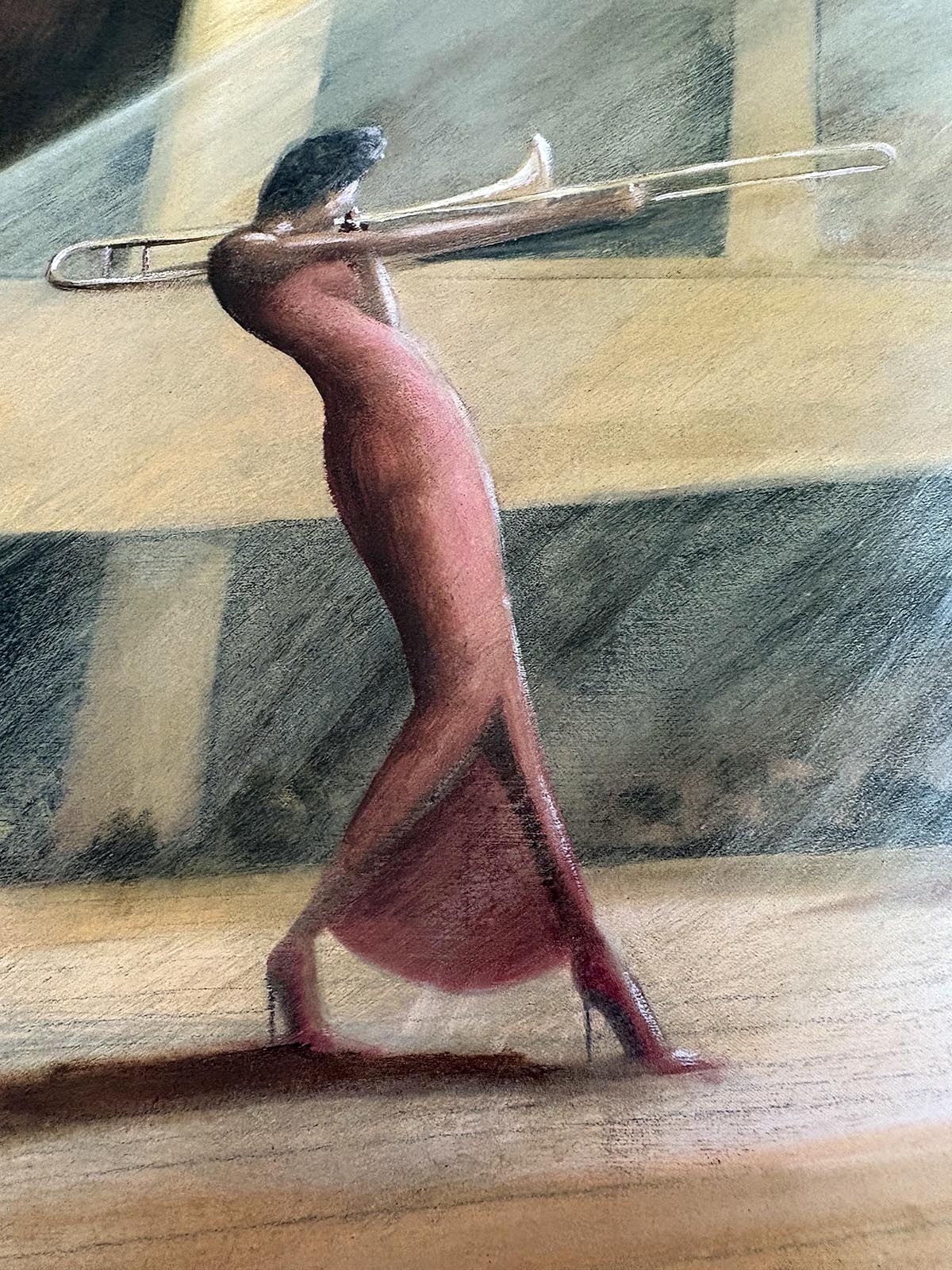
Painting by Frank Morrison, from the children’s book, “Little Melba and Her Big Trombone,” by Kathryn Russell-Brown.
As soon as she graduated from high school, she joined the musician’s union and was off on a career that paired not only her trombone skills, but arranging skills also. She’s almost more known for that. She began arranging for Gerald Wilson and got introduced to the prominent big band players of the ’40s, including Dizzy Gillespie, Count Basie, Duke Ellington, and Billie Holiday. Her tour with Holiday in the deep south was a disaster due to racism, sexism, and the failure of the audience to appreciate the new bebop sounds. As big bands began going out of style, she began arranging for pianist and songwriter Randy Weston, in addition to teaching. Weston loved her arrangements, which were built on African rhythms, and not stock big band horn arrangements. In the ’70s, she began teaching in the Jamaica School of Music, coming back to this country when Carol Comer and Dianne Gregg, the women behind the Women’s Jazz Festival in Kansas City, invited her to perform in 1979. This inspired her to start her own band, Melba Liston and the Company.
According to one publication, Liston found a way to innovate, even though her solos are relatively short for a jazz improvisor. “Overall, her motivic playing is what sets her apart from many other trombonists and champions her advancement within the bebop era.”—Trombone Association Journal, July 2026
In 1985, Liston had a stroke and couldn’t play trombone anymore. However, thanks to use of a computer, she could still arrange, so was able to continue her brilliant career. Her collaborations are legendary, which is included in all of the above mentioned, plus Tony Bennett, Eddie Fisher, Billy Eckstine, the Supremes, Dinah Washington, Ray Charles, Aretha Franklin, Bob Marley, Marvin Gaye, and many more!! She got to travel the world, play with the best, and receive many awards. “The horn has always saved me from my sadness. Anytime I need a lift, the trombone takes care of me. I’m not so good to it as it is to me. The trombone set me up as an arranger, and then, when I’m writing, I forget the trombone. But when things get dull, I go back to the trombone, and it saves me again.”—American Women in Jazz by Sally Placksin
Older trombone players have less and less written about them and certainly less recorded. But, although not considered a “women’s” instrument, there are an amazing number of female trombonists in history . Maybe the history is just coming out. I will mention a few:
Marie Lucas, band leader at the Lincoln Theatre in NYC in the ’20s. At one time she featured Juan Tizol, who became a recognized player in Duke Ellington’s band, collaborating with him on the jazz standards “Perdido” and “Caravan.” She trained and developed orchestras for New York City, Boston, Philadelphia, and Baltimore.
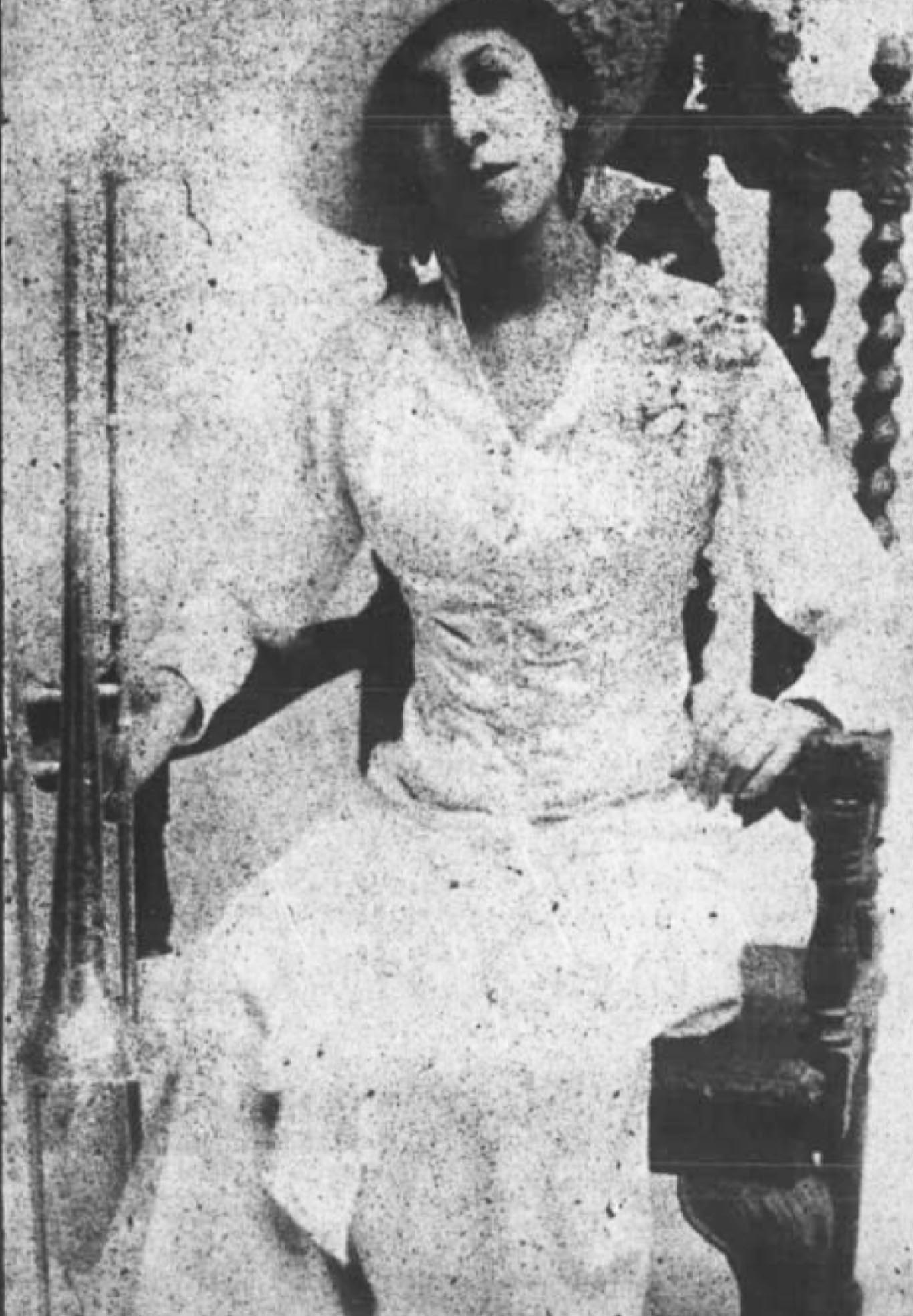
Marie Lucas
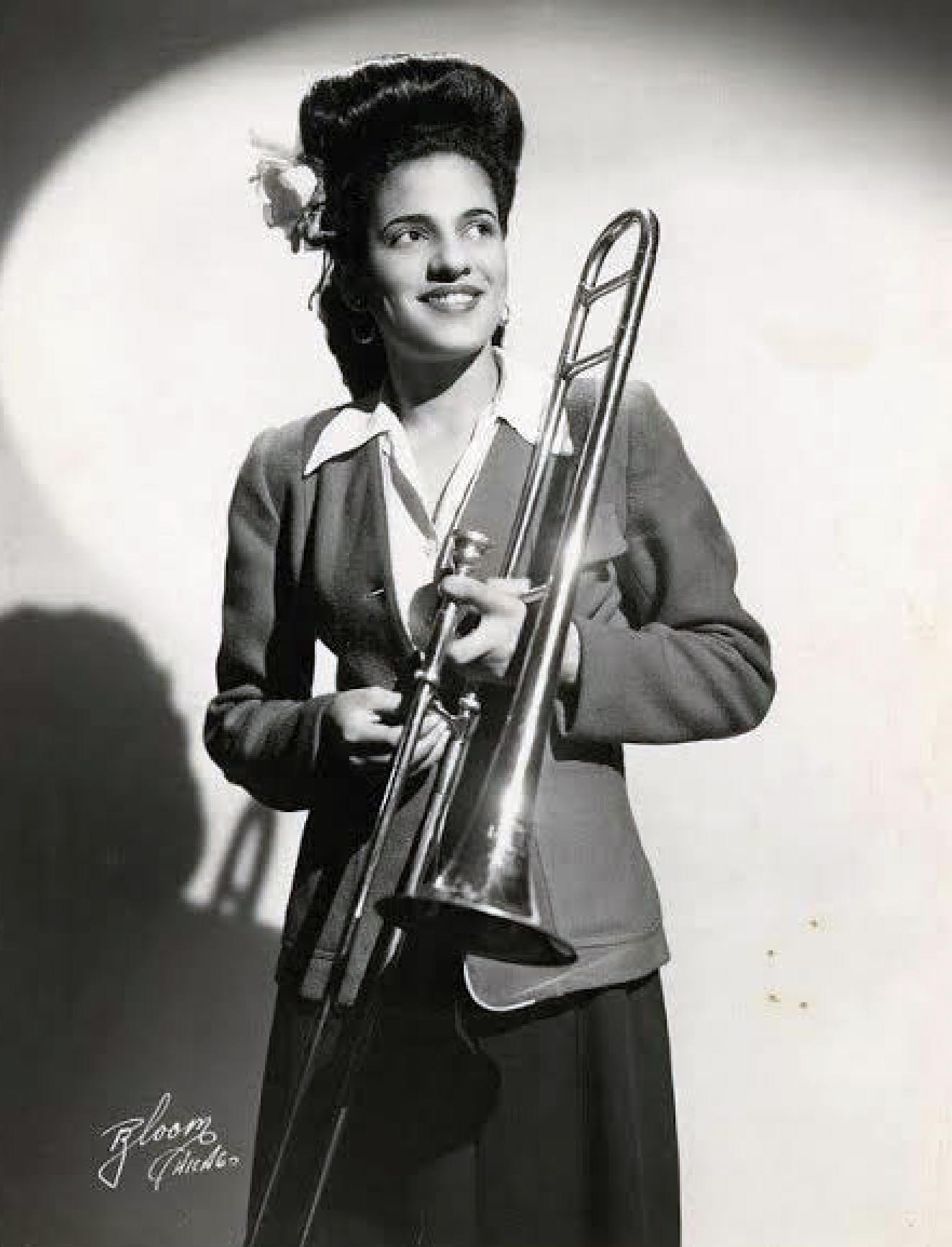
Helen Woods Jones
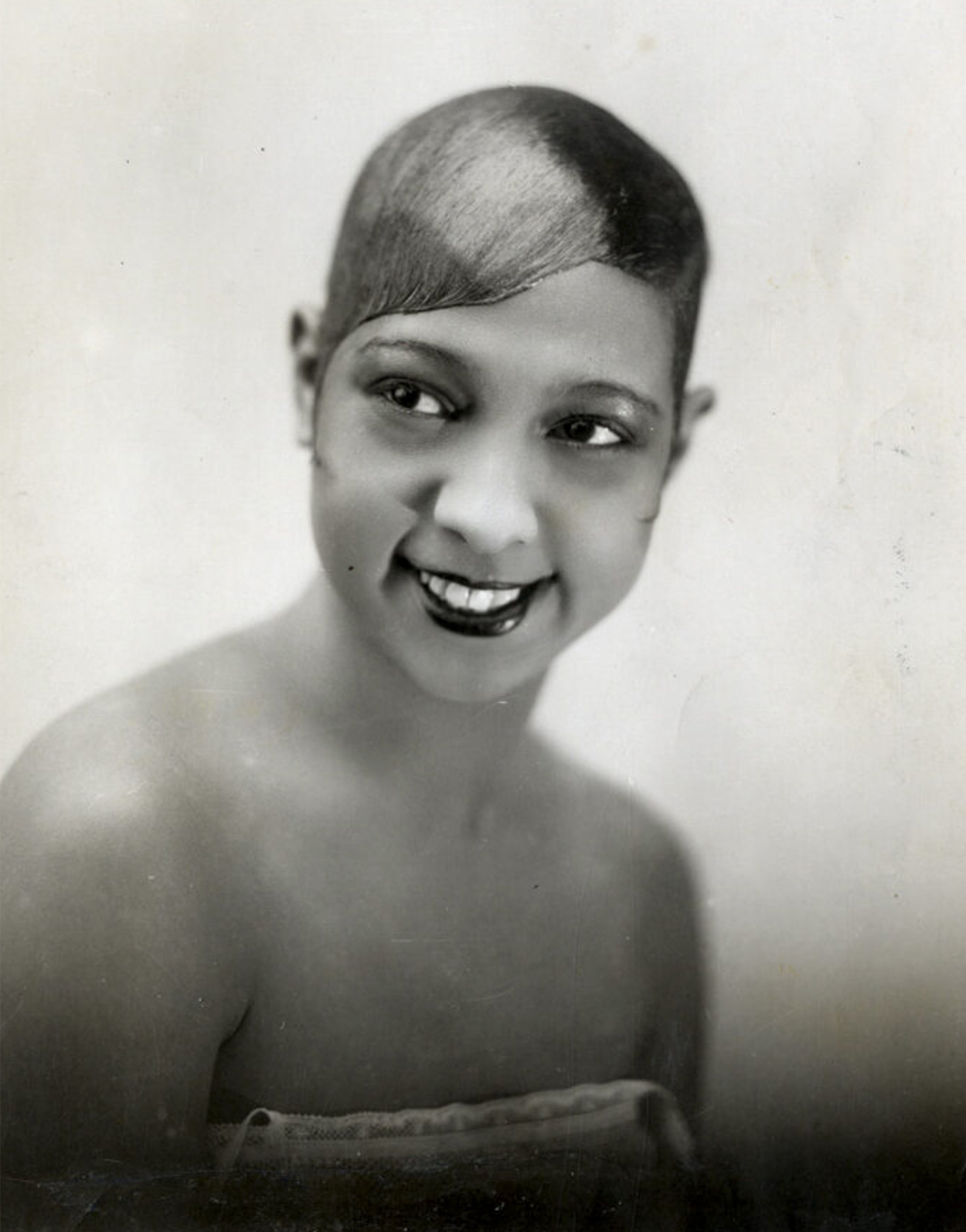
Dolly Jones (1902-1975) is primarily celebrated as a trumpet player and was a highly skilled trombonist. She worked with her family, the Jones Family, in vaudeville and backed up Ma Rainey, Ida Cox, and Lil Hardin. In 1919, Josephine Baker, ages 11-13, performed with them as a dancer and trombonist, honing her chops before moving onto New York and Paris.
Helen Woods Jones (1923-2020), mentioned earlier in the Troubadour, March 2025 (https://sandiegotroubadour.com/lou-ann-barton-international-sweethearts-of-rhythm-jerrie-thil/), was the trombone soloist in the International Sweethearts of Rhythm, mostly in the ’30s and ’40s. This band was considered one of the very best of the all women’s big bands of the time.
While we have scant history of women playing trombone in the early 20th century, they still were. However, while researching this column I found a plethora of female trombone players. In fact, it seems somewhat common!!
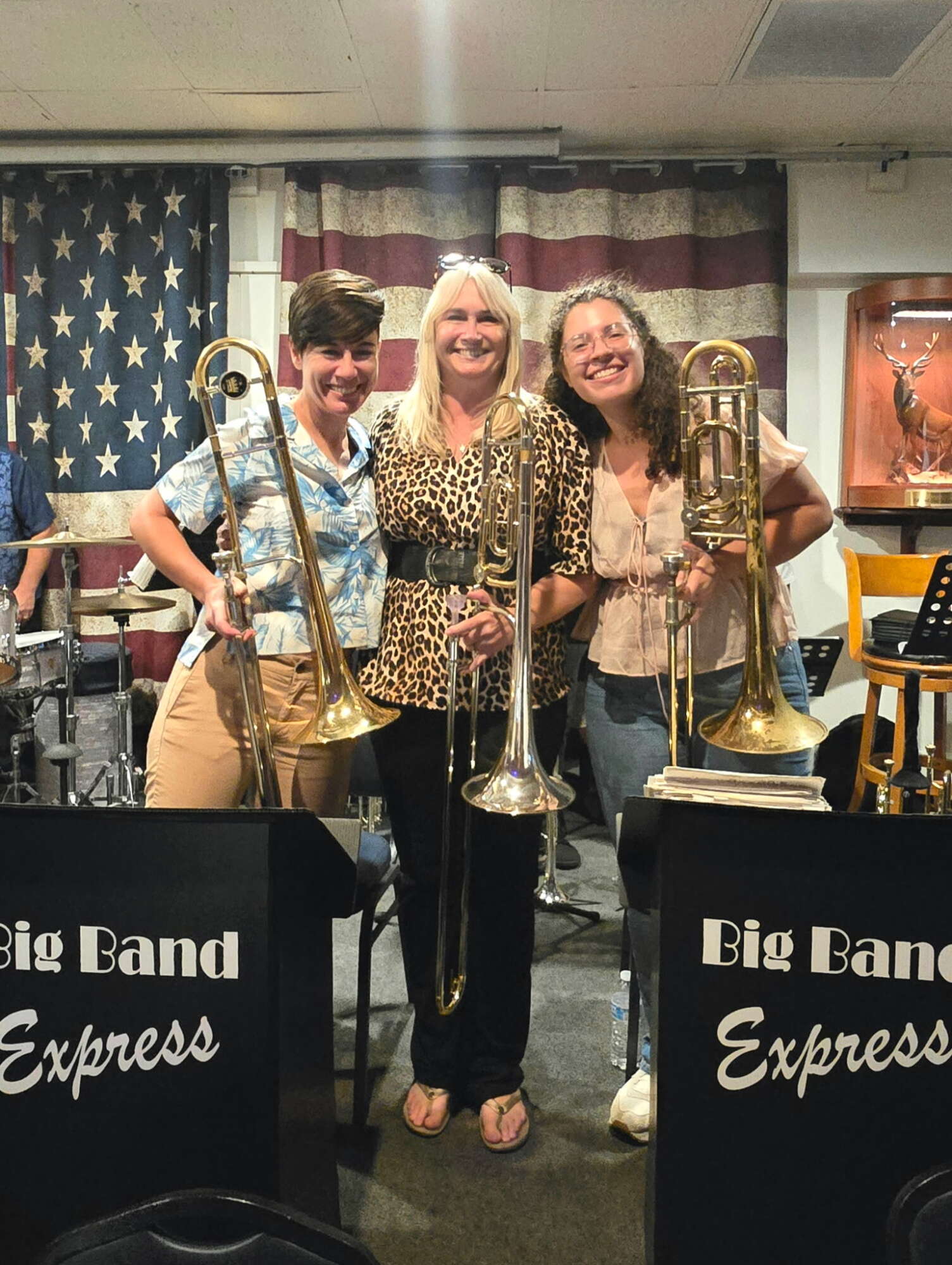
Trombone players in Big Band Express, Nicole, Patricia, and Kayla.
My musician friend Liz Ajuzie, who sings with the Big Band Express here in San Diego, says there are enough women trombonists in her band to fill the whole section! Sometimes when I see bands, I notice if there are any women in the band. Sure enough, if there is one, they are often trombone players. I am mostly talking about certain styles of music, namely many kinds of jazz and blues. As styles go in and out of popularity (for example, when the popularity of guitar came during the early ’50s), certain instruments weren’t as popular. As big bands waned, trombones and pianos were not as predominant. However, I have highlighted just a few current trombonists to show that it is still a thriving instrument.
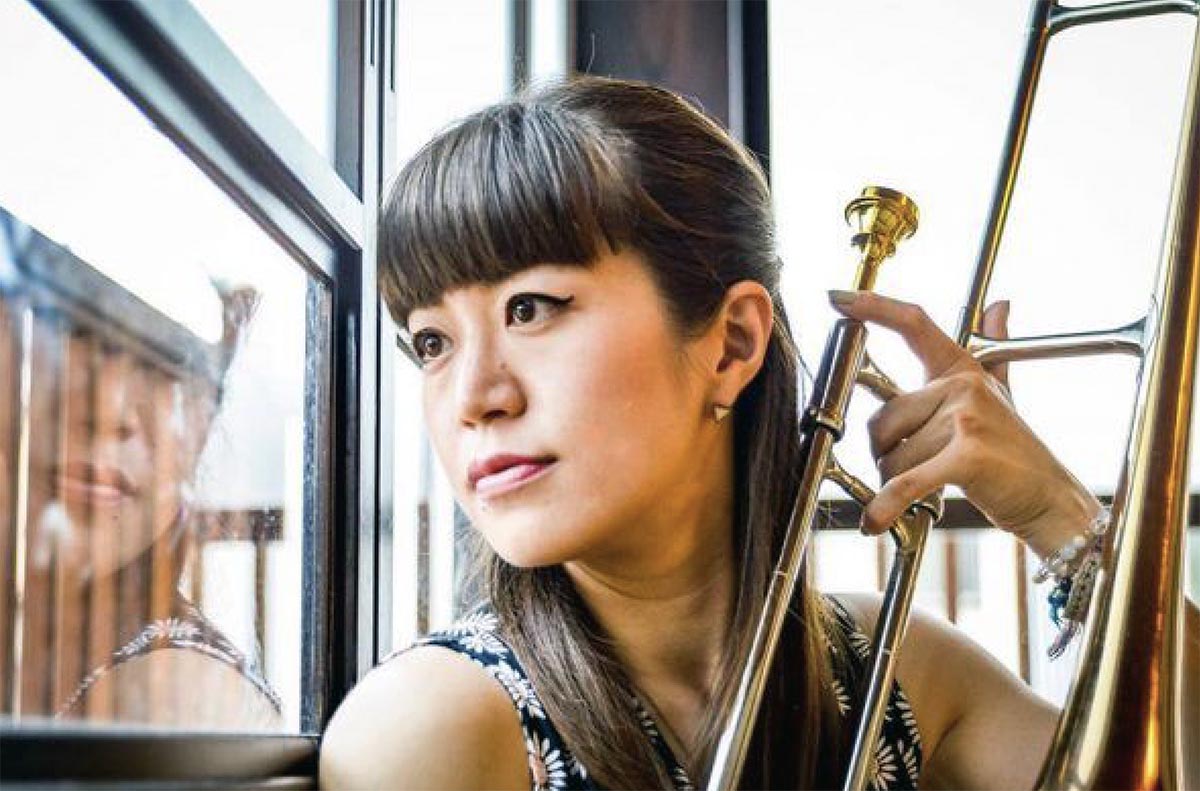
Haruka Kikuchi
Playing more of a traditional jazz style (pre-big band), is a band out of New Orleans. The Shake ’Em Up Jazz Band is an all-female super group, made up of some of the most sought-after young stars of the New Orleans traditional jazz scene today. Originally a pickup band of working musicians brought together for a Girls Rock New Orleans performance in 2016: 10 years, five albums, and six international tours later, the band continues to expand their musicianship, repertoire, and international notoriety.
All the women are fantastic musicians, including Marla Dixon on trumpet, Molly Reeves on rhythm guitar, and San Diego’s own prodigy, Chloe Feoranzo, on clarinet. But in this column, we are featuring their trombone player, Haruka Kikuchi, Queen of Tailgate.
Haruka was raised outside Tokyo, in Chiba Prefecture, and played violin and piano as a child. At 15, she picked up the trombone and began listening to Dixieland music. In 2014, she uprooted to New Orleans and began sitting in on Frenchman St. and meeting many of the trad jazz musicians. I can attest to her enthusiasm and talent; she sat in with my band at the Pismo Beach Jubilee by-the-Sea Festival and didn’t miss a beat. She plays with the Shake ’Em Up Jazz Band as well as the Shotgun Jazz Band, the Preservation Hall All Stars, the Original Tuxedo Jazz Stars, the North Sea Jazz Festival, Umbia Jazz Festival, Edinburgh Jazz Festival, etc. She was a nominated member at the 61st Grammy Awards, Best Regional Roots Music Album, with ChaWa’s album Spy Boy. “Musically, Kikuchi sounds like she may as well have been born in Treme.”—Radio WWOZ
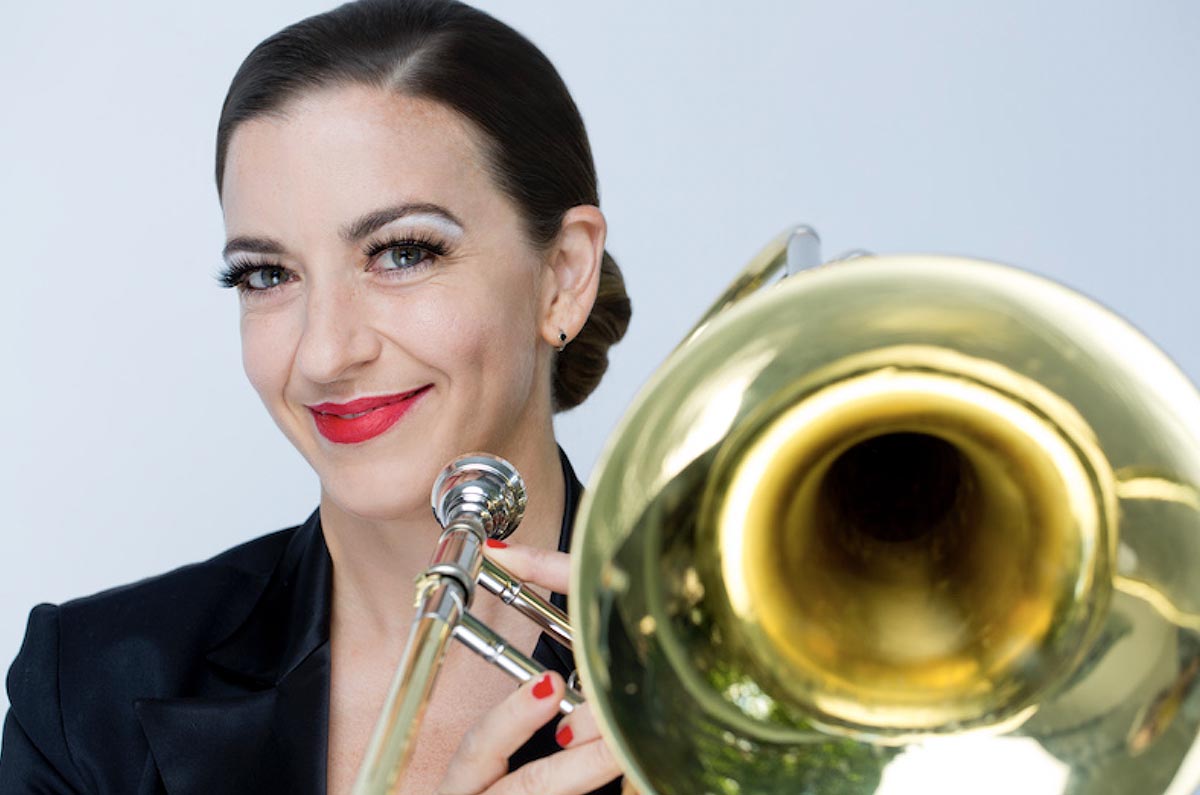
Jennifer Wharton
One of the most provocative names for a trombone band is a band called Bonegasm. Led by bass trombone player Jennifer Wharton, these four trombone players are backed by a rhythm section of piano, bass, and drums for a highly arranged jazz sound. Wharton defines it as “a climax of musical excitement, characterized by feelings of pleasure, centered in the ears and experienced as an accompaniment to hearing a group of trombone players. It is our mission to bring peace, love, and trombone to the unsuspecting masses.”
Bonegasm’s debut album, Bonegasm, in 2019, made the Billboard Jazz Chart in its first week. It was followed by Not a Novelty, which was deemed “Trombone Ecstasy,” by Downbeat magazine. Wharton has a propensity for bass trombone and can be found honking out low notes in a Broadway pit orchestra, a recording studio, on stage, or in a big band section. She is on the faculty at Rutgers University and at Montclair State University.
Aubrey Logan has been called the “Queen of Sass.” She is considered a world-class singer and trombone soloist. Born in Bellevue, Washington, her parents were music teachers, so she learned how to read music and took up the trombone in junior high school.
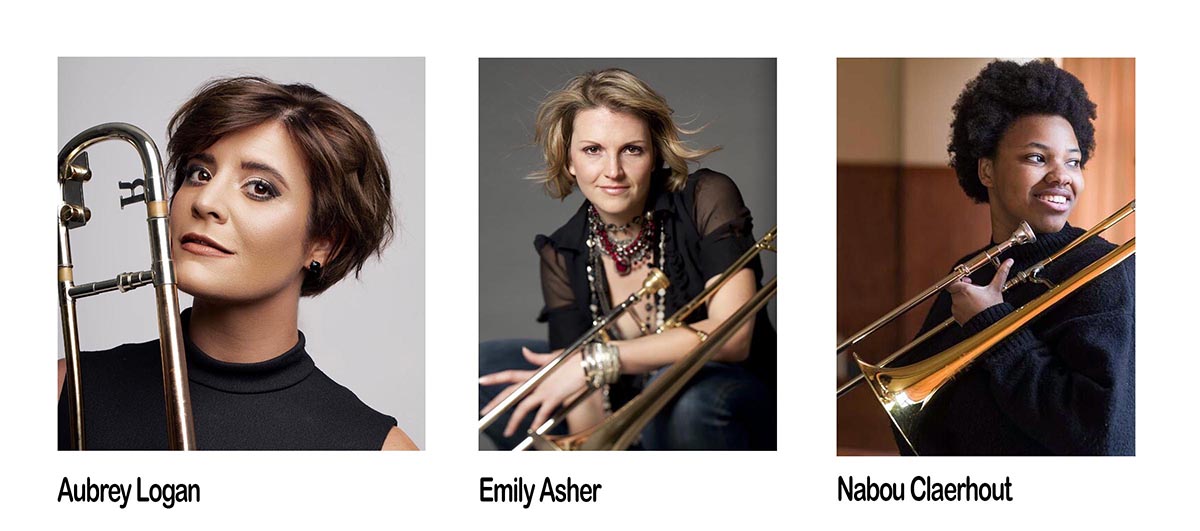
Her newest release is Aubrey Logan and her Bigger than Average Band, from the band’s same name. Logan has been featured in nationally televised PBS specials, toured internationally with Dave Koz and Post Modern Jukebox, and brought her music to legendary stages including Radio City Music Hall, the Sydney Opera House, and the Hollywood Bowl.
Emily Asher is a singer and a trombonist. She is in high demand as a side person, bandleader, and educator. As a leader she has produced five CDs, and led U.S. and Israel tours with her band Emily Asher’s Garden Party. Originally from Seattle, she is on the faculty of the Brooklyn Conservatory of Music and subs regularly in Broadway musicals. She was a prominent member of the all female Mighty Aphrodite Jazz Band, led by trumpet player Bria Skonberg. Bria was featured here for many years at the San Diego Thanksgiving Jazz Festival.
This summer (2026), Asher traveled with another all female band, the Traveling Janes, on their European tour. Katie Cavera, the Janes’ banjo player, was another musician featured in the SD Thanksgiving Festival. I had the pleasure of playing with her in Hal Smith’s Hayriders. Here they are featured in a video in the Spice of Life Jazz Club, Soho, London, this summer.
Led by Belgian trombonist and composer, Nabou Claerhout, the quartet Nabou stands among the rising stars of contemporary European jazz. She also leads a groundbreaking ensemble comprised of five trombones and a rhythm section, showcasing her talent and vision. Claerhout’s third album, Indigo, features this larger group. It has gotten rave reviews for her evolution from her other album, revealing her compositional and arranging skills and especially her trombone prowess. Indigo is very personal and atmospheric and I look forward to this artist’s future work.
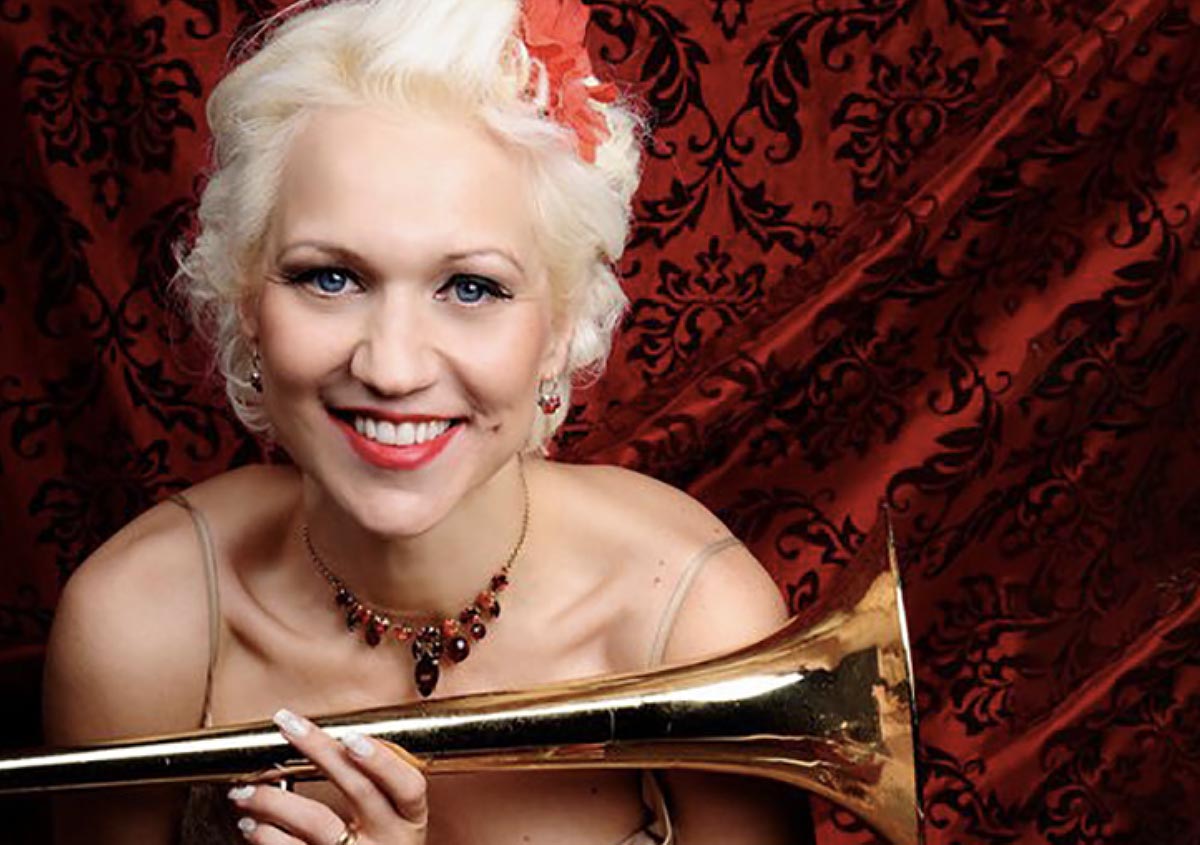
Gunhild Carling
Perhaps one trombone player many San Diegans are familiar with, who now performs here regularly, is Gunhild Carling. Called Sweden’s Queen of Swing, Gunhild grew up in a modern vaudeville family. The Carling Family played all over Europe, and Gunhild and her brothers grew up playing and performing. Everyone in the family grew to be a multi-instrumentalist. Her shows are over-the-top entertaining and you have to see her to believe it. I first saw her on Facebook and invited her to sit in with my band if she was here, with trombonist April West. Eventually, she came to Tio Leo’s restaurant, and April and I played with her band. She plays all the trad jazz standards of the ’20s, ’30s, and ’40s, but also her originals, too. I’ve seen her play piano also. She can play three trumpets at one time! She has performed for the King of Sweden, been featured with the Count Basie Orchestra as well as Post Modern Jukebox, and is an international superstar.
Her husband, Johan Blome, also a musician, moved with their two children, Idun and Viggo, to Northern California in 2018. Her children have been brought up in the same Carling Family tradition and Idun often performs on trombone with her. They were still quite young when I played with them, but are growing up with careers of their own. Gunhild plays regularly with her family band, on Facebook and is very inclusive with all of them. The Carling Family Tradition lives on!
Yo Jonesy Jones on hoverboard, April West on toes, Gunhild Carling on tap dancing.
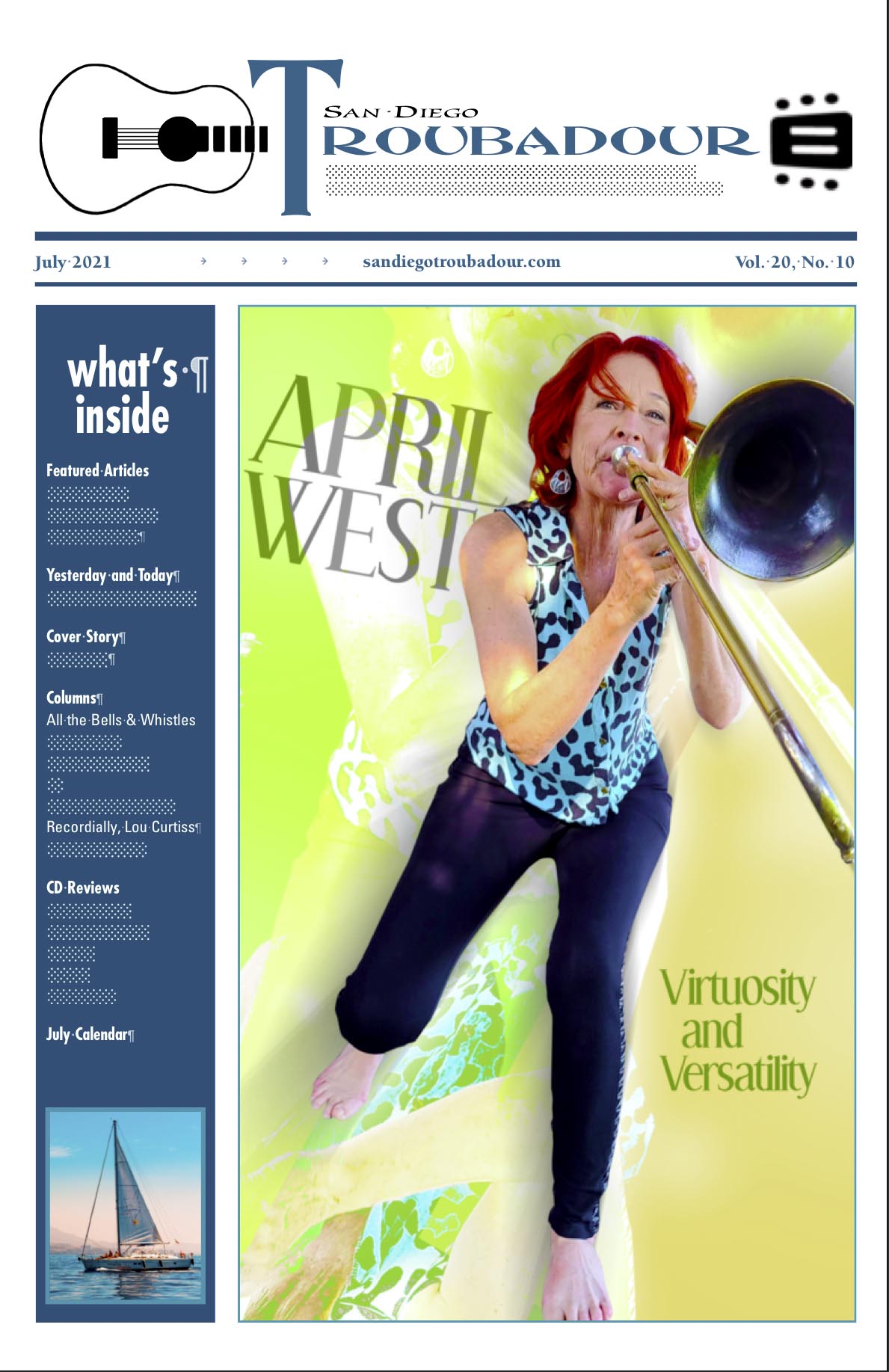
April West on the cover of the San Diego Troubadour, July 2021. Photo by Julia Hall McMahon.
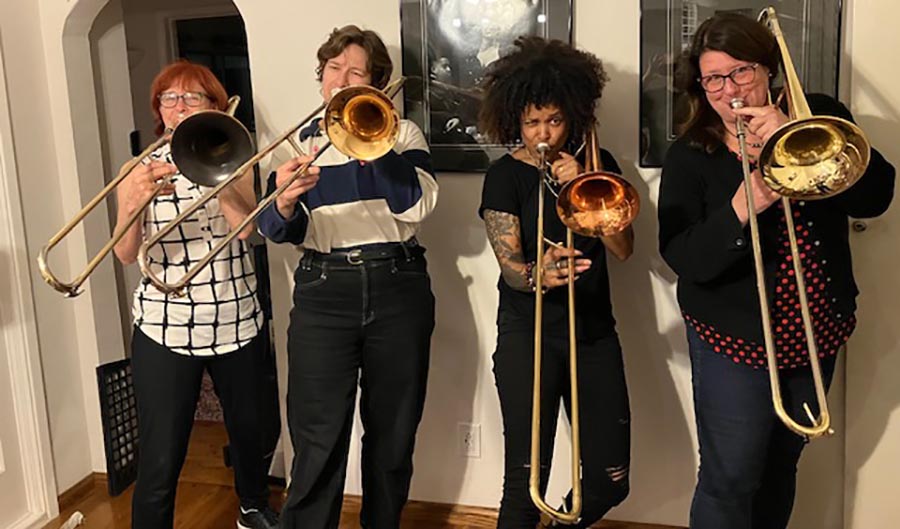
April West, Rebecca McKinley, Yo Jonesy Jones, Shirley Coggin.
My original inspiration to write this column has been my longtime friendship with April West. We started playing together in a rock band called Ms.B.Haven, in which she was hired to be the bass player (a frequent double for trombone players, both covering the low notes). That evolved into several styles and several bands later, and she is now a major part of my current band, the Motel Swing Orchestra. I first heard an arrangement for three trombones in the ’80s, in the band Tobacco Road. Our esteemed bass player, the late great Preston Coleman, loved to arrange and wrote a beautiful one for Ellington’s “In My Solitude.”
The substitute horn players that day were all trombone players: Louise Titlow and Nathan Fry, and joined April on the instrumental version. I always wanted to do another trombone feature like that and finally got to do it at San Diego’s biggest New Orleans roots festival, Gator by the Bay with an 11-piece band, all women, in 2024. April arranged for four trombonists: Shirley Coggin (Sabrosas Latin Orchestra, Don L Big Band), (Yo Jonesy Jones (Pulp Vixon, Yo Jonesy Jones Little experience, High Tide Society, Mystery Train Experience), Rebecca McKinley (Chunky Hustle Brass Band), April West (Sue Palmer & her Motel Swing Orchestra, Euphoria Brass Band). We had three vocalists and a four-piece rhythm section, including international star Laura Chavez on guitar, and, of course, four trombonists.
There are definitely a lot of women playing trombone now around the world. I only touched on a very few.

Sue Palmer has been a San Diego musician and resident her whole life. She has received numerous San Diego music awards as well as an award for Best Self-Produced CD from the International Blues Challenge in Memphis. She was inducted into the San Diego Music Hall of Fame, has recorded 30 podcasts, and hosted her online radio show for three years on the local jazz and blues radio station, KSDS Jazz88.3.

