




Cover Story
Re-Joyce: Faith and Process Lead Drummer Justin Joyce Back to Familiar (Almost)

Prologue
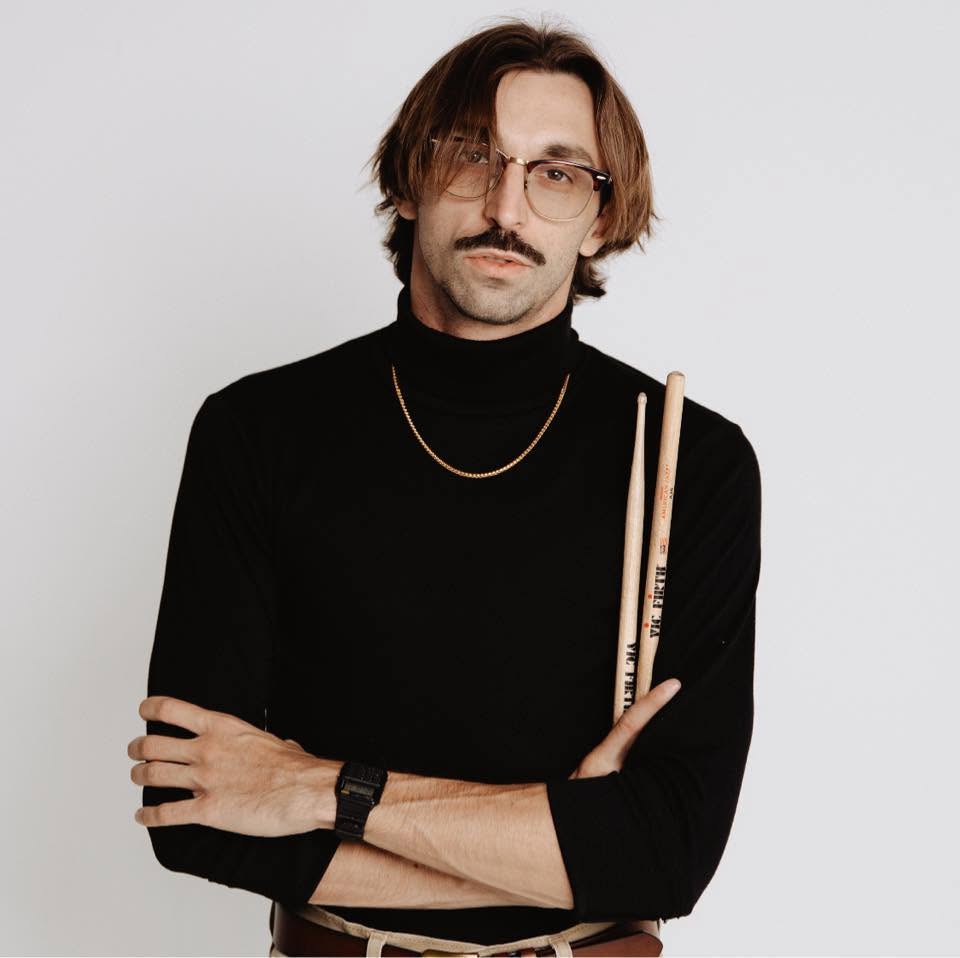
Justin Joyce
Have you seen Justin Joyce? If you’re looking straight at him and he pivots 90 degrees to one side or the other, you might miss him; he’s quite skinny. He’s hip; he’s on the scene; he’s old school, so he might actually read Playboy magazine. He’s definitely no square, though he literally is J-squared. No word on whether he calls his girlfriend “man,” though probably not; some things that were hip in 1966, when Bob Dorough and Dave Frishberg were writing cheeky tunes for Blossom Dearie, are no longer hip. Joyce would likely be considered hip in either era. But this era is particularly lucky to have him because he’s a wonderful drummer, might ultimately prove to be an even better songwriter, and is a deep and enlightened cat.
When I reviewed Joyce’s latest album, last year’s Almost Familiar, for this publication in May, I described it in glowing terms, describing it as “everything I think contemporary jazz ought to be in terms of respecting the audiences jazz already has while venturing to cultivate new ones.”
Five months hence, I affirm my prior judgment. Almost Familiar succeeds on two fronts. It’s successful as a jazz record because the ghosts of Eddie Harris and Pat Martino are present and participating. Duke Pearson and Alfred Lion and Rudy Van Gelder are in some kind of cosmic communion with Paul Castelluzzo in the production booth. The legends continue to have a say in the conversation.
But there’s also something prophetic to me about the album’s title. Indeed, the future of jazz as I see it will literally be “almost familiar.” It’s not just a clever name for an album, it’s a prescient one.
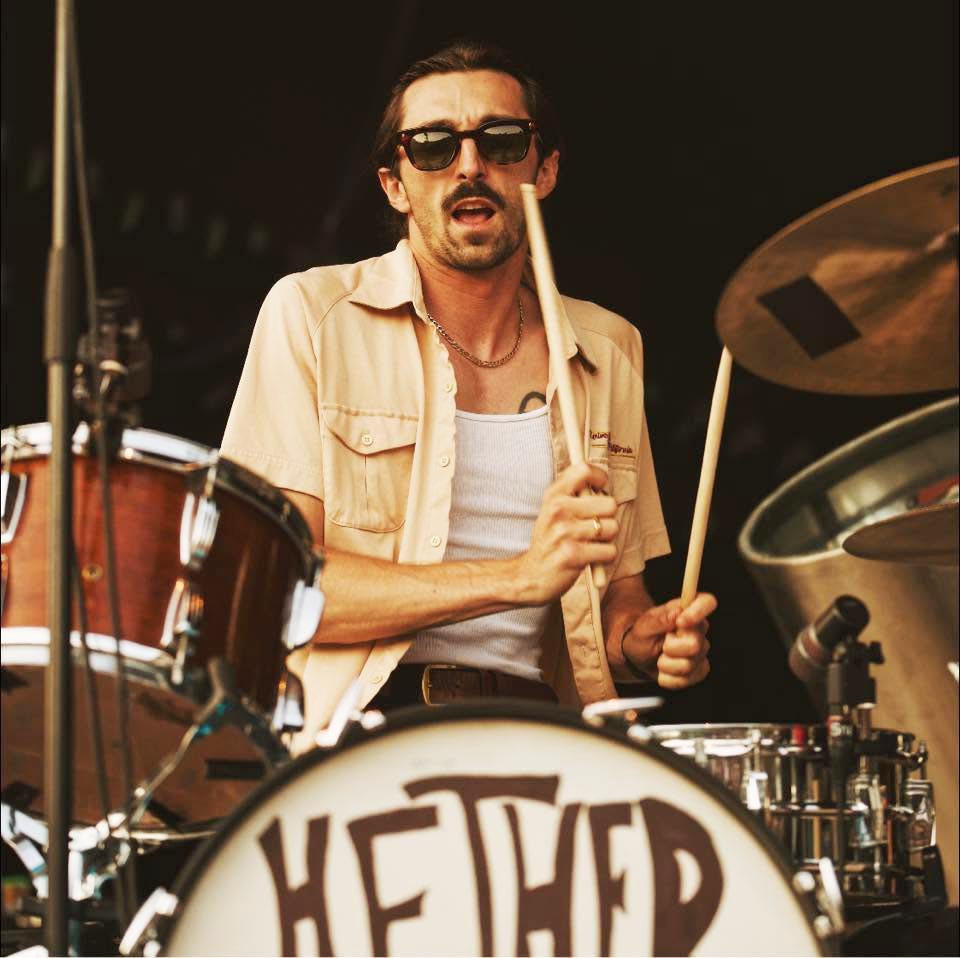
Joyce on Don’t Stare at the Sun Tour, 2023
It’s 2026. Instruments can be plugged in and the melodies, harmonies, and rhythms produced can still be called jazz. And in 2026, it’s time to stop pretending this hasn’t been the case for the last 60 years. Brilliant producers, legitimate sonic architects like Castelluzzo, Joyce’s best buddy and co-producer on Almost Familiar, are making a compelling case for the recording studio as a bona fide instrument in itself. In the calendar year 2025, there were three heavily jazz-influenced records that made exceptional use of the recording studio to add genuine layers of emotional depth to the composed music: Okonski’s Entrance Music; Erik Deutsch’s This Was Then; and Joyce’s Almost Familiar.
The jazz police—you know these guys; they think jazz ended in 1964—would call these projects “jazz adjacent” and mean it pejoratively. But to paraphrase Ruby and the Romantics, their day has come (and gone). The future of jazz will be something almost familiar, eschewing prescriptive notions of what jazz must be while revealing jazz’s ostensibly discrete epochs to be mere checkpoints along an unbroken continuum.
Who Is Justin Joyce?
Talk to Justin Joyce for any extended period of time and you’ll feel like you need a strong coffee to keep up. This is a man with a lot of energy. He talks fast—very fast—like a man who’s very aware of both the infinite amount of relevant things he has to say—on virtually any given topic—and the time constraints the universe has resolved to place on us as mortal men. This is a ball of concentrated energy with an innate understanding of how the universe imposes time and tempo. Indeed, by disposition, temperament, and vocation, this man is a drummer.
Still, though a man of time he may be, Joyce is not quite a man of this time…or even this place. Which marks him, ostensibly, as an enigma, since he’s only 32—just barely old enough to qualify as a millennial—and underwent all of his schooling in San Diego, from grammar school to Patrick Henry High School and through undergraduate and graduate study at San Diego State. His preferred manner of dress—you might even say his aesthetic essence—is bespoke mid-’60s vintage, more mod than rocker, more Jimmy Cooper than Alice Cooper.
At Lestat’s, for a midweek kaffeeklatch, it’s ripped jean shorts and a Padres jersey, a threadbare replica ballpark giveaway that Joyce has personalized by cutting off the sleeves, like a much lankier Rick “Wild Thing” Vaughan. But on the bandstand, it’s turtlenecks, earthtones, form-fitting textured knit polos, a mustache tended to with intent and care, smart frames, and hair cut neat. Inspired and highly cultivated, yet uncontrived. It would have to be. Cosplay, conscious branding, image curation—any of the myriad variations on bullshit—those things go over like lead balloons in Jersey City, a place that shaped him just as much during his formative years as San Diego did.
The only child of an Italian-American mother from Western Massachusetts and an Irish-American father from North Jersey, Joyce spent a lot of his downtime as a kid around his large extended family back East. So much so, he says, that there was a point in his childhood where he knew the Jersey City streets of his father’s youth better than the San Diego streets of his own.
“I walked around like Henry Hill,” he jokes, “like this MFer who wants to be a gangster because I watched Goodfellas too much [laughs].”
“My cousins were like siblings to me growing up,” Joyce adds. “I used to go back every summer, every winter, every spring break, until I was 16. Between my birth and second grade (when 9/11 happened), I probably had traveled alone on airplanes north of 100 times. I’d go back three times a year, back and forth, by myself.”
Now in his early thirties, a pillar of San Diego’s nationally underrated jazz scene, Joyce is a die-hard Padres fan most at peace in the stands at Petco with a fountain Coke and a bag of peanuts. But his first loves weren’t the Friars or fish tacos. They were the New York Yankees, Notre Dame football (owing to his father’s Irish-American roots), and ice hockey—and not in that order. His childhood best friend and neighbor here in San Diego was the son of Detroit transplants who initiated him into the cult of the Detroit Red Wings.
“As soon as you’re a Red Wings fan,” Joyce explains, “it’s all or nothing.”
Hardly the preoccupations of your typical SoCal teen.
“I played hockey all through high school,” he says. “I was captain of the hockey team. I cared way more about hockey in high school than I cared about…anything, including drumming.”
When you wonder where a meatball gets its distinct flavor profile, more often than not it’s all in the sauce. Joyce’s parents, at least during his formative years, were not assimilationists; they took neither quickly nor eagerly to the style and pace of SoCal living. My guess is the way San Diegans talk about “May gray” or “June gloom” just didn’t compute, conceptually. What the hell were these people who’d never scraped a frozen car’s windshield even talking about?
“My dad grew up in a very East Coast house, and my mom, like my dad, is just not West Coast. She’s from Massachusetts, where ice hockey’s a big deal,” Joyce says. “My parents were, like, East Coast, urban Irish, and Italian Catholic through and through.”
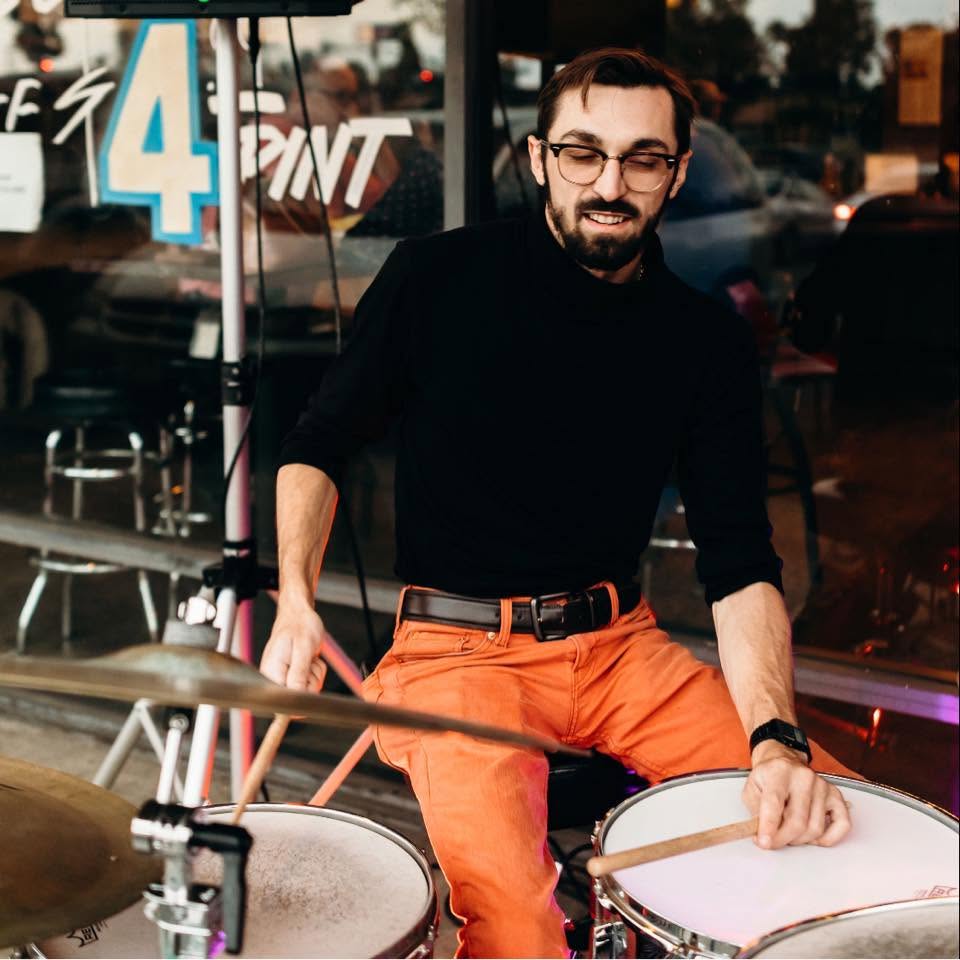
It’s corny to say because the subject of this story is a drummer, but it’s no less true that the two people most responsible for shaping this young drummer really did march to a different beat.
“You know when, like, there’s no question that you’re a child of those two people? Well, that’s me,” Joyce says with a proud smirk.
His childhood, to hear him tell it, was a decidedly non-chill, delightfully anachronistic upbringing that he wouldn’t trade for anything.
“My dad was in the Navy for 28 years, a sonar technician who moved frigates through minefields. He was a lifer, so that’s how my house was,” Joyce recalls. “Even after he retired, my whole childhood was getting up at 5am with my father, making my bed, taking a shower, and then reading the parts of the newspaper that he had already read. Then I’d watch Married with Children, and I’d go to school.
“It was like a very ’90s childhood that just so happened to be happening in the early 2000s. Everything was, like, extra old school.”
A Throwback Process Theologian
If you think that’s old school, check out Joyce’s typewriter collection. He owns 40 of them, and he’ll gladly lend one to you if he believes you’ll actually use it. Like Tom Hanks’s similar promise, it’s born of both magnanimity and a missionary’s zeal.
“I believe so much in the process of things, as opposed to the outcome of things…that’s where the importance of things is. In some sort of way, I’m very much a process theologian.”
Much of this theology comes out of the graduate thesis he researched and wrote for Dr. Eric Smigel at San Diego State.
“My thesis was on acoustic and electronic drums and their role in beginning students’ pedagogy,” Joyce explains, “and why all the little valuable things you learn through the process of learning to play the acoustic drum set are things that are lost [when beginners learn how to play exclusively on electronic drums kits].”
I’ve seen those bumper stickers that say “drum machines have no soul.”
Is this to suggest the soul of music resides in the process of making it? Is it that “process” we feel as listeners when music hits us and seems to land square in the soul? If he weren’t going through a personal renaissance in his Catholic faith, I’d say Joyce’s approach to music making is his religion. As is, it’s definitely among his gospels. And the man can preach.
Joyce is a throwback and a man after my own heart. He believes that the relentless onward march of progress as defined by innovation is probably for better and worse in something close to equal measure—in other words, something close to a zero-sum proposition at day’s end, if we’re lucky. He believes that for every process we automate or streamline, we inadvertently compress out of the equation a lot of the imperceptible salutary tissue of life, the hardiness and character building stuff that’s yet to be synthesized into pill form. Stuff we all once had to endure…together. Rote, banal things that somehow made us better citizens and better toward one another individually.
“Before you could deposit a check on your phone,” Joyce says to illustrate, “you had to go to the bank. Which means you had to get dressed respectably because that was the common etiquette. And, once you’re at the bank, you had to stand in a line and wait for the teller. And then once you reached the teller, you were expected to communicate cordially with somebody.
“So there were all these things happening within that process that were valuable in terms of patience, discipline, basic interpersonal communication. When we talk about using technology [within music and music education], the outcome is so obviously the focus. We become so preoccupied with efficiency as opposed to self-sufficiency, and all these smaller things [the unquantifiable intangibles that make well-rounded musicians] don’t get replaced in the process of replacing the process.”
Paul Castelluzzo, the brilliant guitarist and soundscape architect who co-produced Almost Familar, co-wrote several of the album’s originals with Joyce, and arranged the most emotionally flooring, awe-inspiring version of Michel Legrand’s “What Are You Doing the Rest of Your Life” I’ve ever heard, turns out to be the perfect partner for Joyce.
Castelluzzo is hyper-competent in the studio. Joyce, by his own admission, is…less secure behind the glass—though, he says, he’s been “learning a lot just from being around Paul, and sitting in the chair next to him while he’s making those decisions.”
While their skill sets are different, their sensibilities are simpatico. Though not averse to—and highly skilled at—bringing the capacities of the modern recording studio to bear on his recordings, Castelluzzo’s instinct, like Joyce’s, is to be rooted in the analog first.
“This is a core principle of mine,” Joyce explains. “I don’t necessarily hate the sound of modern [recording studio technology] like DAWs [digital audio workstations]. Even Paul uses Ableton [a DAW that bridges the gap between traditional linear studio tracking and fluid, loop-based composition] for different things.
“But he believes there’s something about doing things the old-fashioned way, even if that translates into the long way.”
Friendship is the Best Ship
Joyce and Castelluzzo are presently housemates, and they’ve been best friends for over a dozen years. They live distinct musical lives that sometimes meaningfully overlap. Castelluzzo has either played on sessions or produced for Justin Bieber, Britney Spears, Mac Miller, Jennifer Lopez, and Paul McCartney, among others. He’s very humble and self-effacing, especially when asked about the rarefied air he increasingly seems to find himself in. As if mystified by his own ascent, he’ll fall back on referring to himself as “just a freaking jazz guitar nerd” with mild imposter syndrome.
It’s no put-on, says Joyce. Castelluzzo isn’t quite willing to consciously acknowledge the massive scope of his talents, which for myriad reasons, not least self-preservation, is probably sound strategy, regardless of whether or not it’s intentional.
“As much as it would make him uncomfortable to hear this,” Joyce says, “Paul’s a visionary, a major visionary.”
Naturally, when given the platform for self-aggrandizing, he demurs, distributing credit.
“I’m blessed to have been able to work with successful artists, and I’ve learned a lot doing that,” Castelluzzo told me back in February when he and Justin guested on “Breaking Jazz,” my radio show of blessed memory, “but I find the most joyful and rewarding sessions are with people like Justin, friends who are also really inspiring musicians and who love music for such a pure reason.
“That’s why it was so fun getting to work with Justin on [Almost Familiar]; he brought in such beautiful melodies, and I just wanted to accentuate them with the tools I have available, and I wanted to color the album and give it a certain feel.”
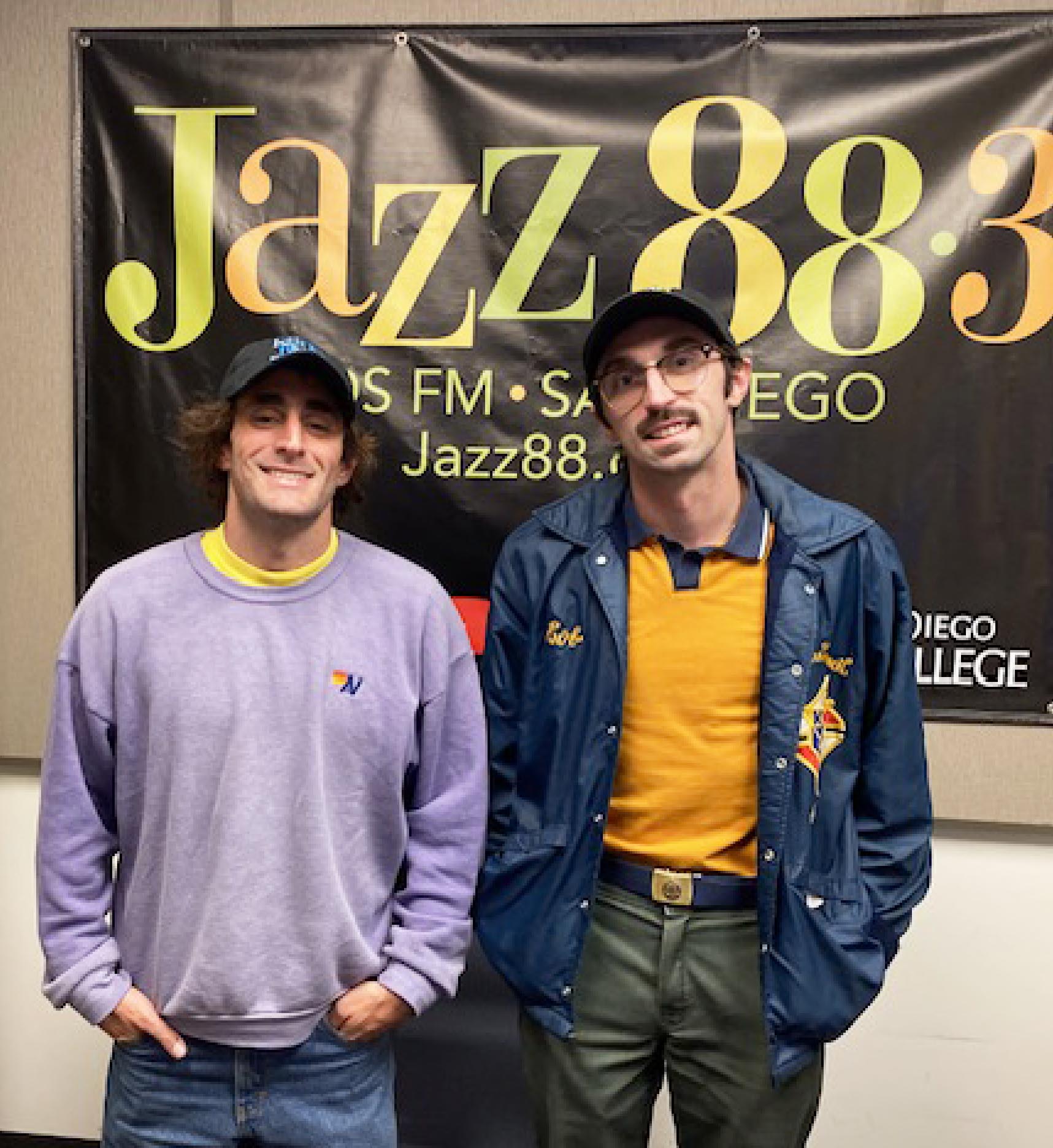
Joyce with Paul Castelluzzo.
When you’re talking about Castelluzzo and what he contributes musically, feel is the secret sauce; it’s the God particle he’s able to bring to a record. The textured soundscapes Castelluzzo cultivates on Almost Familiar unlock all the latent emotional potential of Joyce’s musical ideas, subtle in-between shades of the human condition’s emotional color palette that, absent Castelluzzo’s intervention, might have still been expressed but incompletely. In that sense, especially on a tune like “What Are You Doing the Rest of Your Life,” you can feel as a listener how Castelluzzo’s contributions elevate what’s already a knockout arrangement of a great tune to a genuinely memorable piece of art.
“Jazz is a style of music where things need to be felt almost more than heard sometimes,” Joyce says, echoing this idea. “Paul and I make a good team because I’m the type of guy who can recognize what’s missing, and Paul’s the type of guy who can tell you how to get there.”
Castelluzzo’s released four, full-length albums as Hether, most recently Holy Water (2025, R&R Records) and Return of Earslime (released this past Augusty on Earslime Records), companion recordings that blend soul-jazz guitar and indie pop. Joyce features on both recordings, playing primarily vibes, alongside celebrated San Diego musicians like Jake Najor (drums), Travis Klein (winds), and Ed Kornhauser (piano). He also serves as Hether’s primary touring drummer and percussionist.
In 2023, Hether toured nationally, as the opening act for singer-songwriter Dominic Fike’s Don’t Stare at the Sun Tour. He’ll reprise that role this fall, reuniting with Castelluzzo and bassist Sean Sobash (Rooney, Remi Wolf, Lulu Simon) to reconstitute Hether for five shows in Europe, including Paris’s buzzy Pitchfork Festival in early November.
“It’s honestly surreal,” Joyce says of the opportunity to tour the world playing music with his best friend. “I never thought I’d have the opportunity to be doing any of this.”
Perhaps most surreal was the opportunity on Hether’s first tour to play at Massey Hall in Toronto, on the same stage where, in 1953, the quintet of Dizzy Gillespie, Max Roach, Bud Powell, Charles Mingus, and Charlie Parker gave what many consider to be the greatest jazz concert ever. If you think yourself even a casual jazz fan, not having that live recording — Jazz at Massey Hall — in your library is not something you’d ever admit.
“On the day before the soundcheck,” Joyce said, “I listened to that Charlie Parker record, and I was looking at a picture [of that legendary 1953 concert], and I was like ‘damn, my drums are like right where Max Roach’s were.’”
“The next day, we soundcheck with ‘Donna Lee’ because why the hell not, ya know?” Joyce added, referring to the Charlie Parker tune, which, played at blistering tempo, remains a time-honored proving ground for jazz musicians. “When in Rome [laughs]. But to me, yeah, that really was surreal.”
The Fallacy of Originality Doesn’t Excuse Imitation
Because Joyce and Castelluzzo tend towards contemporary music with an evocative, Lo-Fi nostalgic bent, one of the things the casual listener might not realize immediately is just how much reverence these guys have for jazz history, progenitors of the artform, and those who’ve added meaningful statements to the ongoing conversation along the way.
Hether’s new release, Return of the Earslime, leans heavy into groove-driven soul jazz atmospherics redolent of Cannonball Adderley’s mid-60s to mid-70s David Axelrod-produced catalog. Almost Familiar exists within a similar constellation. Its sonic adornments, indispensable to its emotional resonance, make classifying it more difficult, sure. But for as idiomatically omnivorous as it is, it’s also very clearly a love letter to the classic bop-oriented albums they consider to be indispensable to their musicality.
The jazz legends who are universally valorized—Miles, Trane, Cannonball, Mingus, the list goes on—would probably hate all the repertory tributes regurgitating their old hits, but doing them worse. There probably is no such thing as genuine originality; there are just awesome pastiche artists and shitty ones. The awesome ones can synthesize hundreds of years and myriad styles with their own musical impulses. The shitty ones are like the kid who copied from me in high school Spanish: too dumb to even identify the right person to copy. But if there’s one thing all the great jazz masters agree on, it’s that mimicry is no honor and flattery via imitation won’t earn you respect.
These guys honor their heroes and mentors by offering the musical equivalent of a winking nod to the elders, while expanding the language’s usable vocabulary and eschewing re-enactment.
“I think your creativity and your uniqueness is your ability to combine all your influences and find a way to make it your own,” Castelluzzo told me back in February. “But, ultimately, you just acquire this huge toolbox of vocabulary and figure out new and different ways to combine phrases.”
Joyce agrees. Enthusiastically, in fact—stoked that the conversation organically turned into one of his favorite talking points.
“It’s really apt that we’re talking about that,” Joyce said, “because that was kinda the main thought for the record, hoping that listeners would hear tidbits of melodies and say ‘that sounds like something I know.’”
Both agree that familiarity doesn’t compromise the pursuit of saying something true to your own voice.
“I think [whether and how much you decide to honor the past] has a lot to do with your ego,” Castelluzzo said. “A lot of musicians go to school, then when they get out, they forget about everything and want to be as out there [unorthodox] as they can.”
Interestingly, perhaps ironically, Joyce surmises that this impulse Castelluzzo describes among recent music school grads doesn’t get them closer to their original voice; it actually takes them further afield.
“I think if you spend enough time really trying to sound like your mentors,” he says, “you really have a better approach to sounding like yourself.”
The Genesis of Joyce
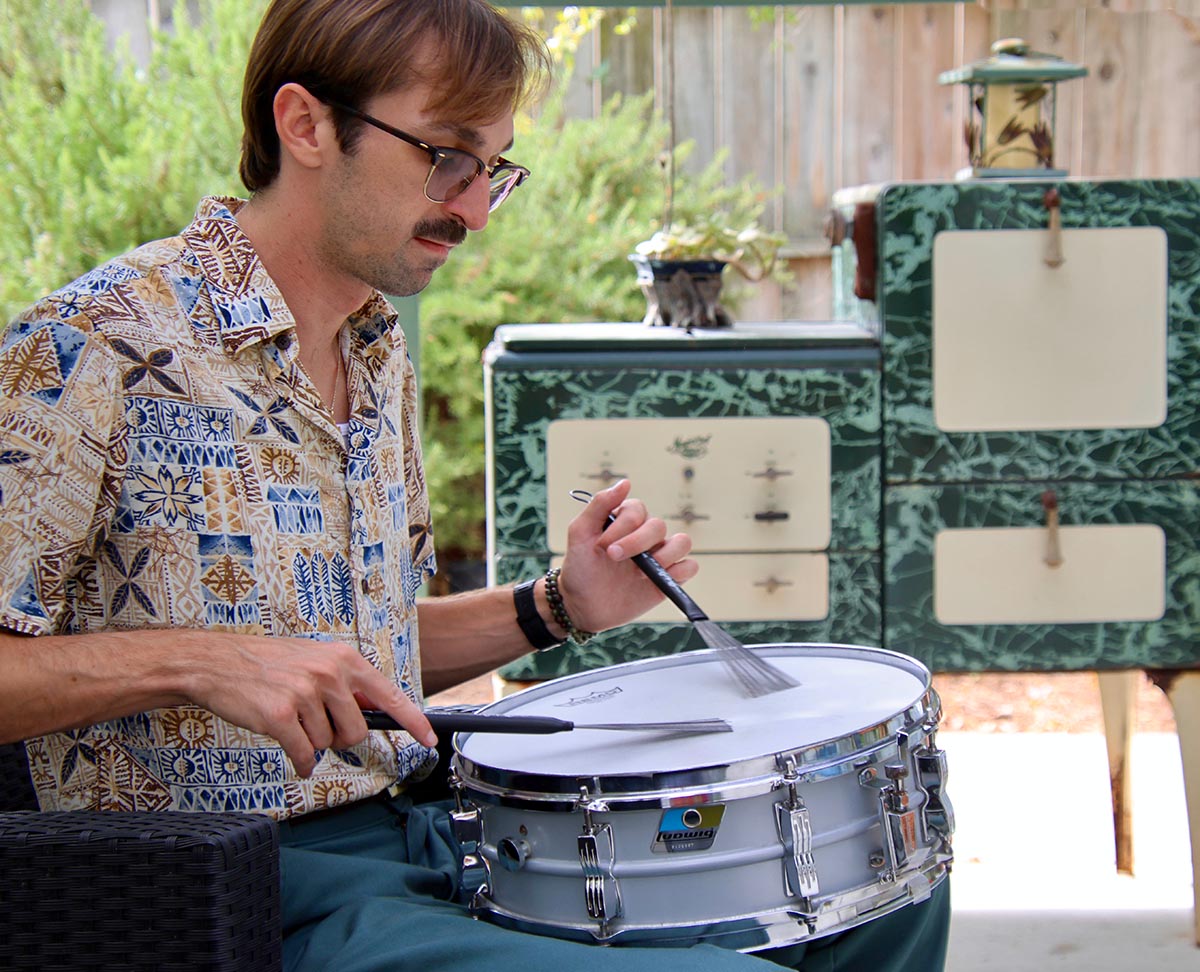
Photo by Kristin Albright.
If process theology is New Testament Joyce, we’ve got to take it back to the fire and brimstone of Old Testament Joyce for the origin story. How does this hockey-crazed kid of a distance runner’s build, analog upbringing, and vagabond sports team allegiances carve out this unlikely career as one of the most idiomatically versatile drummers and composers in San Diego’s creative music scene?
“Well, in sixth grade I chose band instead of visual arts because there was this really cute girl in percussion.”
A man of divine inspiration, to be sure, but a man of flesh and blood all the same.
The young Joyce was virtually clueless about jazz. He listened to the Beatles, Zeppelin, Hendrix, The Who, Springsteen, Genesis, and Mötley Crüe—all the rock ‘n’ roll his dad and uncles and older cousins would listen to. But he wasn’t necessarily fixated on emulating Ringo or John Bonham or Mitch Mitchell. Mostly, he was playing hockey; Keith Primeau and Keith Tkachuk would’ve been bigger idols than Keith Moon up to that point. But he’d stuck with band, and by the end of middle school inadvertently ended up negating his whole reason for trying it in the first place.
“I got put into a concert band, the top [middle school band],” Joyce recalled. “And I ended up replacing the girl I thought was cute, who was the whole reason I joined in the first place [laughs].”
Even through high school, drumming and music remained tertiary concerns. But as it began to dawn on him that there was no future in hockey beyond high school—“my best friend was ten times better than me and he wasn’t making the pros”—he actually started learning valuable lessons in musicianship.
“In high school [at Patrick Henry in Del Cerro], it was all about marching band and very drum-centric,” Joyce said. “And I’m so grateful for that because I think all great drummers, at least the ones who are my favorites, have their roots in rudimentary drumming. And all that stuff—the snare etudes, etc. — it’s still foundational to my playing and makes it that much easier for me to learn new, more advanced things.”
Even with strong fundamentals, studying music in college was going to be a stretch. Joyce’s first interaction with San Diego State’s music program came when showed up to audition as a classical percussion major. It was his first ever formal audition, and, as Joyce remembers it, he “showed up in a raggedy Aztec hockey shirt.” Shades of Happy Gilmore approaching the first tee at Augusta National in his Boston Bruins jersey and floppy-tongued Timberlands. It wasn’t a fit.
Joyce resolved to return to campus the next day for the jazz auditions, even though, by his own admission, he’d had no jazz training—and virtually no drum-set training, period—to that point.
“I didn’t know anything about jazz,” Joyce admits. “I didn’t know who Miles Davis was. I didn’t know what “Giant Steps” was. I didn’t know what swing was. I didn’t know a waltz was in three [3/4 time]. I didn’t know my scales. The only thing I knew about jazz was, like, Frank Sinatra, because I grew up in the Tri-State area.
“Somehow I got in; I don’t know how. I must’ve had the worst audition in the history of the program.”
This became a major source of motivation for Joyce, and he caught up quickly with a combination of formal and self-directed study.
“My first semester of college, I asked everybody—I mean, everybody—every day, ‘what should I be listening to?’” said Joyce. “I’d write them all down. And every day I’d practice for like eight hours throughout the course of the day, and then I’d go home and just actively listen for another six.”
Groove, Groove, Groove, Groove, and Groove
After six years on the Mesa, Joyce left SDSU with bachelor’s and master’s degrees in jazz studies, specifically drum set and vibraphone performance. As a grad student, he was selected for a graduate assistantship and completed a graduate thesis on acoustic and electronic drums and their role in beginning students’ pedagogy. Outstanding individual accomplishments that Joyce insists would not have been possible but for the mentorship he received from exceptional teachers, particularly Dr. Eric Smigel, SDSU’s celebrated chief musicologist who served as Joyce’s graduate thesis advisor and Mike Holguin, Joyce’s primary percussion instructor throughout college.
As a musical historian and academic on the cutting edge of how musical idioms evolve and interact with other artistic mediums and the humanities at large, Joyce endorses Smigel as an academic who needs to be heard. “Every year, I try to get him to do a TED talk,” Joyce says of Smigel, “because he would blow people’s minds, just the way he’s able to resonate with students. The best educator I’ve ever had.”
On the practical side, Joyce credits Holguin for teaching him how to apply classroom instruction to the bandstand. Holguin, Joyce says, not only effectively taught him how to be a professional musician—including how to play music that prioritizes the listener’s experience—but gave him the foundation from which he’s now able to teach others, something that’s not only gratifying but an economic necessity for most working musicians like Joyce.
“Like any great mentor on your instrument,” Joyce says, “Mike taught me a lot about life and how it connects [with music]. “And now, my whole teaching curriculum is centered around how Mike taught me.
“Mike would say ‘What are the five most important rules about drumming? Groove, groove, groove, groove, and groove.’ And I think about that every time I play.”
Audience and Purpose
To hear Joyce talk about it, the prerogatives of the audience and the artists don’t need to be mutually exclusive; to him, that’s the last thing they ought to be. Foregrounding the experience of the listener isn’t subverting the integrity of the artist, he suggests, unless and until the artist fails to treat themselves as a listener.
“I think it was Wynton [Marsalis] who once said, ‘Music is always for the listener, but the first listener is the performer.’”
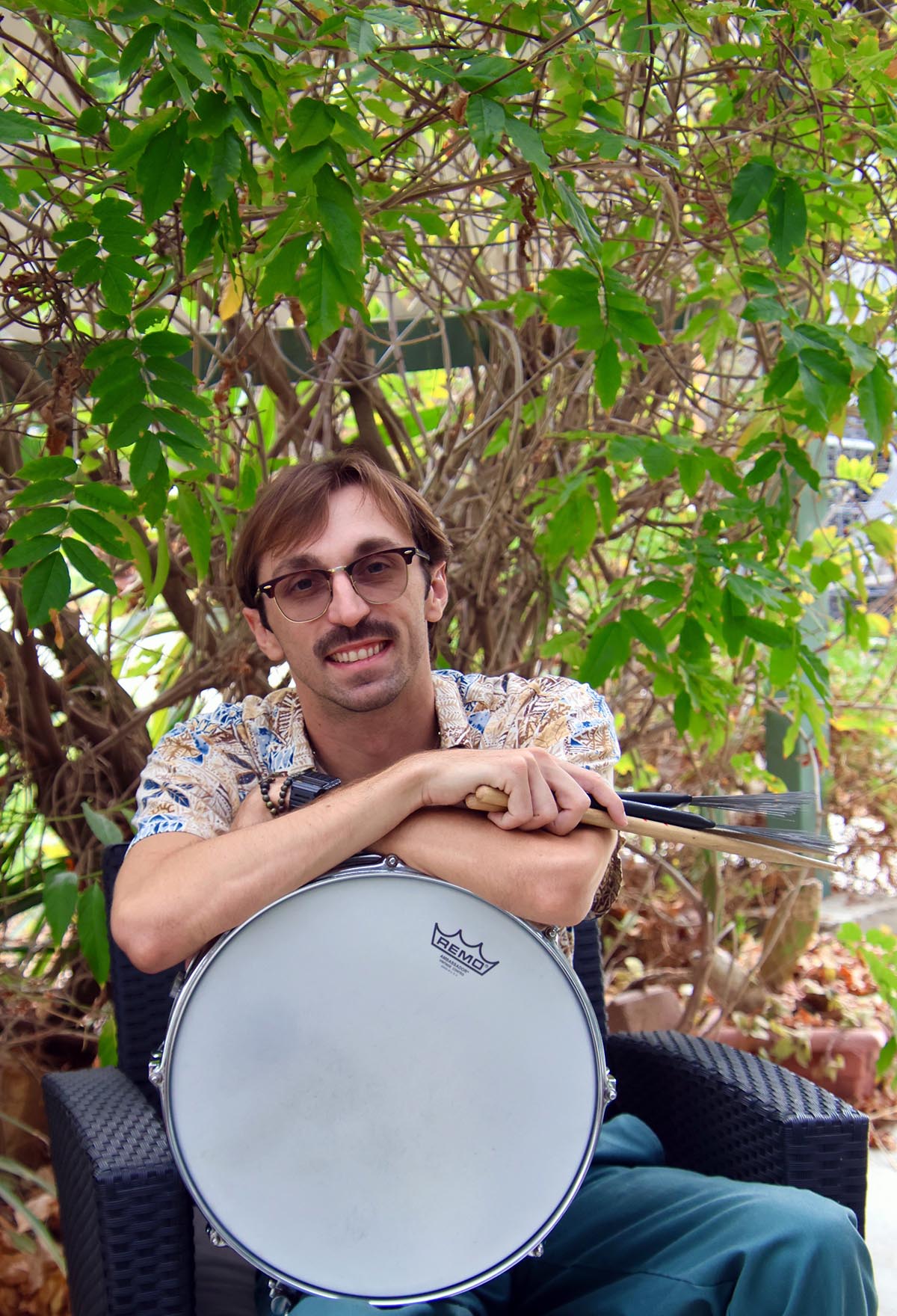
Photo by Kristin Albright.
Jazz is a balancing act—and maybe an aspirational one at that. The hope is to reconcile the heights of individual creative expression with the consummate expression of teamwork. It’s a tantalizingly elusive ideal. Still, a good faith effort to appease the jazz gods is required. Anything less is bad form, bad manners. Said differently, protracted digressions and tangents that are at best incidental to what the music as a whole is trying to communicate—even and maybe especially when those digressions are technically impressive and athletically extraordinary—can rub some bandleaders the wrong way, and often do when those bandleaders are drummers.
So it’s not surprising that “instrumentalists who do a lot of talking and don’t say a lot of things” tend to stick in Joyce’s craw.
“The more mature I get with my musical tastes,” Joyce says, “the more it’s truly illuminated that simplicity is often the correct answer.
“It’s like that old New Yorker cartoon,” he continues. “There’s a drummer and a guy in a suit. The drummer plays all these different notes and combinations and [the guy in the suit’s] like ‘wow, you’re amazing.’
“And then there’s a second drummer who plays something real simple—like boom boom bap, boom bap—and the guy in the suit turns to the second drummer and says, ‘you’re hired.’”
If the San Diego jazz scene comprises various spokes shooting out in overlapping, yet idiosyncratic directions, the hub for those spokes are the neighborhood jam sessions. Effectively a musical pick-up game where a rotating cast of musicians jam together on the standard repertoire that all working jazz musicians are expected to know, the jams are an essential part of gigging in this town.
Currently teaching at MiraCosta College in Oceanside, Joyce preaches the gospel of the jam sessions to his students. “I constantly tell them that the most vital thing [they] can do is go to the jam sessions, because when you go to the sessions, usually a gig comes out of it.”
Of course, artists always have notes to give. If there’s any critique Joyce has of the present state of the loosely connected confederation of jam sessions, it’s that these sessions can tend to devolve into glorified woodshedding sessions where folks are coming in to show off new chops or what they’ve been practicing, as opposed to seeking genuine musical communion in real time.
“Don’t get me wrong, It’s not about how anyone is running the sessions,” he says. “I like the way everyone runs the sessions in town. It’s just what’s happened to the nature of the game.”
“Play how you want to play,” Joyce continues, “but I feel like when the emphasis goes away from the music as a whole, then you get into this thing where it’s more like everyone pulling out a tape measure, you know?”
If you’ll indulge my good faith attempt to synthesize his feelings on the matter, I think what Joyce is trying to communicate is that the jams have the potential to be a place where the artform is genuinely furthered if enough people were to see it that way. He rightly points out that the institution of the jam session was once a genuine incubator, and the inspired, yet spontaneous music it produced played a big role in expanding the repertoire that constitutes what we now call the Great American Songbook. It’s idealistic—replicating the magic of 1940s after-hours Harlem is no easy task — but it’s not wrong.
“Sometimes,” he remarks, “it feels like the jam session right now is an attempt at the preservation of tradition, as opposed to it being this practice of furthering the music.”
It is true that, historically, some of the most famous and beloved contrafacts—new melodies written over top an established standard’s chord changes—came out of the jam session tradition, most famously at Harlem landmarks like Minton’s Playhouse and Monroe’s Uptown House. Hundreds of tunes worked out in real time on those makeshift jam session bandstands, tunes that would go on to become standards in their own right, derived from the changes to “Cherokee,” “I Got Rhythm,” “How High the Moon,” et cetera.
Joyce isn’t the first jazz musician to think along these lines. Vocal Nicole Zuraitis talks frequently about what she calls “The New American Songbook.” She argues that songs by Dolly Parton, Joni Mitchell, and Stevie Nicks are just as ripe for jazz treatment today as popular tunes written by the Gershwins, Jerome Kern, Irving Berlin, and Cole Porter were eighty years ago—and she’s proven it, recording her own arrangements of dozens of these tunes and winning Grammys for it.
Dozens of Stevie Wonder jazz contrafacts are already out there. For example, Robert Glasper’s “Wondering” is a contrafact of Stevie’s “Golden Lady,” and Pat Metheny’s “James” is described by many as a “reharmonization” underneath a characteristically James Taylor-ish melody. Imagine the trailblazing spirit of the after-hours jam sessions of the 1940s applied to the tunes of the New American Songbook.
Who knows: Maybe 50 years from now, we’ll be talking about this as jazz’s second big bang.
How to be a Pro’s Pro: The Importance of Reading and Playing Everything
One of the most important things Holguin did for him, Joyce says, was model versatility, the ability to play confidently and competently in any conceivable gigging environment. Through the years, Joyce recalls a phase where he only wanted to sound like Ringo Starr, followed by a phase where he only wanted to sound like Tony Williams, followed by a phase (this one lasted the longest) where he only wanted to sound like Elvin Jones. Such hyper-fixations might lead to narrowly tailored mastery, but they don’t offer the surest path toward solvency as a working musician. That, says Joyce, comes from comprehensive idiomatic fluency and being a great sight-reader.
“If you know Mike [Holguin], you know he’s one of the most adaptable drummers. He plays everything very, very well and reads better than anyone I’ve ever met. Knowing how to read as a working drummer…so important. I can’t tell you how many gigs I get just because I’m a good reader. That’s what pays my rent.”
When Joyce and Castelluzzo joined me on the air back in February, we played maybe four tunes from Almost Familiar over the course of about an hour and during one in particular, “Ciao Bella,” a piano trio tune on which Joyce is joined by bassist Sean Hicke and pianist Ed Kornhauser, I noticed Joyce smiling and shaking his head to himself in disbelief after a particularly fanciful solo piano tributary off the tune’s upbeat, churchy theme.
“My favorite thing about Ed is he’s one of the most idiomatic players I’ve ever played with,” Joyce said. “You can throw him into every kind of gig because he can play in literally every style. He’s got the chops and got the lines and got the vocabulary, and that’s kinda what I’ve worked to be able to do as a working drummer.
“Like, I have my ‘home sound,’ but you could throw me in a pretty authentic Afro-Cuban situation, and I’ll hang just fine. Most of all, I think [fluency in a variety of styles] is a way to be honest to yourself, especially if you love and care to play a lot of different styles of music, as both Ed and I do.”
More recently, his touring and recording with Hether has introduced Joyce to a different milieu, pop. When Rock and Roll was still king of the American cultural mainstream, plenty of jazz instrumentalists memorably served as sidemen for pop performers. Freddie Hubbard, Toots Thielemans, Phil Woods, Michael Brecker, and Eddie Daniels all guested memorably on Billy Joel records; Branford Marsalis and Ornette Coleman each individually toured with the Grateful Dead; and Ernie Watts toured with the Rolling Stones. And, more recently, Joshua Redman has both toured and recorded with jam band Umphree’s McGee.
And yet, the stereotype of the haughty jazz musicians turning up their noses at pop music persists. And, at least as of the late ’90s/early 2000s, there was some validity to it. For nearly 30 years, my father, a clarinetist and bandleader, led a successful Philadelphia-area dance and society band—corporate galas, charity balls, upscale weddings, and the like. Over the years, he had some seriously talented jazz musicians play with his band; it wasn’t their primary gig, but they took dates when they needed extra cash. Some adapted easily to the repertoire; others struggled. It was always the guys with boundless chops, at home taking chorus after chorus off of Coltrane heads, who didn’t know the changes to standards.
“That’s why I tell my students—long before I turn them onto Elvin [Jones]—to listen to Ringo,” Joyce said. “It just gets the drummer to focus on what the music is about. It gets them to think about what supports the music. I mean, that’s the ultimate thing.”
As a jazz fan, if you’re talking Mt. Rushmore drummers with Joyce, the conversation starts with Elvin Jones, the drummer of the Classic Coltrane Quartet. “Elvin’s probably the most influential jazz drummer,” Joyce opines. “Because John Bonham was the most influential rock and roll drummer, and the guys Bonham talked about being influenced by were Gene Krupa, Buddy Rich, and Elvin. Same with Mitch Mitchell [Jimi Hendrix’s drummer].”
But, for beginning students especially, exposure to Elvin can wait.
“I tell my students, ‘If you’re not into [Trane and Elvin] right away, wait till you can get into it. Because you will get into it if you take the steps to get into jazz.”
When he gets on a roll talking about the musicians that transformed him from an incoming college freshman with no jazz background whatsoever to a true jazz fanatic, Joyce is still as animated about the musicians whose virtuosity fueled him to devour records and learn everything. Throw out the name of virtually any legendary jazz drummer and Joyce will spit back an essential listening syllabus as AI might.
Jeff Hamilton: “Modern master of brushes. And Jeff would tell you the guy to listen to is Ed Thigpen (Oscar Peterson).
Eliot Zigmund: “Oh, Bill Evans’ ‘You Must Believe in Spring.’ Unbelievable.”
Vernell Fournier: “Just think about the groove in ‘Poinciana.’ He plays that the entire song!”
Alan Dawson: “The Sonny Rollins Trio with Alan Dawson and NHOP, from Denmark. Either 1964 or 1968. That concert is a must watch. That was the video where I’m like, ‘Oh, now I get why he’s the guy who Tony Williams went to for lessons.’”
Gary Burton: “There are certain guys where you look at them when they play their instrument, and you’re like ‘I’ve never seen anyone have command over the instrument like that.’”
The college kid who wanted to be Elvin Jones and idolized his power and virtuosity is clearly still in there. But, as he’s matured, his core operating principle has shifted: “I want to do what the music calls for. I want to make the song that we’re playing as good as it can be.”
Epilogue: The Father, the Son, the Holy Notes
There are no other musicians in Justin Joyce’s immediate or extended family. But, ultimately, it’s their influence—and maybe even innate gifts—Joyce carries with him onto the bandstand when he plays.
For the longest time, what Joyce wanted most, apart from maybe one day playing for the Detroit Red Wings, was to be like his father.
“It took me to, like, the middle of grad school to realize—or, like, fully decide—that, like, I wasn’t gonna [go into the Navy in some way],” he says, telling me that his father remains his primary reference point for dignity and integrity. “My whole dream as a kid was to be an officer, so my dad would have to salute me [laughs].”
Like the greatest jazz legends, perhaps the greatest source of pride for parents is not when their children imitate them but when they emulate them, cultivating an inherited aptitude and applying it as independent beings.
Joyce’s father may not have played an instrument or read music, but he did have a precisely tuned ear.
“As a sonar tech,” Joyce recalls, “he was the type of person where you could play, like, a random pitch, and he could tell you what frequency you’re hearing. So, I credit my father; I think that’s where I got my ear from.”
Joyce also inherited that long, lean marathon runner’s build from his father, who likely had little difficulty with the Navy’s endurance training; before Justin was born, he was a professional distance runner, sponsored by Reebok, and an alternate on the 1980 and 1984 American Olympic teams as a marathoner.
“I’m built exactly like my father,” Joyce says. “Same height, same weight, same everything.” You can hear the pride in his voice when he describes his father as “just the biggest upstanding gentleman.”
Joyce’s father died after a prolonged battle with cancer in 2018. Right around that time, his graduate program became a lot less demanding, time-wise. Structures he’d relied on to maintain order and discipline suddenly weren’t there. The period that ensued was a crucible that could’ve destroyed him.
“The years immediately prior to Covid, I hadn’t really been playing in the scene that much,” Joyce told me. “I was only at school like two days out of the week, whereas every other semester, even in my undergrad, I was there from, like, 8 in the morning to 7pm. That’s when I had fallen into drinking, and I was just doing a lot of stupid shit.”
Eventually, during Covid, he started taking back control, bit by bit, using the idle time afforded by a largely shutdown world to read voraciously every day.
Reprising the brand of hyper-focused self-directed study he’d once employed as a college freshman to catch up to his peers’ working knowledge of jazz, Joyce diligently worked to put himself back together, first via the philosophies of the ancient Greeks (Plato and Aristotle) and then by returning to Catholicism (he recently completed Confirmation).
The ancient Greek philosophers Joyce studied classified music as something ultimately distinct from art, language, poetry, medicine, theater, mathematics and other discrete areas of science and the humanities. To hear Joyce tell it, they believed music to comprise all of these things. But, categorically, they viewed it as something bigger, more broadly encompassing.
“[Music] was seen as, like, the connecting force of the cosmos,” Joyce says of the Greeks, “in the sense that the patterns that arise in music are [those that arise in] nature, both on a microscopic and macroscopic scale.”
Filtered through the lens of his Catholicism, Joyce interprets that thusly: “I believe the ‘connecting force of the cosmos’ is just another way of saying the ‘the language of God.’”
If I’m understanding this exceedingly well-read and thoughtful young musician correctly, both seem to have ultimately aided in re-affirming Joyce’s belief that the intentional creation of music is an article of faith. Or, maybe from the perspective of an agnostic, a practice for communing with some grand organizing mechanism beyond our capacity to perceive — you know, just in case we need a way to talk with aliens someday.
To be sure, it’s conceivable that music has myriad applications beyond its most common and conventional uses. You read about children with developmental delays, nonverbal kids who are exposed to music and, somehow, it unlocks something within them, and they’re able to communicate in ways they weren’t before. We already know about music’s power to foster camaraderie and accelerated acknowledgment of shared humanity between musicians and music lovers across cultures that are otherwise very different from one another. It begs the question: What other magic can music do? Which doors and wonders beyond our imagination might be able to unlock?
So does Joyce believe we have anything close to a full understanding of what music is for and why we come pre-wired to make it and feel a sense of exaltation when we consume it?
Dubious though he may be that “music as we commonly consume it” is being used to its fullest potential, he’s quick to add: “That doesn’t mean that music [as it’s expressed and consumed now] isn’t great or that music’s not doing great things either.”
Returning Back to Earth
Since emerging on the other side of his Covid-era perspective-shifting gauntlet, Joyce has been sober, acknowledging “I’m not capable of having just one.” The novel virus that shut down the world allowed Joyce a reset. “It was one of those things where it actually did save my life.”
He started working again, the scene welcomed him back, and, in 2022, with the help of some of his closest friends and musical colleagues, he released Story Tales, his debut recording as a leader, an album largely consisting of original tunes he’d composed during graduate school. Mack Leighton (bass), Ian Harland (vibes), and Ed Kornhauser are all featured on it, as is trombonist Matt Hall, Joyce’s grad school classmate who recorded his own debut album, I Hope to My Never, with the exact same personnel. The two albums were recorded a week apart at LMP Studios in Claremont (it’s kind of like how Cannonball and Coltrane and Kind of Blue were recorded with different leaders and virtually same personnel just 29 days apart in 1959).
And, with as busy as he is now gigging and teaching and touring with Hether, the positive, redemptive lifestyle changes he’s made have motivated him to think about the next vehicle for his own original music.
What that might look or sound like is anyone’s guess. He’s got a lot of guiding principles. I tried to write them all down, but he talks really fast; he’s from New Jersey.
What happens if/when some of those guiding principles venture to go in opposing directions?
Who knows. Remember, we don’t know what any of this is for yet. If the future of jazz is really something that’s almost familiar, you’ll probably catch a sliver of the old record in the new one.

