





Lessons from Melody Ranch
What Else Haven’t I Heard?

It’s October! Finally. The harvest moon has just passed and we enter the best season!
“Autumn is the best season. And if you don’t think so, you’re wrong” pal Kinnie Dye informed me yesterday when she pulled in from her long road trip from Texas. She told me this on the phone because, after a quick stop in Roswell, she drove to my Santa Fe ranch from Texas and arrived earlier than expected.
“Hello?”
“I’m here!”
“Oh wow! You made amazing time!”
“I did. Are you not here?”
“I’m in town, at a powwow. But I just got into my car to head to you.”
“Stay! Enjoy yourself!”
“No, I’m coming. I only slotted out two hours for this and it was super intense.”
I proceeded to tell Kinnie all about the drum circles, the regalia, the realness of it all.
“Have you never been to a powwow?” she inquired.
Now you have to understand, Kinnie Dye is from Oklahoma.
“Not a real one.”
“I mean, I’ve been to Knott’s Berry Farm more times than I can count, but that’s Knott’s Berry Farm.”
“I have no idea what that means.”
Is this a California issue? I say it all the time now that I live in New Mexico. Growing up in California, Indigenous culture almost seemed like a theme-park cartoon-character thing. A relic or a novelty of some sort. The shows we saw were commercial and created for people like me who were ignorant, whitewashed and unaware of our history in its real context. My family is Indigenous, but my grandfather grew up in LA in the ’50s, and by my mama’s generation, we were whitewashed. By the time it got to me, we were just Californians. I know now that this didn’t happen in a vacuum. American education spent generations deliberately separating Indigenous children from language, religion and culture in the name of assimilation.
It wasn’t that Indigenous culture wasn’t there. Somehow, I had learned to see it as something that used to be there. This was the first time I saw the event as a living, breathing, magnificent thing. My pal Dez’Baa invited me to join her and her family as they kicked off the celebration for her kid’s birthday. So I was lucky enough to be there with an Indigenous family. Otherwise, I probably wouldn’t have gone, despite it being open to the public. It seems so silly. Kinnie has gone, and she’s a white lady. But it goes to show you: you never know. Why do I feel like an intruder?
When I met Dez’Baa’s dad, I felt my brain artifacting in real time. He spoke slow and low in that way every Indian actor seems to. It calmed me instantly. And then I realized I had noticed it. My brain confirming performative Indigenousness. Ugh. Stop it, Frannie.
I guess I was surprised her family didn’t gather around the drum circle at first. Instead, they exchanged hellos with friends and family they knew in the jewelry and artist marketplace for quite some time. I met a small whirlwind of artist friends of Dez’Baa’s. I bought a beautiful onyx necklace from a woman from Santo Domingo Pueblo, also known as Kewa Pueblo. I wore it so if anyone liked it, I could send them straight to the artist’s booth. Wouldn’t you know it, not five minutes later, one of Dez’Baa’s pals asked about it, and then somehow the conversation shifted into a story about how her sewing machine had broken the night before and how disappointed she was that she couldn’t add certain pieces to her costume? Outfit? Regalia? Ugh. I’m so ignorant, it’s bothering me. She told me that she had been working on what she was wearing for years and how much dedication the craft took. She pondered how she would afford another sewing machine. I recalled that I had just bought a sewing machine to take up an old skill. “I wish I could afford a new machine,” she lamented. These artists make beautiful art with very few resources.
Regalia can evolve with its wearer over years, incorporating handmade pieces, gifts, family history, heirlooms and contemporary materials. She wasn’t describing a costume she hadn’t managed to finish. She was describing a living body of work she had been building for years. As an artist myself, that distinction landed hard.
This was also something I was talking to Kinnie about. We passed the Georgia O’Keeffe Museum later that evening and I commented, “That’s the Georgia O’Keeffe Museum. I try to get people to go somewhere else. IAIA is our favorite museum.”
“Why don’t you like the Georgia O’Keeffe Museum?” Kinnie inquired.
“It’s just that she’s the most famous artist to come out of here and it’s a travesty. There are so many Indigenous artists. So many talented humans that get no attention. And we celebrate the white lady for painting these magnificent New Mexico landscapes without talking nearly enough about the people who were already living in those landscapes.”
I’m not the only one thinking about it. The Georgia O’Keeffe Museum itself has begun doing some of that reckoning. O’Keeffe arrived in New Mexico in 1929 and spent much of the last 37 years of her life painting the landscape around Abiquiú and Ghost Ranch. The museum now explicitly points out that those landscapes were never empty or “untouched.” They are Tewa homelands, with Tewa names, histories and people that long predate O’Keeffe’s arrival.
And then there’s IAIA’s Museum of Contemporary Native Arts, our favorite museum in town. The word contemporary suddenly feels important to me. Its collection holds more than 9,500 works by Indigenous artists created from 1962 to the present. These are not artifacts from a vanished people. These are working artists. Artists like the woman I had just met whose sewing machine broke while she was still building her regalia.
Back to the powwow.
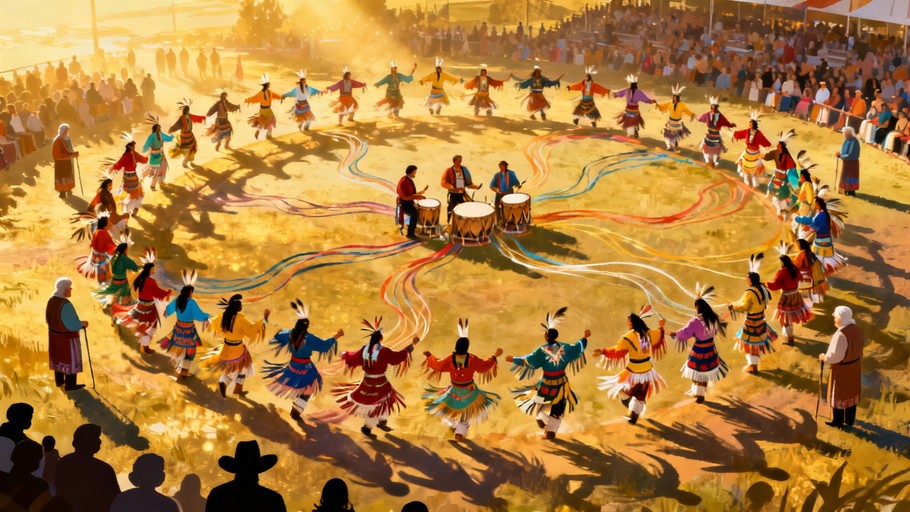
Dez’Baa’s family didn’t head to the drum circle with me. I had to fly solo if I wanted to see it early on. So I wandered over. I saw several old white ladies with two-foot-long camera lenses. Archiving. That’s how it happens. It really seemed like the Indigenous folks were not photographing. Noted. Hm. I can’t remember the last concert I went to where there weren’t more people recording on their phones than I could count. Not wanting to push to the center and with a lack of hands in the air, I found my window. I watched dancers covered in bells, jingle-jangles, beads, leather and feathers. Brightly colored, dancing in a circle. Strangely enough, one in ten people were in jeans and a T-shirt. There were toddlers and babies. Surrounding the center dancing circle were three massive drums. The size of our dinner table at home. Around each drum, mostly men, with a few women among them.
Anyway, big men pounded the drums as they sang full force, with no fear of nasality, in that sound my ears immediately recognized as powwow singing. The call and response passed from the men around the drums to the women surrounding them, like a choir. Again, several babies on hips. No ear protection, content as can be. Everyone in full flow. They followed each other. I felt them passing leadership from one drum group to another, all playing the same tune. They ebbed and flowed together. Then louder and louder, to a climax.
That’s when I had to step away.
I was in tears.
Thoughts of how little in life I really know and have experienced flashed through my mind. I felt shame, embarrassment, anger, but mostly sorrow. I knew this powwow was part of an America250 initiative. 250 years since the Declaration of Independence. Standing there listening to those drums and looking around at all these people, one thought kept running through my head: 250 years. These people endure and endure and America just erases and erases.
I wandered into the exhibit room to find Dez’Baa and her family. I bought prune pie, a new thing to my eyes. And I caught them at an artist’s T-shirt table. Dez’Baa’s kiddo waved me over. As I stood, catching up, I couldn’t believe what my ears were hearing.
“What does that say?”
“Look closely.”
I tilted my head like a New Mexican brown dog, back and forth, as I tried to decipher his art.
“Indian…”
“Merciless Indian Savages.”
I paused and uncomfortably looked side to side for context.
“Have you never heard that before?” the artist inquired.
“Um, no.”
“Everyone here can educate you on it.”
I quickly grabbed my phone and Googled it.
I felt a bit of nausea as I read the Google AI summary aloud. “The phrase ‘merciless Indian Savages’ appears in the final grievance against King George III in the Declaration of Independence.”
“It’s in the Declaration of Independence?”
“It is.”
“That’s heartbreaking.”
No one saved me from my sadness. I stood there in stunned silence.
“Um, I guess I have to buy that shirt now,” I said as I pulled out a $50 bill.
He laughed and said, “Nothing wrong with a little reparations.”
That one hit especially hard. I already knew why we were talking about 250 years. What I hadn’t known was that those words were sitting there in the very document whose anniversary we were commemorating. I had been standing beside the drum thinking about everything Indigenous people had endured over those 250 years without knowing that the Declaration itself had described them as “merciless Indian Savages.”
When I got home, I started digging back into the music. The funny thing is, much of what I found wasn’t new information. I studied world music in college. I knew about Northern and Southern singing styles. I knew about vocables, syllables that carry melody rather than words. I knew the basic architecture of the music and the relationship between singers and drum. My musician’s ears had even picked up much of it in real time: the lead and response, the repetition, the way the music built and intensified, the way everyone seemed to know exactly where it was going without anyone appearing to conduct it.
What surprised me was how different it felt to stand beside it. I had read about this music in textbooks. I had listened to recordings. I had studied it alongside music from other places and other peoples. But somehow, in my education, it still felt historical. Even the term “world music” seems strange to me now. It put all these enormous living musical traditions into a category that somehow meant somewhere else. Someone else’s music. Something to study.
Standing beside that drum, there was nothing historical about it. The women were singing. The men were pounding the drum. The dancers were dancing. Friends were catching up. Artists were selling their work. Somebody’s sewing machine had broken. Somebody was holding a baby. Dez’Baa was celebrating her kid’s birthday. It wasn’t history. It was Saturday.
So, once again, Santa Fe is changing me. Opening my eyes, ears and heart. The artist made a joke about reparations, but I left feeling like I had incurred a debt of my own. Not a debt I can discharge with fifty dollars for a T-shirt. I need to go study these arts that I really still know so little about.
I studied world music in college. Apparently, that isn’t the same thing as knowing the world. There’s far too much to know. But right now, I’m digging into what I listened to at this powwow and the artists I learned about there. I spend my life listening. I teach other people how to listen. Maybe that’s why this shook me as much as it did. My question is: what else haven’t I heard?
Listening Homework
Powerhouse: find a live powwow recording. Powerhouse was the Northern host Drum I heard that Saturday in Santa Fe. Don’t put this on while you’re answering emails. Listen to the singers enter, listen to the drum, listen to the repetition and the changes inside the repetition. This is where this column started.
Southern Slam: then compare. Southern Slam was the Southern host Drum. Listen to them after Powerhouse. Don’t worry about passing a test afterward. Just see if your ears begin noticing the differences.
Raven Chacon: “Biyán.” Chacon is a Diné composer and musician from Fort Defiance who studied composition at the University of New Mexico. “Biyán,” derived from the Navajo word for “song,” reflects on the function of singing and repetition in Navajo ceremony. If your brain has created separate boxes for “Native American music” and “contemporary classical music,” let this make a mess of them.
Black Belt Eagle Scout: pick a song and turn it up. Katherine Paul is a Swinomish and Iñupiaq musician making guitar-driven indie rock. I’m deliberately not telling you what Indigenous music is supposed to sound like anymore. That’s sort of the point.
Mato Wayuhi: “NEW MEXICO.” Wayuhi is an Oglala Lakota rapper, producer and composer whose work includes music for Reservation Dogs. “NEW MEXICO” appears on his album STANKFACE STANDING SOLDIER. Indigenous music is not frozen in a museum case. It has bass.
Raye Zaragoza: go exploring. Zaragoza is a singer-songwriter whose work moves through folk and Americana, and who works to create visibility for Indigenous artists. Start somewhere, then follow whatever catches your ear. That is part of the assignment.
Then find somebody I didn’t give you. This is important. Don’t let my list become another textbook. Find an Indigenous musician yourself. Learn what nation or community they come from. Listen to something they made recently. Then follow one connection from that artist to another artist. See where you end up.
Homework
Go find the Indigenous artists where you live. Not the Indigenous people who used to live there. Who is there now?
Find the musicians, painters, jewelers, dancers, writers, filmmakers, galleries, cultural centers, artist markets, radio stations, concerts or powwows. If you attend something that is open to the public, go respectfully. Buy something directly from an artist if you can afford to. Ask questions when questions are welcome. Mostly, listen.
And then ask yourself:
What have I learned to think of as history that is actually happening right now?
Only create with people that you love on work that you love.

Francesca Valle is a singer, songwriter, multi-instrumentalist, writer, producer, and entrepreneur. Originally from Los Angeles, she spent 12 years in San Diego and still stays closely connected to its arts community. She’s the founder of BugByte Studios and WiseJack Marketing, now based in Santa Fe, New Mexico, and Costa Rica, with creative roots planted in the people and stories that have shaped her.

