




Featured Stories
Speaking Jazz in Present Tense: In Praise of Saxophonist Joshua Redman

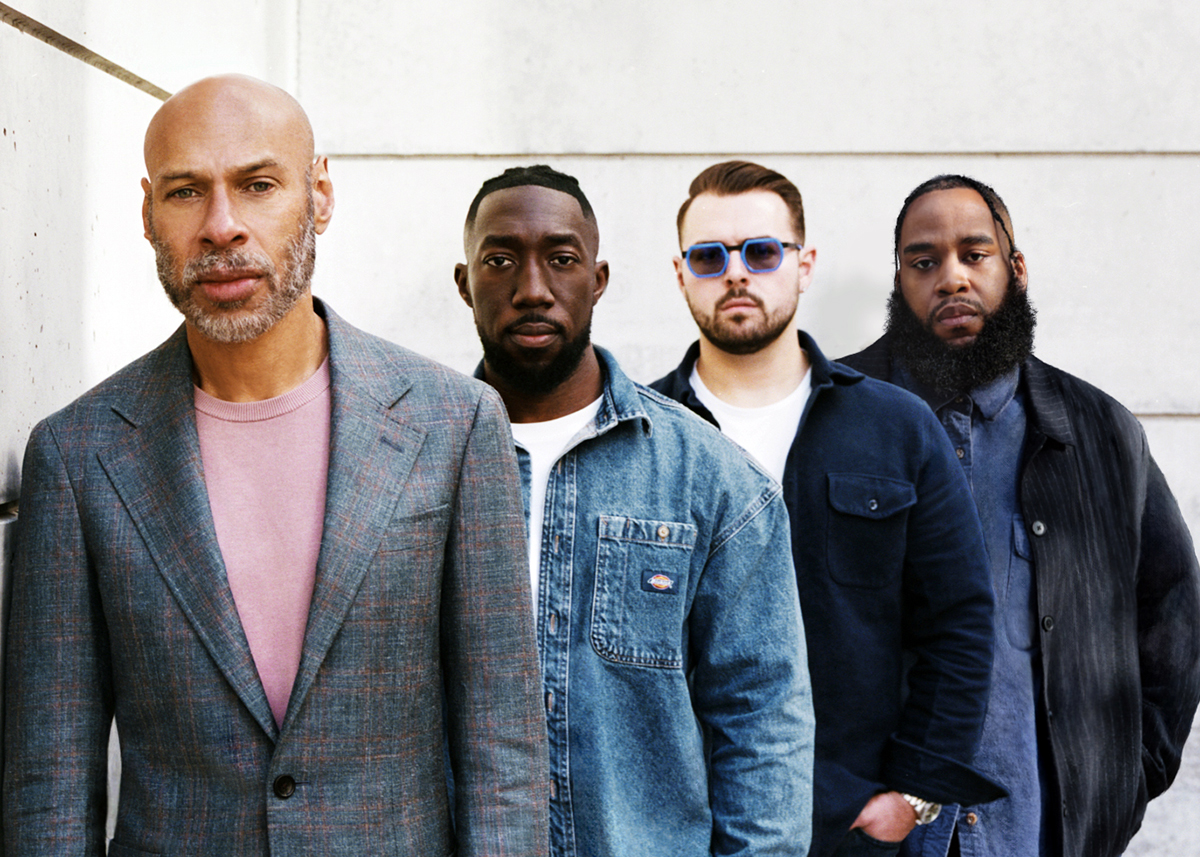
The Joshua Redman Quartet
The Joshua Redman Quartet opens the fall 2026 season of the Dan Atkinson-curated Athenaeum Jazz Series on November 3, at the Scripps Research Auditorium in La Jolla. For tickets and more info.
1991. A year of consequence and profoundly altered courses. The legal underpinnings of South African apartheid crumbled. Operation Desert Storm drove Saddam’s forces out of Kuwait. Before Super Bowl XXV in Tampa, Whitney Houston delivered the most iconic performance of the “The Star-Spangled Banner” there ever was or will be. Scott Norwood missed wide right. The USSR dissolved. History was declared over.
And Joshua Redman decided not to go to law school.
In the spring of ’91, Redman graduated summa cum laude from Harvard. He’d already been accepted to Yale Law School but decided to defer enrolling for a year, to see if he could hack it as a musician in New York City.
That fall, he won the Monk International Saxophone Competition, beating out generation-defining talents like Eric Alexander and Chris Potter. A major label deal with Warner Bros. soon followed, as did invitations to tour with giants like Jack DeJohnette, Charlie Haden, and Pat Metheny—three pioneers of the modern, melodically accessible avant-garde, who’d memorably recorded with Redman’s father Dewey, a commercially under-recognized saxophonist deeply admired by his musician peers.
Redman never made it back to Yale Law.
Instead he did for jazz’s signature small combo, the quartet, what Brad Mehldau did for the piano trio—he opened it up for cross-genre and intergenerational conversation. Like Mehldau, Redman rejected both historical re-enactment and pressure from an avant-garde preoccupied with theory, abstraction, and in-group signaling. He chose to honor both the intellect and the soul; not just his own, but those of his bandmates and audiences too. In the tradition versus innovation “jazz wars” of the early 1990s, he refused to dignify a faulty premise by choosing a side.
“The goal of jazz musicians should not be to lose themselves in their heritage, striving only toward mastering and replicating the music of their elders,” Redman memorably wrote in the liner notes to his self-titled 1993 debut. “Neither should it be to repudiate the wisdom of the ages, sacrificing what is beautiful and natural for what might be considered novel.
“The goal of all jazz musicians should be…to lay aside, at the instant of performance, all their preconceived formulas, theories, and agendas, and to just play.”
Redman, then and now, has stayed true to pursuing this third way: open and continuous dialogue with the ghosts of jazz’s golden age and antennae receptive to cross-dimensional transmissions from jazz’s future, all in service of musical ideas that have always communicated something real and honest in whichever present moment Redman happens to find himself.
“Playing acoustic jazz is not about recapitulation,” Redman told the Dallas Observer in 1995. “It’s about playing it now. Jazz is a music of the moment.”
That’s not to say the elders didn’t loom large in his development. “…honest Improvisation always makes references to Tradition,” Redman wrote in those aforementioned 1993 liners, “since no individual can fully escape the influence of his or her predecessors….”
His father Dewey, John Coltrane, Joe Henderson, Dexter Gordon, and most especially Sonny Rollins are all foundational to Redman’s instantly recognizable sound on tenor saxophone—warm and lyrical yet muscular and authoritative; emotionally communicative and vulnerable rather than detached and dispassionately “cool”; and faithful to the hard-bop shibboleths of blues, gospel, and swing.
But, while coming up, he never gave any quarter to the non-stop comparisons made to Wynton Marsalis, who, by the time Redman was releasing his first albums, had already become the king of the so-called neo-traditionalists. Redman never showed any interest in being Marsalis’s saxophonic equivalent, even as so many were dying to anoint him the messiah or “Golden Horn” of the wildly hyped (for jazz) Young Lions bop revival of the early 1990s.
Because just as integral to the development of Redman’s ear were the Beatles, the Police, Led Zeppelin, and even Bruce Springsteen, whose music excited Redman’s massive ears to the potential of “singing through the horn.” The harmonic structures of pop and rock tunes, designed to support a lead vocal melody, opened new doors of expression for Redman; they allowed him to communicate his emotions more directly, like singers do—both on covers and on originals like the one below, from 2002’s Elastic, a personal favorite.
The Zeppelin influence on “Can a Good Thing” is immediately recognizable. Indeed, throughout Elastic, Redman showcases his, erm, musical elasticity. The album title’s a bit on the nose, perhaps, but its 11 other original tunes illustrate the extent to which acts like Weather Report, Earth, Wind & Fire, Prince, and Stevie Wonder proved similarly impactful across his discography as both a leader and a sideman, instilling in Redman an abiding commitment to the kind of deep, persistent groove more common to funk and neo-soul.
Considered in the aggregate, Redman’s discography and live performance history over the past 35 years amounts to a veritable musical multiverse, much like Miles Davis’s and Herbie Hancock’s.
And, like those two, Redman’s breadth of virtuosity merits superlatives. Could Joshua Redman be the most complete, most idiomatically fluent saxophonist since 1990—and maybe ever?
I think so.
There’s a reason—valid, music-based reasons, his last name and Ivy League pedigree notwithstanding—why the jazz press of the early ’90s tried their damnedest to tout Redman as the next savior of straight-ahead (i.e., classic) jazz.
Here was a young kid with the feeling, the musical mind, and the facility to communicate in all the sacred styles of saxophone’s patron saint, John Coltrane. Looking for a modal jazz waltz with soaring soprano lyricism redolent of Coltrane’s “My Favorite Things”? Try Redman’s “Second Snow,” from 1995’s Spirit of the Moment: Live at the Village Vanguard.
For the melodic DNA and plaintive spiritual yearning of A Love Supreme, combined with solos of harmonic density that call to mind Trane’s “sheets of sound” approach from Giant Steps, drop the needle on “Sublimation” from Redman’s self-titled debut. How about variations on the playfully off-kilter antagonism of Monk? Check. Or the blazing bebop vocabulary of Charlie Parker? Check. Both the rocket-fueled ferocity AND the romantic smolder of Sonny Rollins? Check, mate.
Thing is: Like Miles and Herbie, Redman never wanted to stop there. His musicality was far too broad, too informed by his own generation’s musical tastes to be painted into that corner—a corner he loved and continues to love but also one that would’ve inevitably become creatively suffocating.
Redman has managed to have it both ways. I think that’s for two reasons. First, when musicians like Miles and Herbie went hard into fusion and electric jazz, they took relentless criticism from a preservationist segment of the jazz press with real influence. But the music’s evolved (jazz lives!), and the industry has changed. So much so that, in 2026, if you hear the words “jazz press” and don’t instantly reply “what jazz press?” I question what planet you’re living on. Yes, there are still pitiable souls existing at the margins who still believe that describing Redman’s music as “populist” is some kind of burn. But, on the whole, Gen-Xers like Redman and especially the cohorts coming up behind him haven’t been subjected to that sort of thing nearly as much.
Second, and most consequentially, Redman doesn’t abandon or graduate from certain styles; he cycles through them, and returns to the musical forms that make him who he is, never imitating older (i.e., younger) versions of himself, but adding, amending, revising, re-stating. He’s right when he acknowledges innovation at the expense of everything else is a trap; it’s illusory. He doesn’t just honor the past; he actively honors his past.
New Iterations of Legendary Quartets
Redman’s first two albums, Joshua Redman and Wish, both released in 1993, were bona fide hits, both critically and commercially. The former was nominated for a Grammy (Best Jazz Instrumental Performance); the latter, with legends like Pat Metheny and Charlie Haden as sidemen, was named Album of the Year by DownBeat. Combined, that pair of records sold over a quarter million copies. But 1994’s MoodSwing is the one for the history books, the first recording of the Joshua Redman Quartet with Brad Mehldau on piano, Christian McBride on bass, and Brian Blade on drums. The New Yorker has called Mehldau “arguably the greatest working jazz pianist,” but the rhetorical hedge is merely authorial CYA. McBride isn’t just the greatest living jazz bassist; for at least the past decade, he’s been jazz’s pre-eminent kingmaker and tastemaker. Blade is the most emulated jazz drummer of the last 40 years. Before MoodSwing, the die-hards and industry insiders knew these guys were promising. After MoodSwing, every dilettante knew these names.
It was inevitable that Mehldau, McBride, and Blade would each become touring and recording bandleaders of generational significance. “I knew better than anyone else,” Redman has said, “just how incredibly lucky I was to have even that short time with them.”
But Redman has done a masterful job, over the years, of keeping formats and personnel fresh, while simultaneously keeping his favorite sidemen within his solar system. Each maintains its own distinctly eccentric orbit, but, occasionally, they pass near enough for an interplanetary reunion.
Throughout the ’90s and 2000s, Redman continued to work individually with each: Blade anchors all the “electric” projects like Elastic (2002) and Momentum (2005); Mehldau and Redman dazzle as intertwined improvisational supernovi on 2016’s duo album, Nearness, and 2013’s Walking Shadows presages some of Mehldau’s appetite for large-scale orchestral arrangement we see fully satisfied on last year’s Ride into the Sun; and while McBride and Redman have never recorded a bass/sax duo album, the universe keeps finding ways to bring them together. Check them out, playing an impromptu duo set at the North Sea Jazz Festival.
In 2020, after 26 years, the original quartet came back together again to record RoundAgain, a few months before the last “great conjunction” of Jupiter and Saturn. A reunion coinciding with a once-in-800-years celestial phenomenon suits “musical soulmates.” Two years later, they followed it up with LongGone. Glide Magazine, apparently unmoved by the cosmological significance of it all, declared, “…this four-way regrouping would appear to be a phenomenon unto itself.”
A phenomenon? Sure. Twenty-six years in the making? Sounds like something amorphously positive to say in a press release. I doubt the when, where, why, and how of it had been taking up an inordinate amount of real estate in each guy’s head since the mid ’90s. I’m sure they believed they’d get to it. With all due respect to the spirit of the moment, they weren’t going to force it. Each prioritized their professional and personal growth—and, critically, each prioritized their own growth as artists. Even mediocre artists never stop growing and evolving. Guys like this—the best in the world at what they do, guys dedicated to making the best possible music they can make in the present—they’re maniacal about growing. They never stop learning. They never stop listening.
RoundAgain and LongGone memorialize this. Each member of the quartet brought 26 years of playing and studying and listening and living to bear on these records. It’s why, if commercial considerations didn’t exist, those musicians could’ve literally re-recorded every tune on 1994’s MoodSwing, and what they’d have produced would’ve been a new record.
And it’s also why what Redman was able to do in those intervening years, and since—and with whom he chose to do it—is probably an even more important part of the story.
“The spirit of jazz is immediacy,” Redman famously wrote in ’93. “It is spontaneity. It is, quite simply, Improvisation….Don’t think. Don’t theorize. Don’t classify. Don’t categorize. Just listen to the collective creations of unique artists, joining together in unique combinations, at unique times, and in unique settings to share their souls with each other and you.”
Placing unique artists in unique combinations has always been an under-discussed strength of Redman’s. His judgment of talent and feel for fit are superior. Of course, even with an innate feel for band building, it helps when you’re Joshua Redman and virtually every musician you could dream of working with is certain to answer your call. When he began writing music for 2000’s Beyond, he did so with specific musicians in mind: Aaron Goldberg on piano, Reuben Rogers on bass, and Gregory Hutchinson on drums. They all answered the call, literally and in every other way.
The same quartet ran it back a year later with Passage of Time, an album that, at least compositionally, is probably the most demanding in Redman’s entire catalog. Effectively one long jazz suite in eight movements, it calls to mind, in both structure and sensibility, Coltrane’s magnum opus, A Love Supreme. And now, looking back on Passage of Time in 2026, it feels right to suspect that this album, along with A Love Supreme, played at least a subliminal role in Immanuel Wilkins’s Omega (Blue Note, 2020), to my mind the most seismic saxophonic debut since Redman’s.
My personal favorite from this particular iteration of the Joshua Redman Quartet—and one of my desert island Redman discs—is 2019’s Grammy-nominated Come What May. There are no skip-tracks here; it’s banger after banger. The chemistry between Hutchinson and Redman is off the charts, especially on “DGAF” and “I’ll Go Mine.”
On the latter, Redman is a percussive tour de force, pushing his instrument to its physical limits, with superhuman control and intonation in the upper register. Coming down the stretch, it feels like a cutting contest between the song’s two drummers, Hutchinson and Redman, making for an exhilarating finish.
Sharing in the Groove
But if you really want to comprehend the staggering scope of Redman’s versatility, go beyond his discography and consider the live acts he’s chosen to tour and guest with. We all contain multitudes and among Redman’s is a guy who absolutely relishes the freedom of the moment and measure of immersive escape afforded by the jam band setting—the passages of longform spontaneity; the tension and release; the attendant anticipation and exultation; the co-dependent energy feedback loop that allows audience and musicians to become something close to equal participants in the performance. There’s a reason so many of these bands have cult-like followings; it’s intoxicating.
Redman’s guested with jam band Umphree’s McGee upwards of 20 times, even touring with them and appearing on a few of their live records. Among Umphrey’s superfans, Redman’s performances have become cemented in the group’s folklore.
Most recently, Redman joined guitarist, bandleader, and jazz-funk fusion sensation Cory Wong during Wong’s week-long residency at the Blue Note in New York City. Released back in July from Wong’s RoundWound Media, the live recording of that outing, On a Random Tuesday (Live at the Blue Note), captures Redman in a great place, both emotionally and musically. “Your music makes me happy,” he tells Wong excitedly in some behind-the-scenes footage from their rehearsals.
What so-called jazz purists would call selling out, I’d call being an artist. People like this constantly confuse what is selling out and what isn’t because they only know how to classify; they don’t know how to create and truly don’t understand what the creative impulse feels like. They think like collectors and preservationists, not like musicians. They don’t understand that artists, broadly speaking, don’t give a damn what the music’s called; they’re just compelled to make music.
Watch these guys play. The unalloyed joy and certainty of purpose they play with is palpable; the smiles of awe and admiration for what Redman is able to bring to the gig, to Wong’s music, are a contagion you can see spreading across the bandstand in real time. It’s life affirming and speaks for the proposition that music unlocks the best in us.
When some people think about the ocean, they think about four distinct bodies of water; others acknowledge an Atlantic, a Pacific, an Indian, and an Arctic but understand, fundamentally, that all of these bodies interact as part of one continuously circulating system.
Redman’s perspective is inspiring; his seemingly uninhibited pursuit of projects that both make him happy and keep him humble and learning is doubly so. Whatever freedom is, that’s the kind I wish for myself and those I care about.
This is how you get a musician who continues to tour and record with his contemporaries and continues to stay creatively nimble leading bands with new instrumentation and younger sidemen. In 2023, after an 18-year run with Nonesuch Records, Redman released Where Are We, his first with Blue Note Records and his first, after nearly 30 years, to feature a vocalist, Escondido native Gabrielle Cavassa, now a Blue Note recording artist herself. This is how you know Redman is, as the kids might say, “that dude”—when, on your debut for the granddaddy jazz label of them all, you say, “let’s switch things up.”
Now, three months away from his 58th birthday, the eternally young Redman returns to his native West Coast, fresh off an October where he and the newest iteration of his quartet—Nazir Ebo (bass), Philip Norris (drums), and pianist Paul Cornish, a UCSD Jazz Camp alum who played Dan Atkinson’s Jazz at the Athenaeum series earlier this year—played half-a-dozen dates each in South America, Asia, and the American Midwest.
The rhythm section may be young, but they’ve been touring with Redman for over three years now. If you happen to catch them on November 3 in La Jolla, you’re guaranteed yet another truly excellent incarnation of the Joshua Redman Quartet. Last year’s Words Fall Short with this group is spectacular, start to finish. As I wrote here in July, “[the young rhythm section’s] unrelenting brio [is] an indispensable counterweight to Redman’s meditative, often melancholic original compositions redolent of Max Richter’s landmark score for HBO’s The Leftovers. Redman and his new bandmates’ symbiotic tug-of-war [has] produced the rare record that’s both brimming with self-assuredness and gurutical humility.” The dynamic between the two lead tenors below — Redman and guest Melissa Aldana — is an incredible demonstration of shared authority, turning the concept of a cutting session on its head.
The Tide Goes Out; The Tide Comes In
Redman’s California homecoming this month will coincide with another, less physical, one. As of this writing, Redman’s now just three weeks away from releasing a recorded tribute to his hero, the late Sonny Rollins.
“Sonny’s passing definitely hit me hard. He’s my biggest influence as an improviser and as a saxophonist,” Redman says in the press materials for If Ever You Would Leave Us (we play for Rollins), due out November 20 from Blue Note.
“He was with us forever—for the totality of my life, and a lifetime before mine. He was somebody who felt like he would never leave us.”
At the risk of sounding embarrassingly maudlin, the spirit of Sonny’s music never will—as long as Redman’s still blowing air through his horn
“Through the power of the present, the past and future are bonded,” Redman wrote 33 years ago. “Through the recognition of today, the remembrance of yesterday and the pursuit of tomorrow are reconciled.”
Jazz lives.
The Joshua Redman Quartet—with Nazir Ebo (bass), Philip Norris (drums), and Paul Cornish (piano)—opens the Fall 2026 series of Jazz at the Athenaeum. Tuesday, November 3, at 7:30 p.m. Scripps Research Auditorium, La Jolla.

