



Ask Charlie...
Effect or Affect?

Hello Troubadourians! I missed you in May. It’s good to be back. In my last column I wrote about what I need to play live gigs and how that has changed over time. I’d like to explore that in a little more detail this month, specifically which effects I think are essential to have for my guitar playing. I think I need to first define what I mean by “effects” to put further discussion in context. But even before I do that, I should explain my little play on words with the title of this column. Effect: something that alters a sung, played, or recorded sound in order to produce a desired quality. Affect: to put on a false appearance of (something), to pretend to feel, have, or do (something). In the early days of “effecting” the sound of instruments, voices, and music in general, most of the effects were an attempt to recreate or accentuate natural phenomenon such as reverb and echo. Then, as studio experimentation became more prevalent, there was a desire to recreate in a live environment such studio-only effects such as phasing and flanging. Finally, guitarists needed a way to recreate and control the natural overdrive and distortion achieved by turning up an amplifier—except without having to be exceedingly loud. (Some would say that guitarists are still too loud…LOL).
As technology has developed and evolved, effects have become more complex and extreme, allowing for instruments to sound completely unlike themselves. This can be a powerful creative tool but can also define the sound of a song such that it isn’t the same without the affect of the effect. This has given rise to digital multi-effect boxes and/or pedalboards holding a dozen or more effect pedals. With all due respect, I’m much too old school—or maybe just old—to indulge that deeply in modern effects for my guitar and, as such, I don’t have a lot of experience with modern modalities, so I won’t try to explain them in this column. My ear for tones and effects developed in a more innocent era where there weren’t a lot of effects being used on recordings that weren’t some derivative of a natural phenomenon or crafty tape manipulation in the studio. The hardest to recreate in an effect device is the beautiful choral swirl of a Leslie cabinet (it still is) … and I still haven’t heard a realistic backwards effect. That one may continue to be hampered by the laws of time and physics… But, on to the more possible and accessible.
There are four basic types of effects that are used on guitars: gain, EQ, modulation, and time domain. I’ve covered this before in some depth, but I’ll briefly review here.
Gain: Gain devices include boost, compression, distortion, and fuzz, which all manipulate the gain and volume (loudness) of an instrument signal. General usage: Boost does exactly that; it boosts the signal (makes it louder), either for solos or to drive the input of the amplifier. Compression evens out the gain and output of the signal by compressing the dynamic range of the signal into a specific gain range. Distortion and Fuzz are similar in that they recreate the natural overdrive characteristics of an amplifier turned up, but the result differs with distortion, being more like natural amplifier overdrive and fuzz usually being more extreme. I should include Tremolo in this category as well, since it is essentially an effect that changes the volume of a signal up and down. There are variants of tremolo that yield different character to the effect, but the basic concept remains the same.
EQ: Equalization is used to manipulate the frequencies of a signal. EQ controls can be wide band as in the preamp of a guitar amplifier, narrow band as in a graphic equalizer, or sweeping as in a parametric equalizer. Each one can be used to alter a signal to be less or more of itself as needed for the situation at hand.
Modulation: Modulation includes the afore-mentioned phasing and flanging, as well as chorus, vibrato, and the ever beautiful and elusive Leslie effect. The Phase 90 by MXR was one of the first commercially available effect pedals. It is still used—or digitally emulated—today. The Leslie effect originated with the Leslie speaker system used for organs. The sound of a Leslie utilizes the Doppler Effect by rotation of the speakers within the cabinet. This changed both the pitch and volume of the signal where the speed of the rotation is controlled in a regular pattern. Playing a guitar through a Leslie is a life-changing experience… The Leslie effect is notoriously difficult to recreate in a pedal format as it relies on the physics of the cabinet and the room it is in. I have tried a few Leslie pedals to varying satisfaction and I even have an amplifier that has a moving baffle like a Leslie, but it lacks the tone that I want. In some circumstances, a Leslie can be closely simulated by some phasers, but the closest I’ve come to it is some combination of modulation and tremolo. And let’s not forget the OG of modulation, the Uni-Vibe. You can read about it here: https://en.wikipedia.org/wiki/Uni-Vibe.
Time Domain: Time Domain generally refers to recreating natural phenomenon like room reverb and echo. Chorus walks the line between modulation and time domain, but I’ll put it here too because the effect relies primarily on the time shift to create the modulation or doubling effect. Most guitar amplifiers have reverb with spring types being the most common. Modeling amps usually have simulations of multiple types of reverb—plate, room, hall, and spring. Reverb can be simple or very complex. There are some beautiful digital reverbs available in pedal format. Echo, usually referred to as delay, is what it seems, an echo, but one that can be controlled for time and decay. Some delays have a modulation control which is especially nice as it adds a bit of warble to the normal delay repeats.
Now that we know more about what we mean when we talk about effects, let’s get into how I choose to use them.
Last month, I didn’t mention anything about playing acoustic guitar live, so I’d like to start there. I intentionally don’t use effects when I’m amplifying my acoustic guitar, with one exception. When I’m playing onstage with a full band, I will use mild compression to raise my signal for solos and to add a little extra sustain so that I can articulate my playing like I would on an electric guitar. However, I do use a lot of targeted EQ. Sure, my guitar sounds good using just the output from the pickup, but the pickup tonality tends to dominate which makes the overall sound more generic than I like it to sound. I want my guitar to sound like my guitar, so I use a graphic EQ to remove as such of the artificial artifacts that are native to the pickup and allow the natural tone of my guitar to come through. That takes a surgical approach and requires some adjustments for every environment, stage, and venue. Tedious but worth it to me.
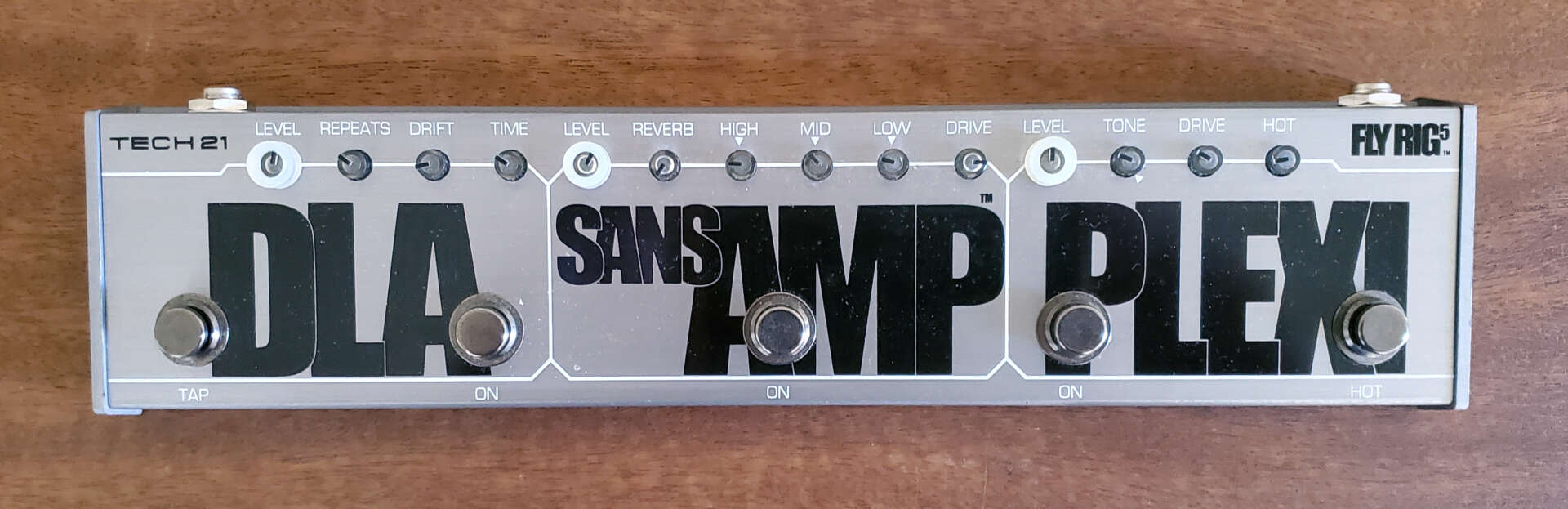
Electric guitar is a little simpler, sort of… My basic sound comes from my amp—currently a Fender Princeton—and I use the tone controls on the amp the set my clean tone. On a Princeton, there are only treble and bass controls. The midrange (middle) is set flat in the preamp. Most of what I do uses an edge of breakup tone and for that I use an external multi-effect (Tech21 FlyRig5), which has three different gain stages—clean/dirty with three band eq, distortion with a global tone control, and a boost. I use the clean/dirty for most things, with it set for that slightly dirty/edge of breakup and a slight midrange boost. This is a classic electric guitar tone that I can manipulate to suit by using the pickup selector, volume controls, and tone control. The distortion channel is voiced to sound like a Marshall Plexi, one of my favorite tones—with a variable brightness control, and I can control that channel from the guitar as well. I rarely use the boost but if I were playing in a loud band, I’d use it for solos. The FlyRig5 also has a delay that is on almost all of the time and is set for an ambient delay to add body and space to my sound. There is a modulation control on this channel that I set to add a little sweetness to everything. The Princeton has the classic Fender spring reverb, which is on all the time, and I sometimes blend the reverb from the FlyRig5 with it to add a different character to the sound. The Princeton also has Tremolo, which I add on occasion. Varying the speed and intensity of the Tremolo can get that old school throb or chatter, and when everything is just right, and with the delay, it does a pretty good Leslie imitation too.
This all comes back to the original question: effect or affect? Are you chasing old school tones or modern modality? As with speech, are you effecting a presentation or affecting an accent?
Both are cool and have their place, but whatever you choose to do with effects—old school or modern—make sure it is intentional and serves the music.
Need to know? Just ask… Charlie (ask.charlie@hotmail.com)
Charlie Loach has played guitar in the San Diego music scene for many years, primarily with the power-house original rock band the Wild Truth and the elegant Americana ensemble Folding Mister Lincoln, performing and recording several CDs with both bands. More recently, he has performed with the vocal trio the Outliers. Charlie is an accomplished session player who is well versed in multiple genres of music from bluegrass to rock to country, and his playing is both smooth and tasteful whether on electric or acoustic guitar.

