





CD Reviews
PETER SPRAGUE: ANTI AI

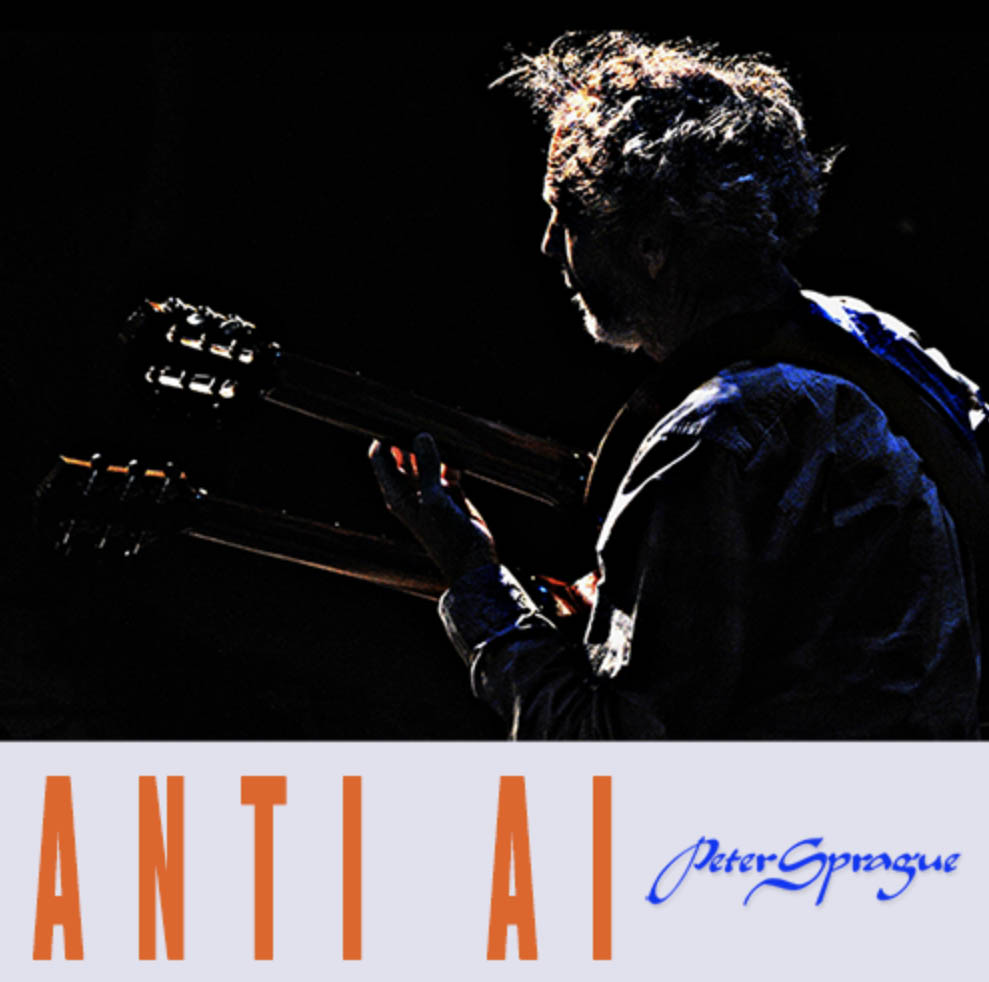
One unquestioned benefit to the transition from music being released on vinyl records distributed by large corporations via retail shops to what we have now—where music is sold via digital downloads—is that the new model has freed up folks—like our own Peter Sprague—to record far more prolifically. Early in his career, Sprague (like most musicians with recording contracts in the late ’70s and early ’80s) put out about an album a year. That was just what was expected by the labels. By the mid-1980s the rate had slowed somewhat to a new album every couple of years.
But now?
Sprague issued four different albums in 2025 alone! Two were covers albums (The Beatles on one, and Dave Grusin and Earl Klugh on the other), one was original classical music, and the other Brazilian.
For his first release of 2026, Sprague is back immersed in straight-ahead bop and post-bop jazz, running through a set of seven new originals, a nice cover of a standard, and a previously unrecorded song by local bassist (and longtime Sprague collaborator) Bob Magnusson.
Sprague is joined throughout by drummer Duncan Moore. Mack Leighton and Justin Grinnell split the bass duties, while Peter’s brother Tripp sits in on reeds on every track but one, and Danny Green holds down the piano on most tracks.
The album starts off strongly with “Convection Oven,” a catchy bit of modern jazz featuring an opening run through of the melody with guitar, sax and piano sharing the lead before Grinnell takes the first solo, backed by Moore with a relaxed approach on drums and Green blocking out punctuation on piano. Tripp Sprague then takes the next solo on tenor sax, Green continuing his Basie-esque, less-is-more approach on accompaniment. On his own solo, however, Green dips more into Art Tatum or Oscar Peterson territory with a rousing workout. Peter Sprague then takes the penultimate solo slot with a measured, thoughtful foray calling to mind his mentor, Pat Metheny. Moore’s drum solo is a reflection of his overriding tasteful approach to everything he touches: not too flashy and utterly in the pocket. The entire band then closes out the song the way it opened: guitar, sax, and piano on lead.
“Valse Warm” is a relaxed bit of small-group jazz, with Peter here sounding closer to Joe Pass than Metheny. This is performed as a quartet (no reeds), with Peter and Green handling the lead duties.
The third track, “Hanalei Town,” is a bit of a thematic (and stylistic) companion to the title track from his 1985 album Na Pali Coast. Also dedicated to a location on the island of Kauaʻi, it likewise features flute as dual lead opposite Sprague’s guitar. Here, though, it is Tripp on flute, while Steve Kujala handled it on the earlier song. As with its predecessor, the song has a light, bouncy tropical feel to it, although there is no hint of Polynesian influences—just a nice bit of sunny fusion.
Magnusson’s “Engulfed in Fog” is arranged in an adagio tempo, with Tripp handling the lead on sax. Minus piano in this quartet setting, it is Peter on guitar who provides most of the framing of Tripp’s lead. It’s a lovely tune and reminds anew that Magnusson provided quite a few of the best songs in Road Work Ahead, the band he and Sprague were in along with pianist Bill Mays and drummer Jim Plank.
The title track is as hectic as “Engulfed in Fog” was relaxed, Tripp and Peter playing the lead together, then off of each other, Green providing a solid chordal underpinning behind them.
The jazz standard “On Green Dolphin Street” is one of the most-covered songs of the jazz canon. This interpretation is loyal to the melody, true to the bop tradition, yet has its own vibe. Again, the Sprague brothers are out front in a quartet setting, Leighton and Moore providing a supple foundation.
Green rejoins the mix on the Peter Sprague original “Palm Springs Soft Shoe,” which has a charming old-fashioned feel to it, the kind of song that would have been featured on a television variety show in the 1960s or ’70s. The lilting theme provides plenty of room for guitar, sax and piano to stretch out on well-informed solos.
It’s another top-shelf outing from Peter Sprague, supported by a stellar cast, with as good a batch of original songs as he’s yet written.

