


Featured Stories
Lou Curtiss: The Lost Interview

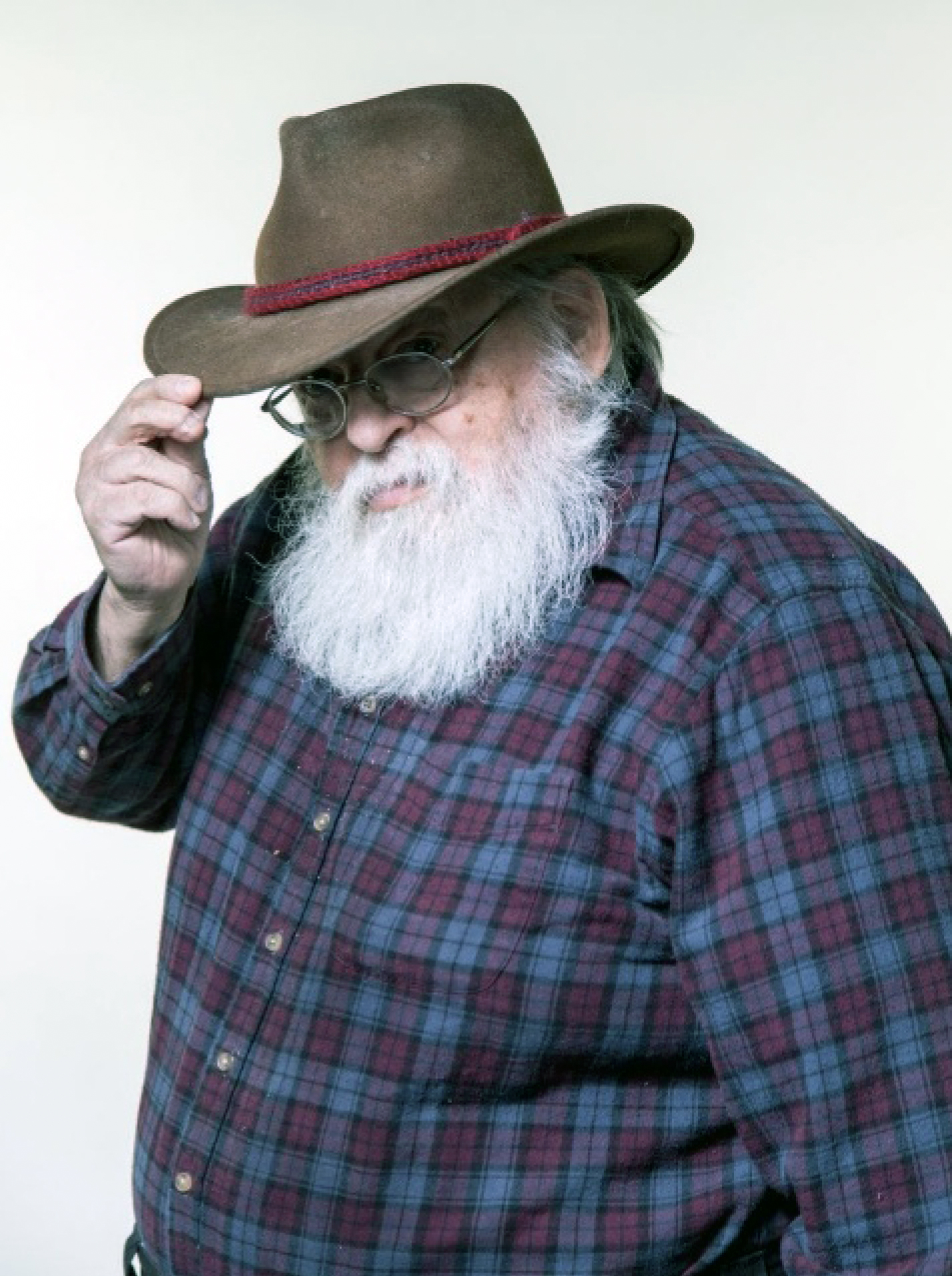
Lou Curtiss, the king of vinyl, 1939-2018. Photo by Ryan Kuratomi.
Lou Curtiss is, of course, no stranger to the San Diego Troubadour as well as all things related to folk and roots music in San Diego since the ’60s. During his lifetime he hosted over 55 Folk Music Festivals in town that included everything from blues and Celtic to zydeco, Tex-Mex, bluegrass, jug band, old-timey, you name it. His Folk Arts Rare Records store was a hub for musicians of all types, performing regularly at his shop (he had three spanning 47 years total).
There was always some kind of event he was planning or about to host during the week or on the weekend. He had a catalog of incredibly rare music that he compiled for the Library of Congress, a lifelong project for him. Not to mention his radio show, Jazz Roots, on KSDS FM88.3, which he hosted Sunday evenings for three decades (1985-2015). But that was only the tip of the iceberg for him. When he wasn’t doing all else, he’d compile a tape for you on just about any subject you can think of. I treasure the two he made for me, one of San Diego country legends from the ’40s and ’50 s, and another of sea shanteys. And when he wasn’t doing that, he’d perform with his wife, Virginia, at various coffee shops and open mics around town.
I can’t recall the first time I stepped into Folk Arts Records and met Lou at the shop’s location on Adams Avenue during the very early ’90s. The shop was loaded from top to bottom with autographed photos, music memorabilia, and posters with very detailed notes if you could read them. It was packed wall to wall with records of just every type, LPs, to 45s, cassettes and 78s. It was all pains-takingly organized, but there were plenty of records in boxes, drawers, small cubbies, and just about anywhere you looked—on the wall or in a stack in a corner. Needless to say, I was in heaven. At first our conversations were just a cordial “hello” and not much else. Then I’d ask a question or two about a certain artist and, depending who it was, or if I asked the right question, I’d reel him in for a great story about him seeing this or that band—which might have appeared at one of the Roots Festivals—or a funny anecdote would ensue. He had many great stories that I savored until I’d come again for another story or tidbit. It took a while for him to warm up to me, I think, another wet-behind-the-ears budding musician and record hound. Though he was on the quiet side sometimes, he was always open to talk to me and chat, whether he was busy or not. Over time, I was invited to play for various Adams Street Fairs and Folk Festivals, either as a solo artist or with my then current bands. There were even occasions when I’d get a band together to back up some traveling troubadours, which for those opportunities I’ll always be thankful to Lou.
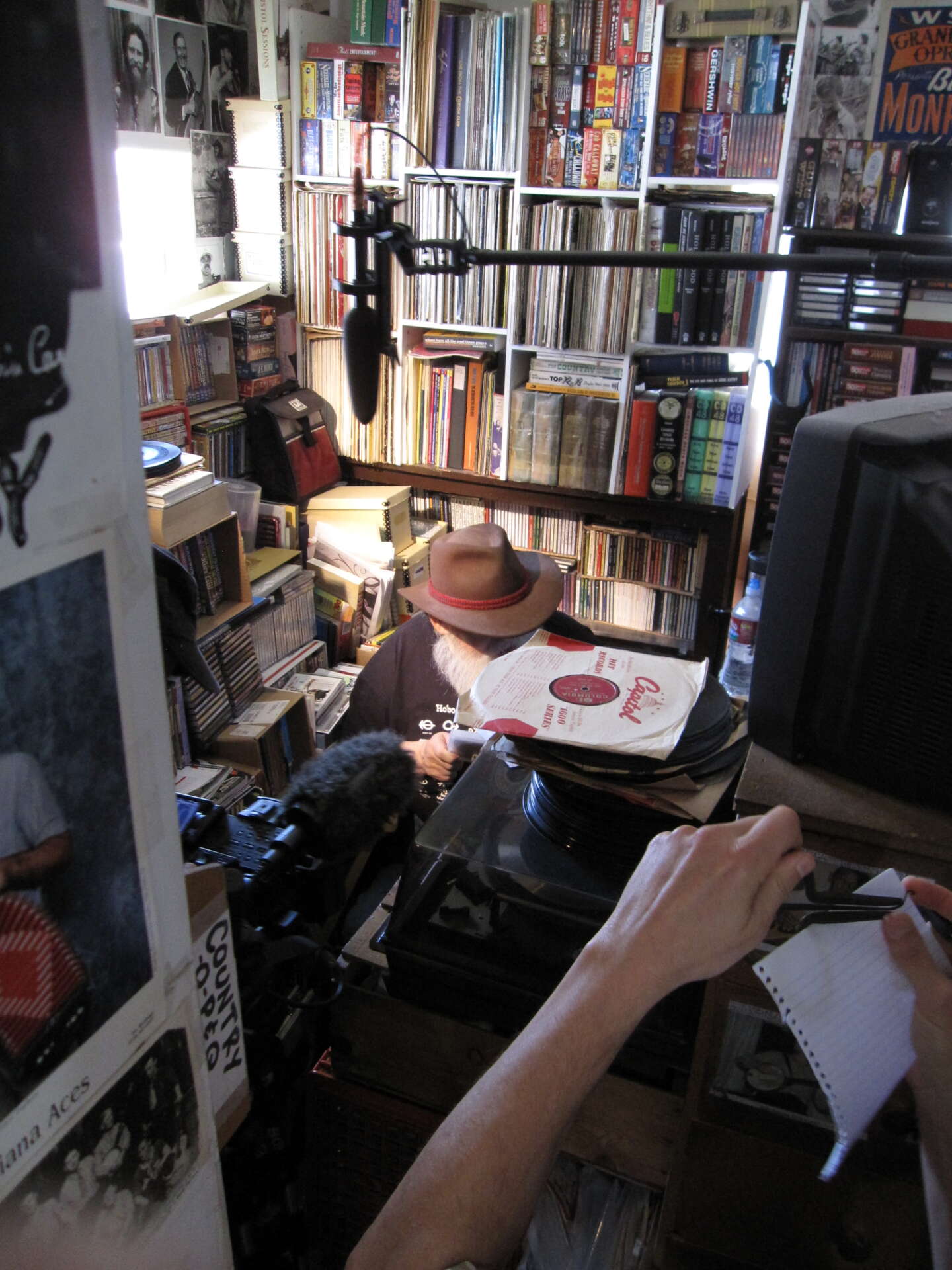
Lou at his shop. Photo by Russ Hamm.
As he was always a fascinating guy to me, I asked him one early afternoon if I could interview him for a brief 30 minutes or so, just out of the blue. I had my trusty hand-held tape recorder at the ready, and I really wanted to talk to him about his life, his music, touching on what made him excited and what he chose to do. He was a good sport about it and answered my questions, and much more, even shifting gears to help a customer or two. I noticed it must have been hard for him to talk about himself. He was certainly proud of doing his part in the music scene as it were, but he always wanted to talk about other artists, bands, and the preservation of keeping the folk music tradition alive. I’m so glad that he opened up about his early life, music, and adventures.
As things happened, the tape I used got damaged, and years went by until I was finally able to get it transcribed, but as they say, better late than never.
Lou passed away in July of 2018, and I feel this is a fitting tribute to a man who humbly gave everything he had, and we are so much more enriched by his tireless efforts. His legacy lives on in all he brought to us and to learn from for many years to come.
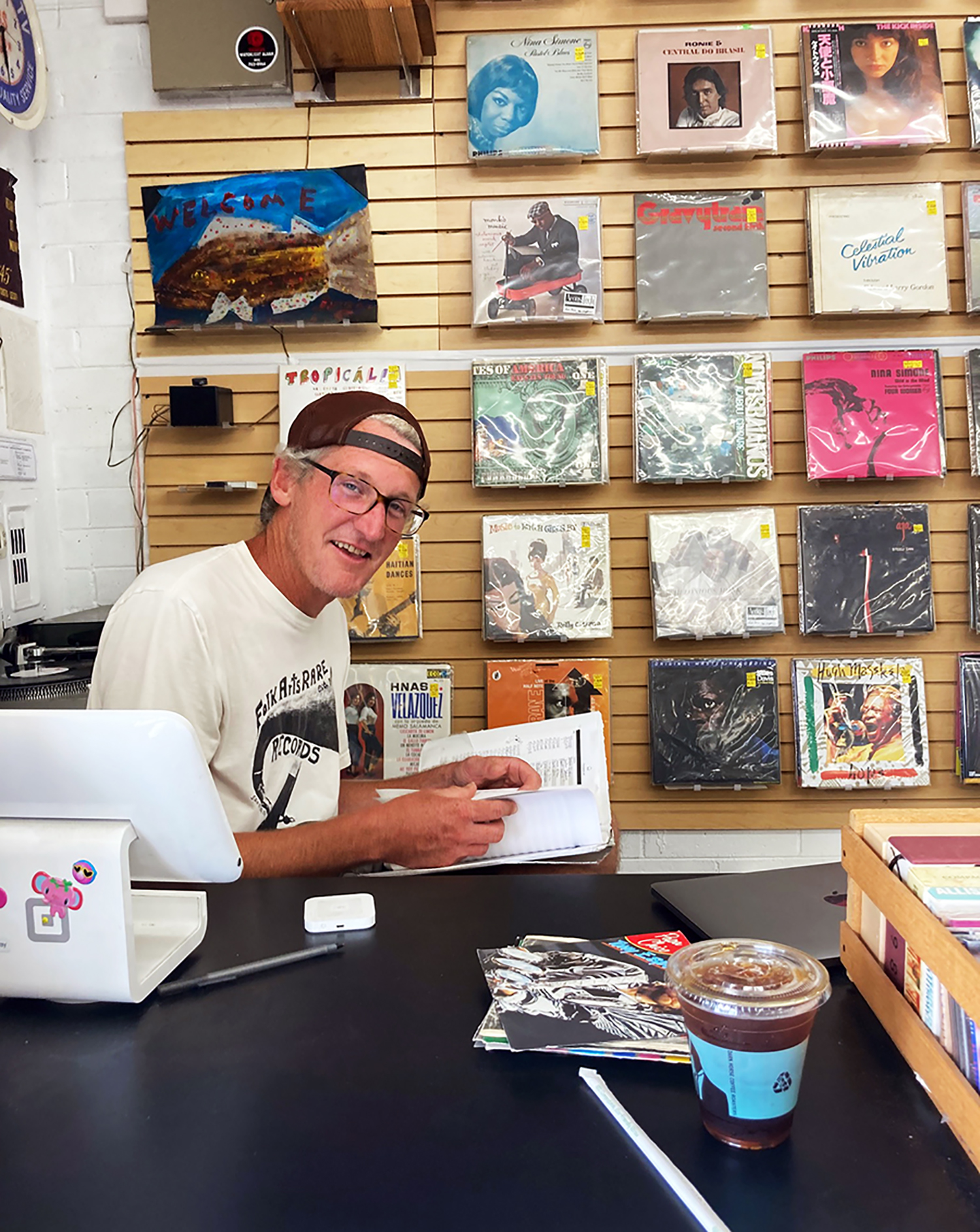
Brendan Boyle
As a footnote, Folk Arts Rare Records continues to be a musical hub, led by new owner Brendan Boyle. For the past 12 years he has continued Lou’s legacy and has kept and cared for it as Lou would have approved. The original posters are up on display, photos of past Folk Festivals, black and white autographed glossies, handbills, and detailed notes of bands and artists come and gone, all lovingly curated as a testament to Lou’s lifelong dedication.—Andy Rasmussen
THE INTERVIEW
Andy Rasmussen: Can you tell me about growing up here in San Diego?
Lou Curtiss: I moved here from Seattle. The first week I was here we went out to see Hank Williams at the Bostonia Ballroom; I was about 12 years old. I remember his band didn’t show and they got stuck east of the Lagunas because of the weather; it was bad that week. He was travelling with Chet Atkins, and he just had Chet Atkins on stage with him. For the second show I think Smokey Rodgers’ band backed him up. I always thought that famous picture with Hank (with his white suit) and Chet Atkins was from that show at the Bostonian. I think it would’ve been the only time they would’ve played together.
AR: What bands around San Diego did you see in the fifties? Did you go into Tijuana?
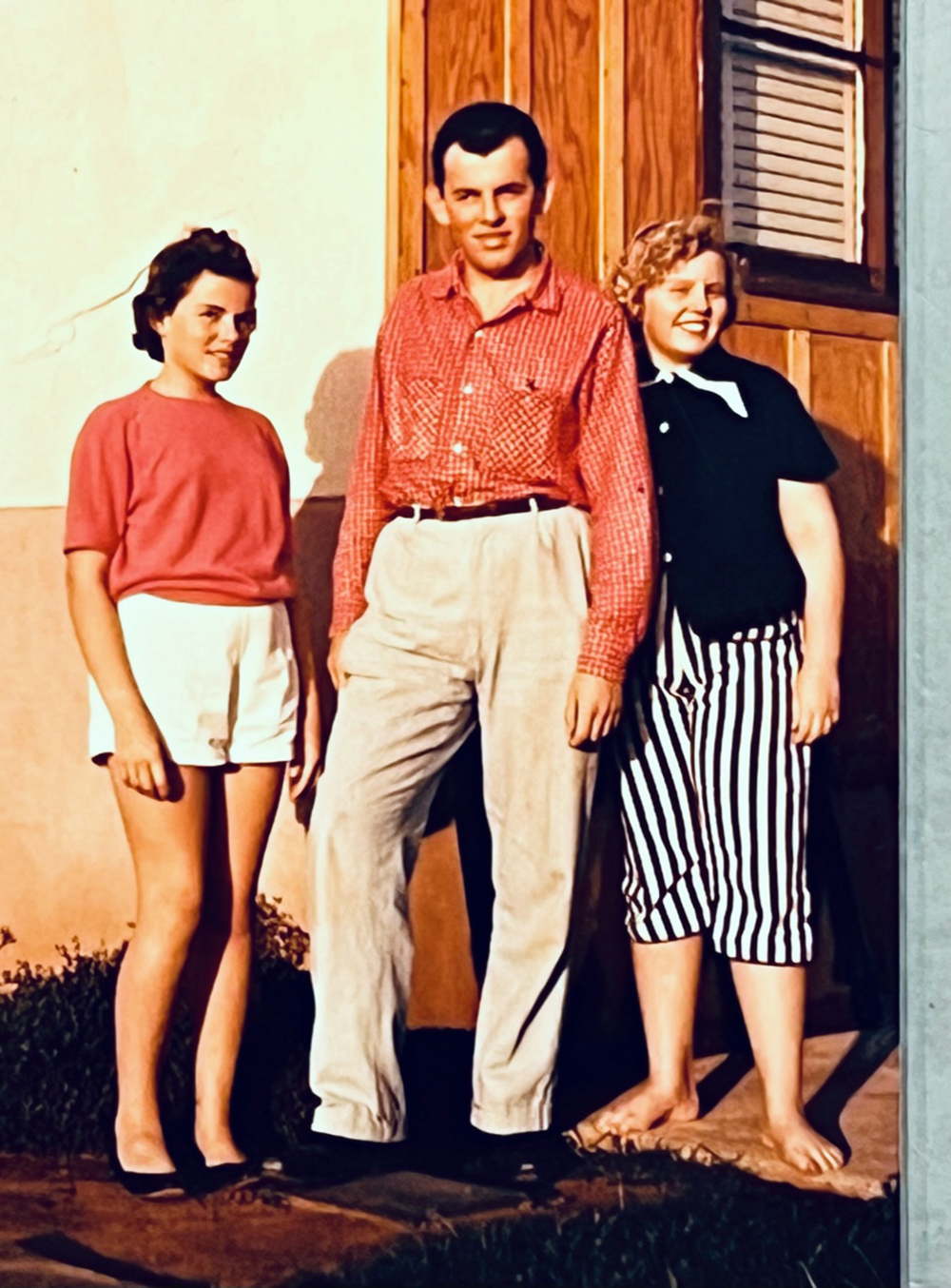
Lou Curtiss and his sisters, early 1950s.
LC: I grew up in Imperial Beach and remember going down to Tijuana when I was 14. There were so many bands I saw that I don’t remember the names of them. There were the Rockin’ Devils—they had a 45—they used to play Mike’s Go-Go bar about ’58-59. They had kind of a rockabilly sound. They did a lot of R&B, like “I Hear you Knockin’.” They did it with a more rockabilly sound. Sometimes they were a three piece, sometimes four; once in a while they had a saxophone player.
The ’50s were a different time then; I went into a hell of a lot of bars before I was 21, 18, or anything. Nobody said anything, nobody checked IDs at the door. I wasn’t gonna drink and get drunk; I was just gonna sit and watch the music. I was a record collector even then. My dad was a record collector, and I inherited that hobby. I remember gomg to see Maddox Brothers and Rose at the 21 Club in National City. I’d seen them before and we used to go to Town Hall Party every weekend, which was the Big Country Barn Dance.
AR: When did that run?
LC: That started in 1952 and ran until 1961. Everybody was a member of that. The band was led by Joe Maphis, and Merle Travis was a part of it. There was Tex Ritter and Skeets McDonald. I saw a lot of rockabilly guys there, too. There was a whole young contingent there, who took lessons from Joe Maphis. Eddie Cochran, the Collins Kids, Dorsey and Johnny Burnette, and Ritchie Valens were all there. Eddie Cochran was there when he was 13 or 14. There were even younger kids around there, around 11 or 12. James Burton and Roy Buchanan were students of Joe Maphis. No one’s really written up on the Town Hall. It was the only barn dance in the country that gave space to the rockabillies. The Opry didn’t even allow drums on stage; the Louisiana Hayride was almost just as bad; they didn’t even know how to cope with Elvis Presley. Carl Perkins never got on a Barn Dance show.
AR: Did you ever get a chance to see Carl Perkins play?
LC: Several times, yeah. He used to come out at Town Hall, and so did Wanda Jackson. I saw Johnny Cash several times. I saw him at the Bostonia.
AR: Where was the Bostonia?
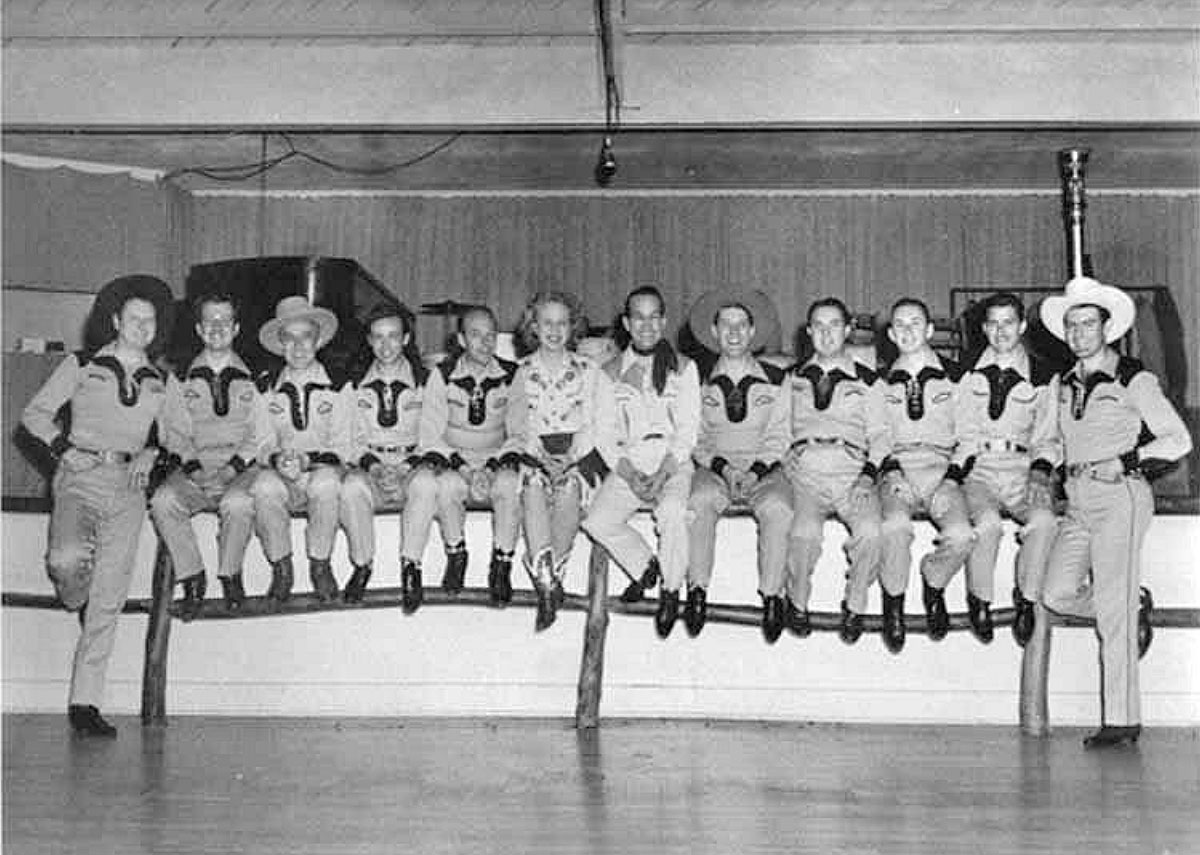
Tex Williams Band at the Bostonia, 1950s.
LC: Now, it would be in the middle of El Cajon; you’d actually go into the country then (between El Cajon and Lakeside).
AR: What bands did you see at the Bostonia?
LC: I saw Johnny and Jack there, Ernest Tubb, Johnny Cash, I saw Eddie Cochran there once. It was a good show. He used to play regularly in San Diego at the College Inn, which was on First and C, right in the middle of the concourse. I remember his band consisted of Jody Reynolds, Dorsey Burnette, and Johnny Burnette. I used to see Jody Reynolds there a lot. Jody was the house band leader there [he did the song “Endless Sleep”]. I had him at the Adams Avenue Street Fair recently.
AR: When you were going to the Town Hall Party shows, were you ever compelled to audition?
LC: During the Town Hall Party days things were a lot looser; you could just walk backstage. I was more interested in seeing the comedians. They had Texas Tiny, who was this great big heavy-set guy, and he wore this big wide tie. They had Quincy Snodgrass—they were their two primary comedians—and occasionally Hank Penny. Hank Penny and Quincy Snodgrass were great players, although they never played on stage. Quincy ran the jam sessions backstage, where there was always a jam session.
AR: Ever play in any of them?
LC: I didn’t play in any of them, but I would stand in and watch them. You get kind of intimidated when you got Joe Maphis there. But Quincy was good enough to keep up with him and so was Skeets McDonald.
AR: How was radio in San Diego back in the ’50s and ’60s?
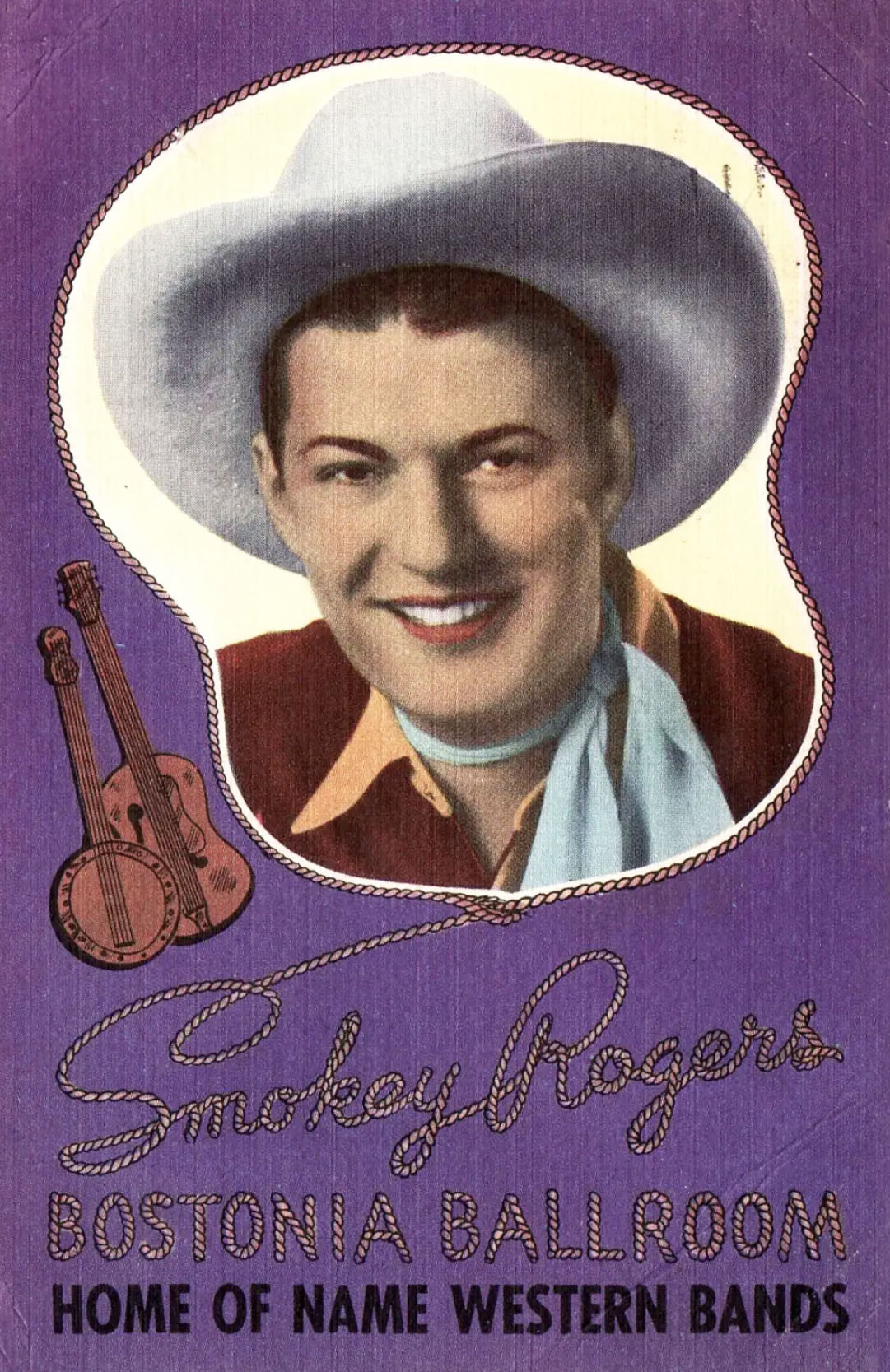
Smokey Rogers
LC: It was pretty terrible. The fortunate thing was you had a lot of students from L.A. come down. Radio out of Rosarito Beach [Mexico] was great. You had for a long time XGRB [later where Wolfman Jack had his show], but it was mainly Smokey Rodgers and Okie Bob on XERB; the Maddox Brothers and Rose broadcasted out of Rosarito, too. Wolfman was the first out here on XELO and that was a guy from Texas, and then they put his shows on transcription, then XELO burned down sometime in the late ’50 s. But they were the ones in the ’30 s that Woodie Guthrie broadcast out of. A lot of cowboy guys broadcasted out of there.
Cowboy Slim Rhinehart, Don and Earle and the Gospel Boys, the Delmore Brothers, and Wayne Raney, all those guys. The Delmore Brothers and Wayne Rainey were down at XERB, too. When I went down there a few years ago I found some transcriptions of theirs. You could pick up their signal on a good day in Seattle.
AR: What recording studios where there in San Diego at the time?
LC: There was a place called Adams recording Studios. Boy, they were recording people there in the ’30 s, on test pressings and stuff. Barnum Brothers had their studio, Smokey Rodgers had his studio [Western Caravan in El Cajon], and there was Fanfare Studios in El Cajon; they’ve been around forever. When I was in my high school band we went over to Chula Vista on Third Avenue, where there was a studio.
AR: I know there had been some jazz and country recordings that were going on in San Diego, but why do you suppose there hadn’t been more acts to record locally in the ’50s and ’60s?
LC: This guy named Kennedy owned about half the clubs downtown, catering to the Navy. What he’d do is have different kinds of music in every club. He had an R&B club, he had a rock ‘n’ roll club, he had a country club, and a jazz club. He had something for everybody. Because the Navy was comin’ from every part of the country, this was a big Navy town in those days. One of the reasons that artists from San Diego didn’t go to bigger and better things is that he would tie them to exclusive contracts. Merrill Moore got tied to an exclusive contract; he could have been someone as important as Jerry Lee Lewis. He certainly was about as good a player or better.
AR: So, when did you first get into performing music?
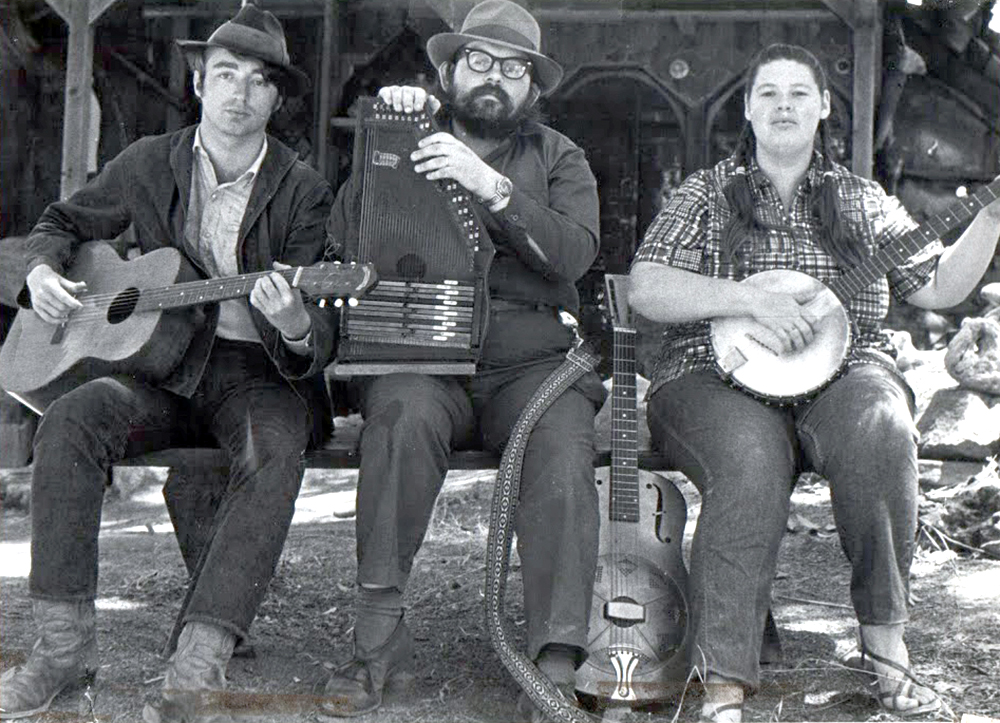
The Lower Washington St. Woolthumpers, 1971—Joe Gwaltney, Lou & Virginia Curtiss. Photo by Sue Levine.
LC: I had a guitar when I was 10 years old, but I’ve never been a good guitarist. I started playing drums in junior high and started working in bands in high school. Right before I opened my record shop, I sold my last set of drums. I got into my folk period in the early ’60 s. I was still playing drums at the time, wherever the money was. Somebody would call and say, “We got a gig or party, would you fill in?”
AR: What bands did you start out playing with?
LC: The first band I was in was called the 6 Sharps in high school; eventually that band became the San Diego Nomads.
AR: Did they do any recording?
LC: Yeah, they did a few, none of which I’m on. I’m on a couple of singles they did for somebody that they recorded anonymously—it was a lady soul singer, but I can’t remember who it was now [I played drums].
AR: What kind of group was the 6 Sharps?
LC: Well, we started off like most high school bands playing hits of the day, I played drums. I was in high school from 56-58, so we did a little Elvis, a little Fats Domino, played a few proms. We had these gigs over at Swiss Park down in Chula Vista. There used to be this thing there every Sunday; we were the house band there for about a year and a half
AR: What high school did you go to?
LC: I went to Mar Vista High
AR: What did you do after high school?
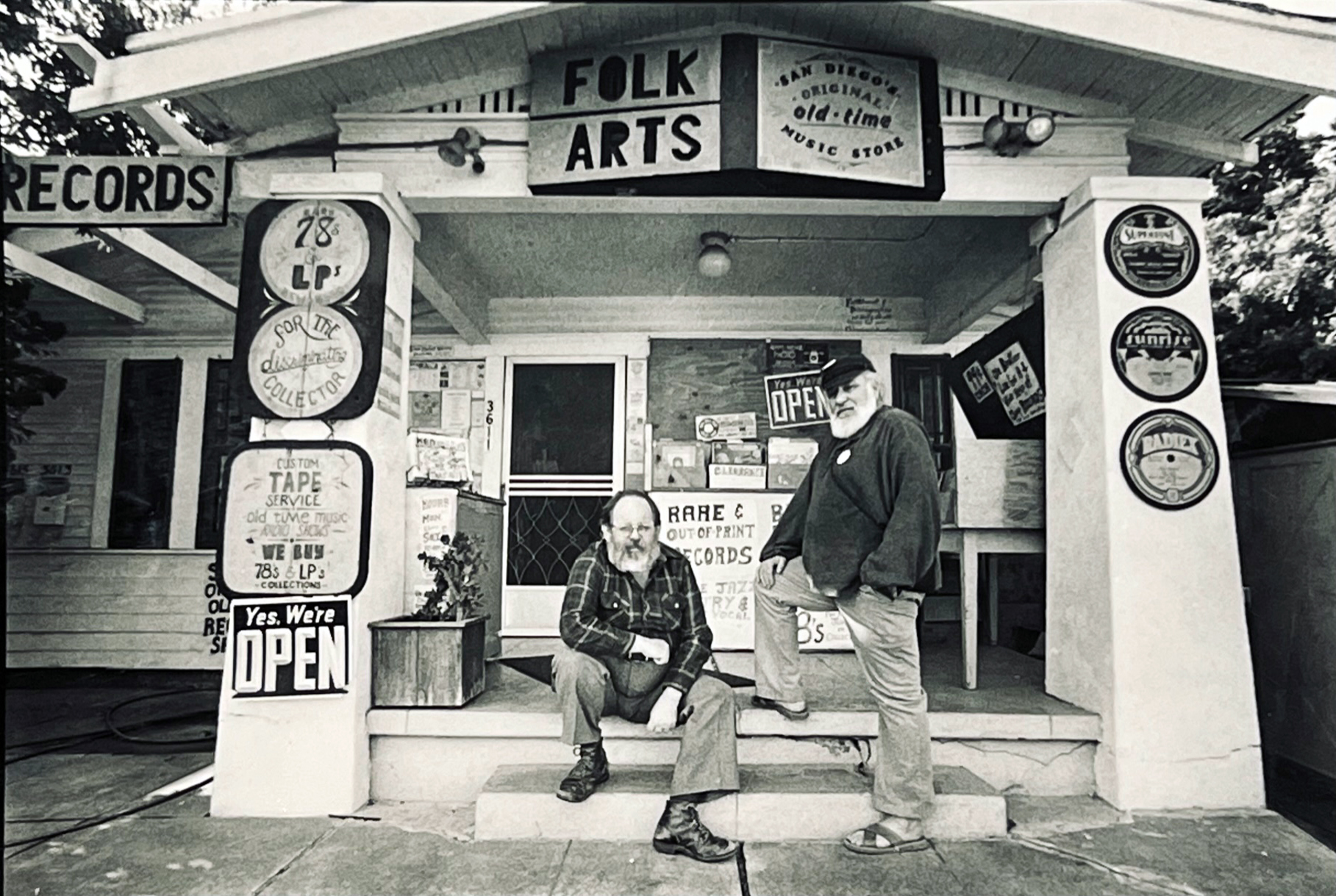
Lou and U. Utah Phillips on the steps of his shop on Adams Avenue, 1970s
LC: By that time in ’59 I was also playing in folk bands, and this was about the time the “Great Folk Scare” hit and I went to New York. If you could play two chords on a guitar, you were recruited for one of those bands. I was in a group called the John B. Trio. We played a few coffee houses in San Diego. There was a place we played up on El Cajon Blvd. called the Upper Cellar (70th and El Cajon), and another by San Diego state called Circe’s Cup. There was also a place in La Jolla called the Ballad Man on Carl St. and another called the Zen Coffee House and Motorcycle Repair Shop where we played our thing there and did our Kingston Trio impressions.
AR: Didn’t the Kingston Trio come out of San Diego?
LC: Yeah, though I wasn’t aware of that at the time. I did meet some people who kinda went on to fame; I did meet Chris Hillman—he was just a kid and younger than I was.
AR: Tell me about your trip to New York.
LC: We went to New York, where we were gonna be stars in the folk world and wound up doing dishes at the Gaslight Café. That’s memorable because Bob Dylan went in there to audition and was turned down. I remember a lot of people who were out there in New York at the time, Ed McCurdy was around a lot. I was only there for almost a year from early ’59 to early 1960. I came back to my apartment one night and some thieves had broken in and had taken everything I had, so I called my dad and told him that I needed to come back home. When I came back, the guys I had been playing music with had gone on, although I did sit-in jobs with the Nomads, who were always kind of a floating band. I was going to State College then and lived in those apartments on University Ave. near campus. Right across the street was a place called the Red Coat Inn, which was where the Cascades played. I got to know Eddie Snyder pretty well, and I’d come over and sit in whenever their drummer didn’t make it. I liked it because their drums were always in the club and I didn’t have to lug equipment. I could just walk across the street, and it was easy money for the night. I was one of their on-call drummers for about two years.
AR: Around the time you started playing with them, was this before their hit “Rhythm of the Rain”? What happened when that song became big?
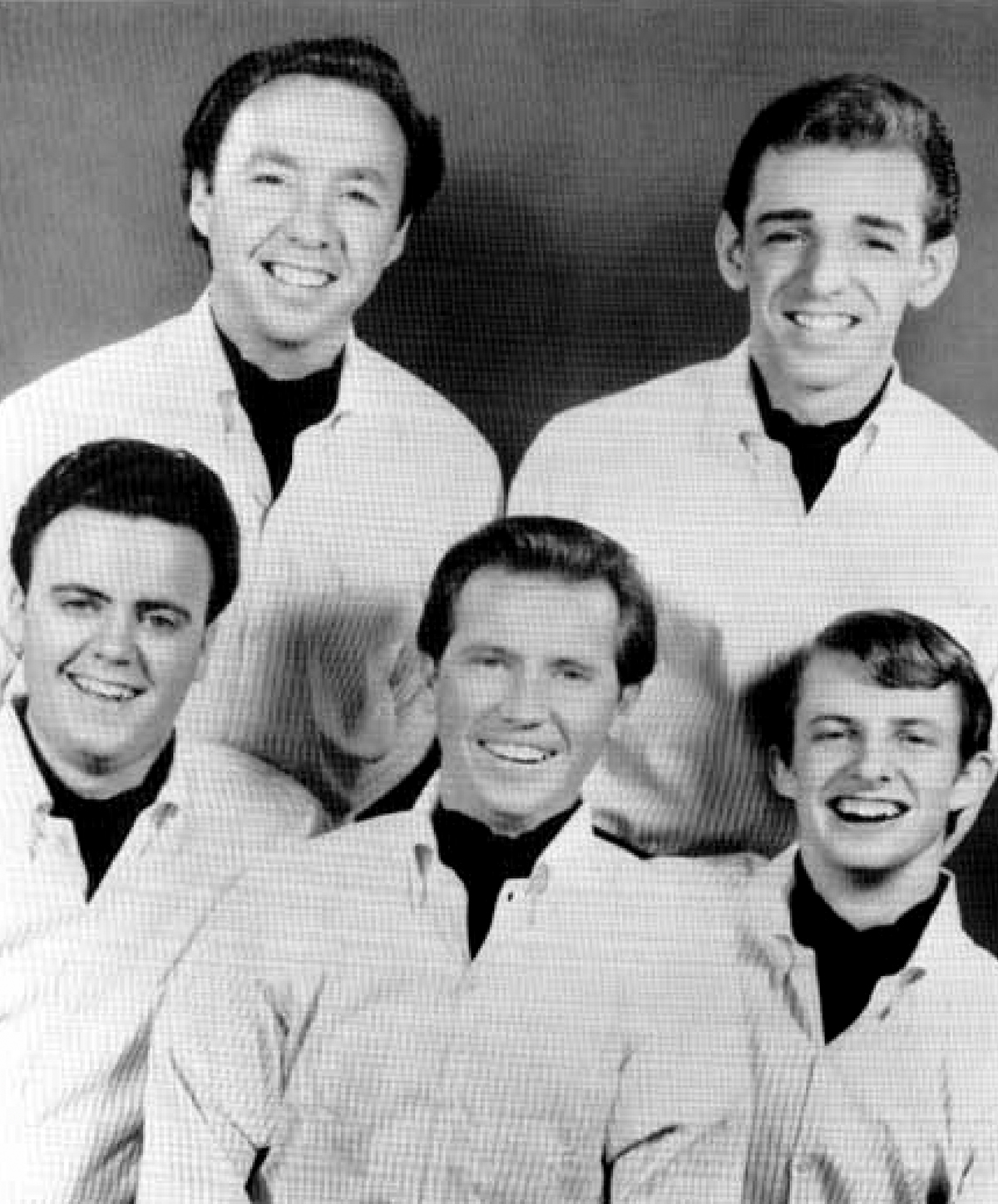
The Cascades
LC: That was one of my claims to fame; I got to go out and tour when the song came out. It was a Murray the K package tour, and it was the Cascades, the Kingsmen, Mary Wells, and Gary U.S. Bonds. We played the Apollo Theater in New York and got things thrown at us.
AR: How was the Apollo show?
LC: It was great for me because I was a record collector and I knew the background. I told them how important the Apollo was, and I got to be the resident expert in the band for a few hours. But those people didn’t come out to see no white boys from San Diego; they came to see Mary Wells and Gary U.S. Bonds. Mary was a hell of a nice lady, and I kept in touch with her over the years. She’s the one person I kept in touch with from the tour. I went to see her the last time she played here in San Diego, which was on El Cajon Blvd, where the Cinnamon Cinder used to be.
AR: How were the Kingsmen?
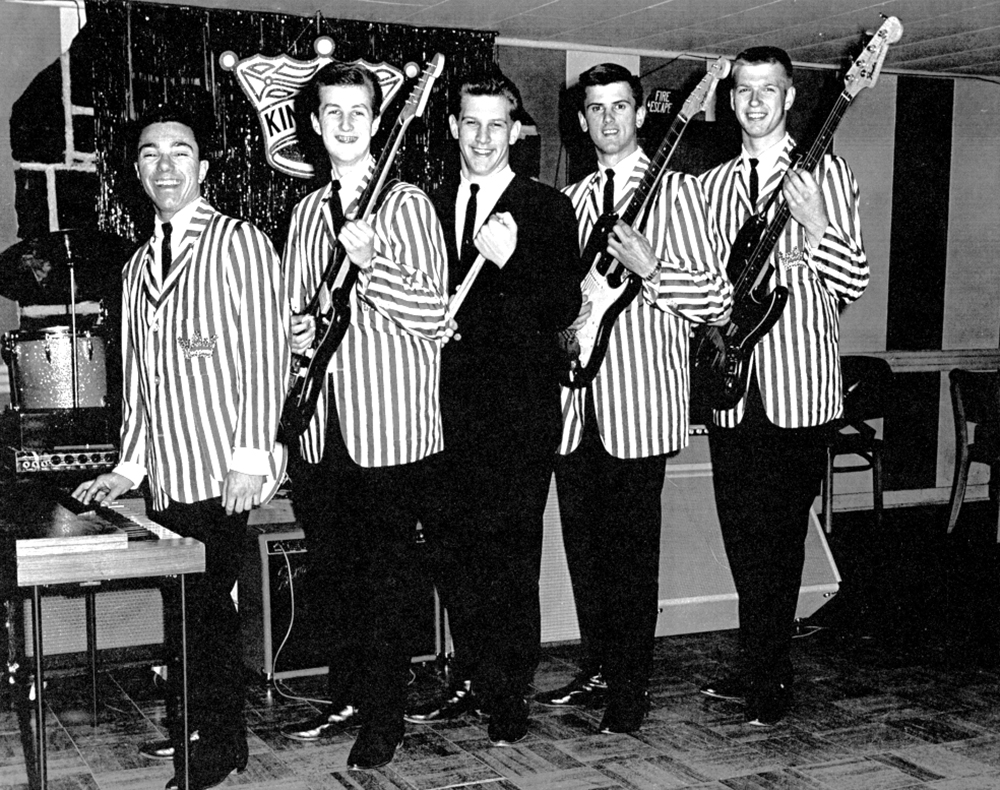
The Kingsmen, 1963.
LC: They had those terrible yellow suits, which is all I remembered about them. I knew “Louie Louie” already from Richard Berry. I had kind of a deal with my folks when I was younger. I’d go to Town Hall with them on Saturday evenings, and they’d let me go down to the El Monte Legion Hall on Fridays—that’s when the big rock shows would happen. So, I got to see Johnny Otis, Richard Berry, Donald Woods, Trudy Williams and the Sixteens, the Penquins, the Medallions, a lot of the doo-wop groups. In fact, we never heard of the term “Doo-Wop.” To me it was all rock ‘n’ roll. White guys played rock ‘n’ roll, Black guys played rock ‘n’ roll. There were also a lot of Chicano bands around the time, from the late ’50s into the ’60s out of East L.A., like Ritchie Valens, Thee Midniters, Little Julian Herrera…
AR: What did you do after the Cascades?
LC: I started concentrating more on folk music. I was going to State College and had a group called the Red Mountain Ramblers. I sold my drums in ’66 and never looked back. I learned to play wrong and, as a result, got arthritis in both my shoulders. I played in some country western bands and tried a little Jazz. I played with Joe Morello a few times and with Johnny Best, the Dixieland guy, a couple times; he used to be the trumpeter with Glenn Miller [those were just party gigs]. I played in country bands out at the Lakeside Inn and played a summer up in Weed, California. A guy up there called us and said, “I don’t want you boys to get involved in the fight.” It’s the only time I ever had to play behind a chain-link fence. They had the band fenced off because if they didn’t, we’d have gotten killed. Half the bar were bikers, and the other half were people from the Tule River Indian Reservation and they all hated each other. They’d come in every Friday and Saturday night and basically tried to kill each other. I lasted about half the summer there; I just said “To hell with this. I’m going home, this isn’t worth it.”
AR: What got you back into playing folk music again, coming around full circle?
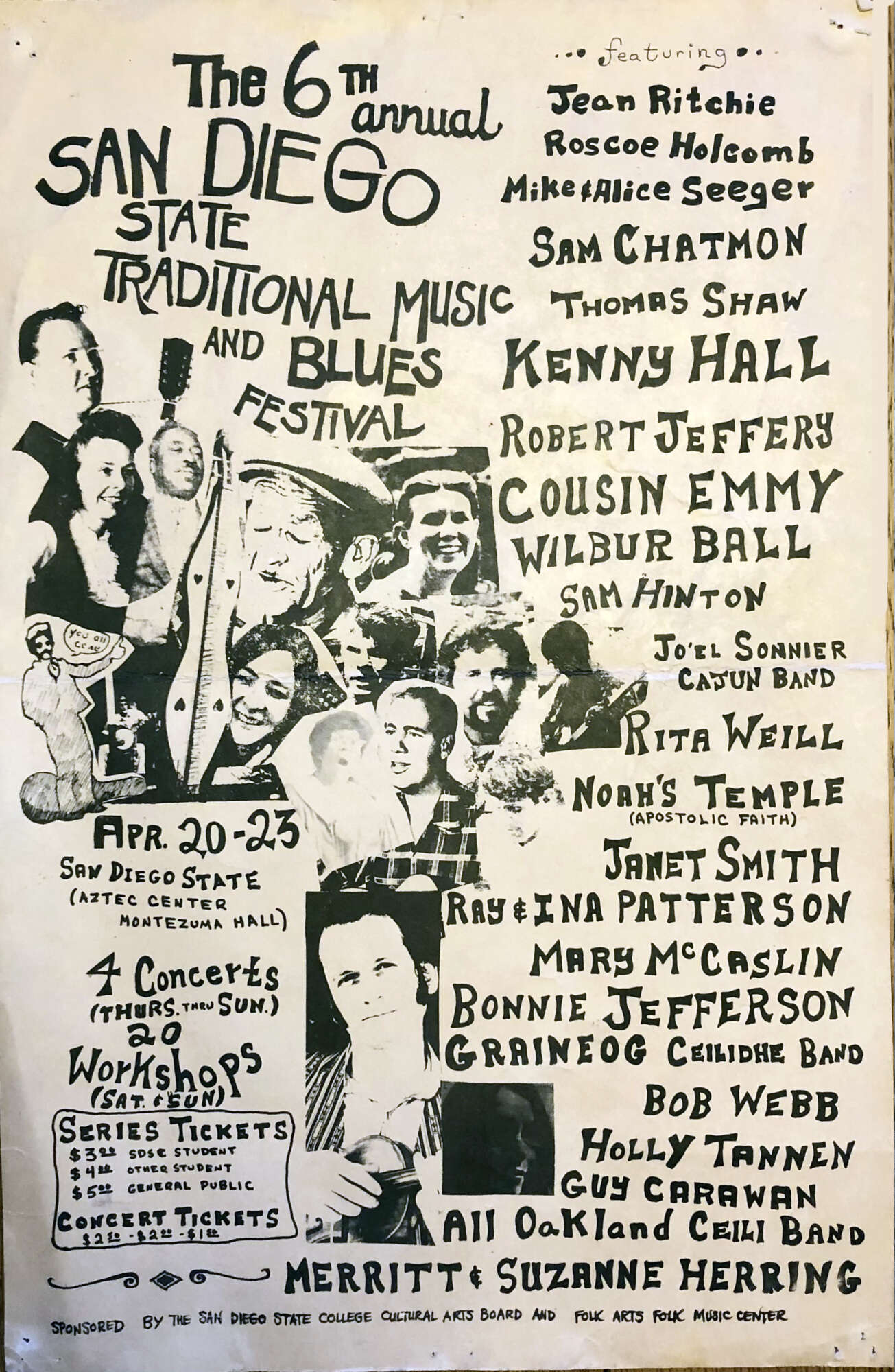
The 6th Annual Folk Festival in San Diego.
LC: I was playing that stuff all along and I was always a country and old-time music collector, and I’d play harmonica, too. I remember I was one of the only people who played harmonica at the time in San Diego, and that’s hard to believe. I don’t ever really remember people playing harmonica until Bob Dylan hit in the folk circles. In the blues circles, there were guys like Sonny Terry and, of course, all the Chicago guys, but that stuff didn’t break out into San Diego until the mid ’60s some time. I saw Sonny Terry and Brownie McGee at the Newport Festival in 1959, and I couldn’t figure out how the hell he was doing that on harmonica, because I’d been playing harmonica before, which I learned from my dad. I listened to Wayne Raney on the radio, I could never figure out what he was doing [laughs]. Sending away for the Wayne Raney harmonica didn’t help either because they were the cheapest damn things, you’d blow them about twice and you’d blow out a reed
AR: When did you start playing on your own?
LC: When I came back from New York, I went to San Diego State in 1961, I got together with Curt Bouterse, and we started a Folk Song Society. We started to have jam sessions about once a week. Curt was oriented toward Appalachian music, as he was from Tennessee, and I had been into country but enjoyed Appalachian, too. We ran into a bunch of people like Clarke Powell, who’s still active in the Roots Festivals and so is Curt by the way.
AR: Did you work on original songs when you started out on your own?
LC: Occasionally. There were a lot of old-time songs that had so many mandolin breaks or fiddle breaks they weren’t long enough for me; I wanted a longer song to sing. So, I did a lot of writing verses to various songs and just connected them to the framework of the song.
AR: What do you feel the importance of cover songs are? Are you trying to educate people about the songs? What do you want people to get from them?
LC: That’s part of it. Probably the reason I do songs is because I like them, and people react to them when I sing them. If I sing a funny song and people laugh, that’s it, or if I sing a sad song and somebody tears up, that’s even more of a trip, ya know. The most important thing I do is put people in touch with their roots, not only their roots, but other people’s roots.
AR: I know you perform with your wife, Virginia. When did you meet her and how did you start playing music together?
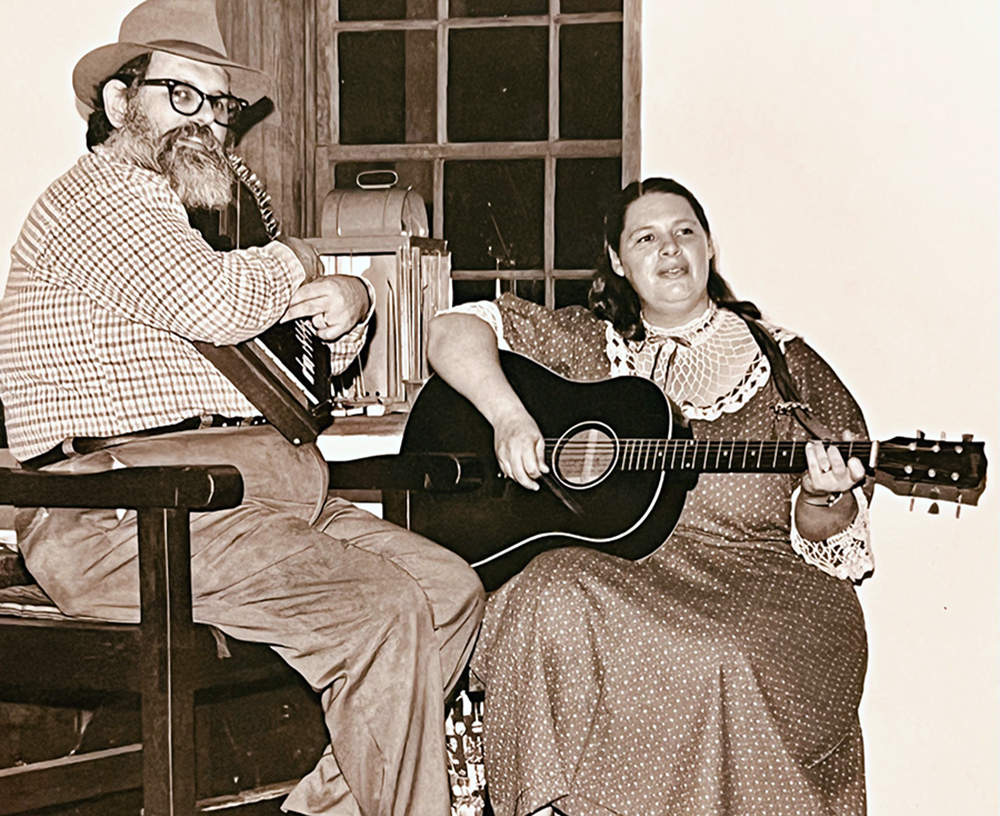
Lou & Virginia Curtiss, late 1960s.
LC: I met her at San Diego State in the Folk Song Society. We had a table set up and were registering people, and she came over and talked to me at the table. I was having open auditions for a new band that we were starting, and she became a part of that. It was called the Old Reliable Egg Preserver Jug and String Band (and Janitorial Service), and we eventually went through other bands together, too. I did the first Roots Festival in ’67, and in 1968 we got married. By then we were a duet playing music, she played guitar better than I do, and she plays the banjo too.
AR: Have you written songs together? Ever do any recording together with her?
LC: I don’t think we’ve ever done anything together. She’s written a couple songs and I’ve written a few over the years. I find I don’t really have too many songs, because there are so many other songs to do. We’ve always wanted to record together but haven’t gotten around to it.
AR: Tell me how you started up your store, Folk Arts Rare Records?
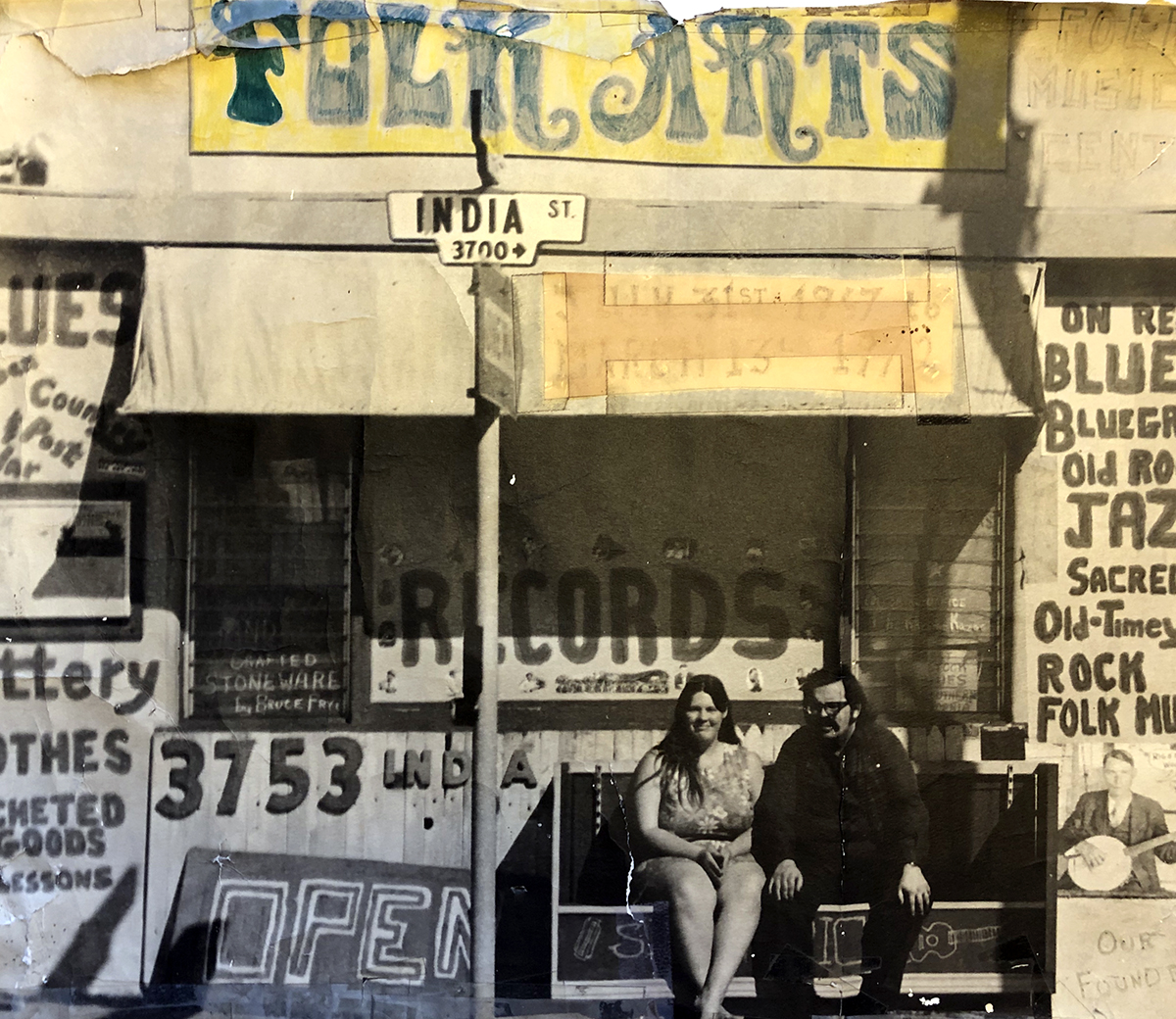
Folk Arts Rare Records at the India Street locatiion.
LC: Three friends of mine got together; we were all having trouble finding the kinds of records we liked, so we decided to start our own record shop. We’d order records from distributors, and they all lasted about six months but I’m still here… I bought them out. The original location for the first five years was down at 3753 India Street, on the corner of Washington and India (where Gelato Vera is now), then I moved up to 3743 Fifth Avenue in Hillcrest, where I was for five years. We used to have concerts at the other shops. There was even a record that was recorded live from our Fifth Avenue store called The San Diego Blues Jam. Lots of people used to hang out there; I remember Tom Waits used to come by all the time.
AR: I know you’ve mentioned going out and seeing the Newport Folk Festivals. Did you happen to see the one where Dylan went electric?
LC: Yeah, I was there. Actually, what he did was brought the Butterfield Blues Band up there with him to back him up, and I remember kinda liking it; I don’t remember anyone booing him, though. The funny thing is, he just did a Victoria’s Secret commercial, and the music press has been making a big deal out of it. I remember the early days at a press conference where some reporter asked him, “You think you’ll ever sell out and make a singing commercial for anybody?” and he said, ”Well, maybe for Ladies underwear.”
AR: Going electric wasn’t such a big deal for you?
LC: No, what was a big deal was when he, a few weeks later went out to a place called the Pine Woods Folk Music Camp, and it was this old-school Communist Party, Radical Folkie group. So, he plays out there but all they wanted to hear was his old protest songs, even if they were electric. I think they were looking for music with more intellectual and social content.
AR: Well, Lou, I’d like to thank you for your time and patience with all my questions. Before we end off here, I know a lot has already been written about it, but would you mind giving me a little background on how the Roots Festival started?
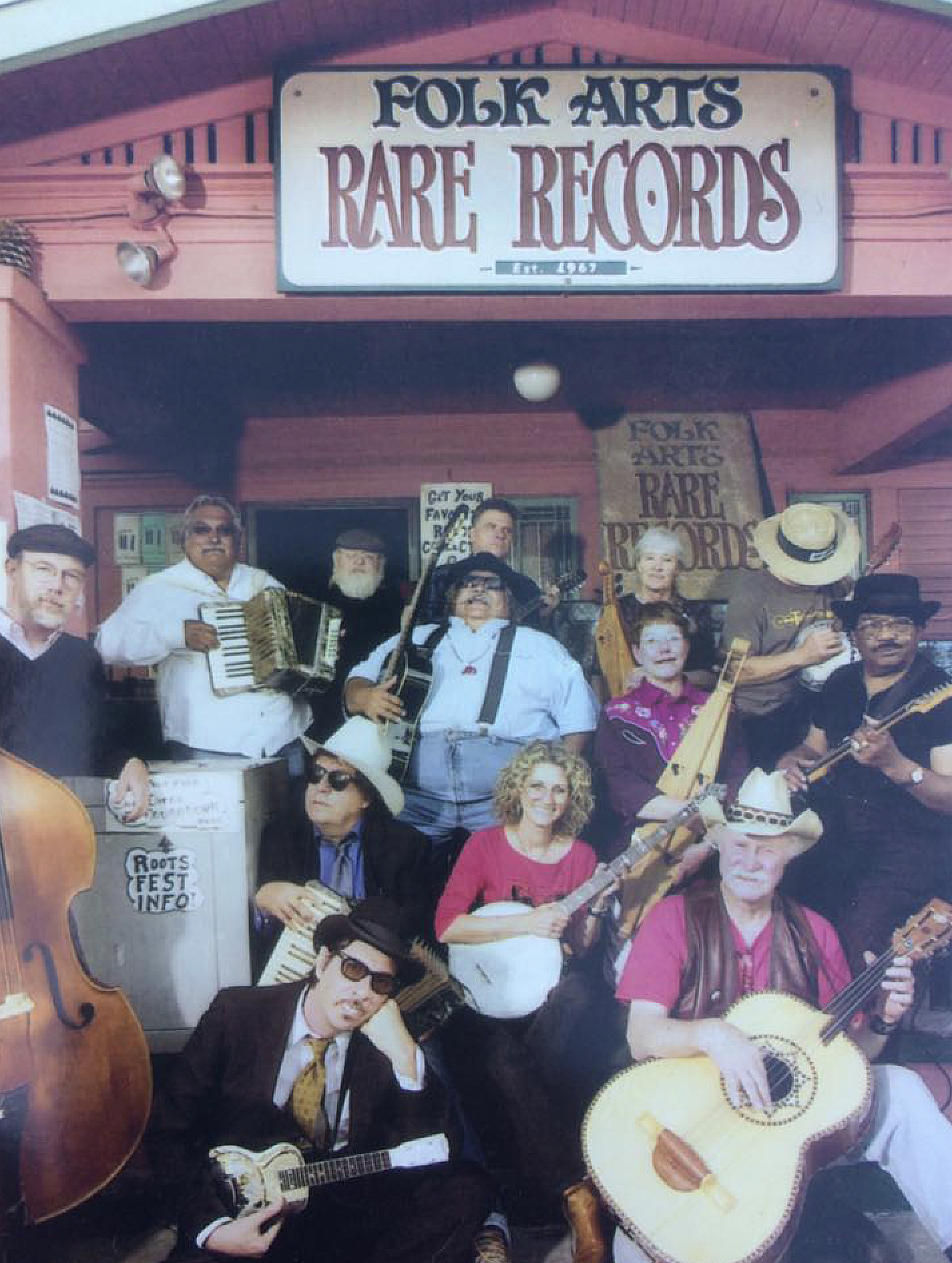
Roots Festival players at Lou’s shop, 2004.
LC: I had been to some folk festivals in the early ’60 s, and then in ’63-’64, UCLA did a couple folk festivals where they brought everybody. That 1963 Festival had Bill Monroe and the Blue Grass Boys; it had Lightning Hopkins. It had Matt Lipscomb, Clarence Ashley and Doc Watson, Cowboy singer Glenn Orlin, Pete Seeger, and many Appalachian singers. It just knocked me out. That festival oriented me toward blues and the different types of ethnic music there were, and I felt that we needed to get a festival going here in San Diego. Another group beat me to it by a couple of years. They had a festival in Point Loma [which is now Point Loma Nazarene University]. In 1967, with the help of friends, I got the first one going at San Diego State, where I did it for 20 years. I took five years off, then was asked to do them here on Adams Avenue, and we’ve done 11 more (at the time of writing), and we’ve had a fair amount of music here with a good amount of musicians. I remember one year having Lydia Mendoza for the first time, and we got a good Latin audience, and older people, too. One of the greatest advantages of having it on Adams Avenue is making it free. We get people to come down to our Festival on Adams that don’t normally go out to see music events. If we put on some Cajun band from Louisiana or an Irish group, or a French Canadian group or something like that, ya know, and someone sees a kind of music they haven’t seen before, they’ll like it, and the band will make more fans, and that keeps that tradition much more alive.
AR: That’s exactly what I like to see about the festival, too, is that there’s a whole generation of people who come to see the music—you have the babies, the parents, the grandparents and teens.
LC: My parents were big on taking me to music events like parades, picnics—anywhere they thought music was going to be played—and it made me enjoy that kind of thing. I’m trying to give back what I had as a kid.
AR: Thanks, Lou!

