







CD Reviews
GABRIELLE CAVASSA: Diavola

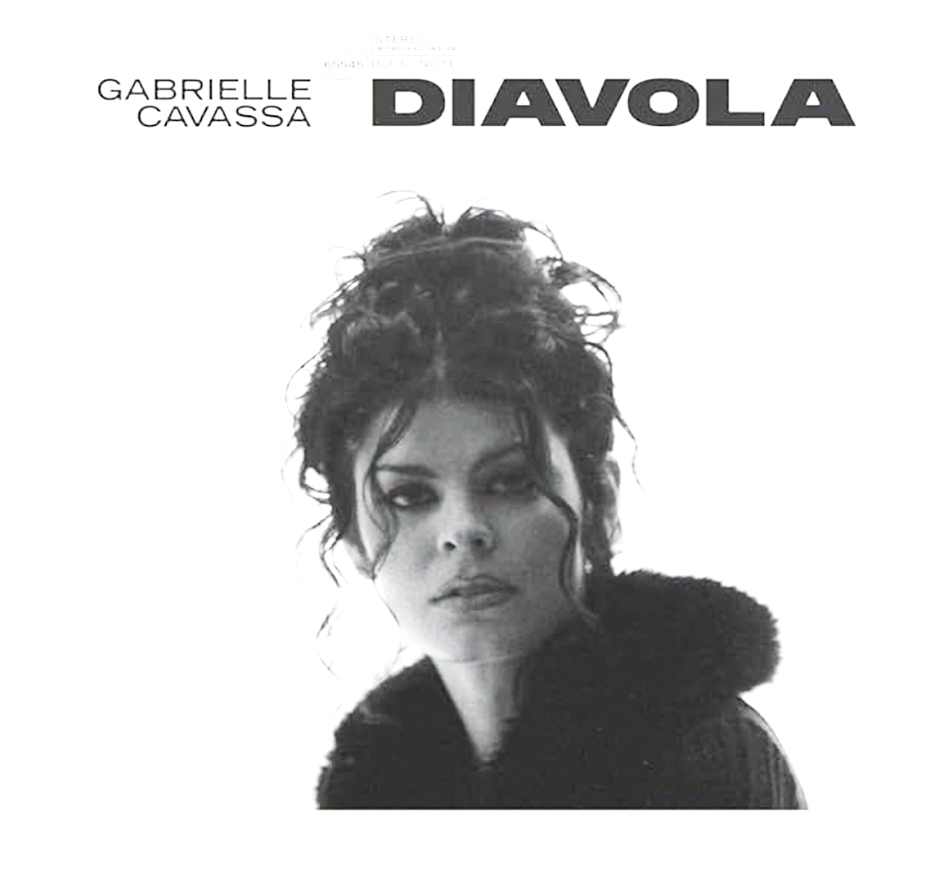
The Blue Note debut from Escondido native and Joshua Redman protegé Gabrielle Cavassa is definitely good, but could it be magic?
On the verge of her 32nd birthday (July 5), vocalist Gabrielle Cavassa has officially arrived. Ooh, ooh, ooh—that’s what signing with Blue Note Records can do for you. But Diavola, her major label debut produced by Blue Note head honcho Don Was and Joshua Redman (in my opinion, the greatest living saxophonist under 60) and released in early May, didn’t come out of nowhere; it’s the culmination of a whirlwind last couple years for a musician the San Diego area has every right to claim as its own.
Born and raised in Escondido—a 2012 graduate of San Pasqual High School, where her father was a teacher—Cassava put the jazz world on notice in the spring of 2021 when she beat out some of contemporary jazz’s most exciting vocalists—names you oughta know like Benny Benack III and—to win the Sarah Vaughan International Jazz Vocal Competition, easily the most prestigious prize for emerging jazz vocal talent.
Fast forward a few months. Cassava is playing a wedding in New Orleans (where she’s lived since 2017). One of the guests is Joshua Redman’s longtime manager, who’s so blown away by what she’s hearing that she texts Redman immediately. I’ve got a vocalist you need to hear.
If you’re familiar with Redman’s prolific recorded output over the past 30-plus years, you might be straining to think of a time where Redman featured a vocalist. That’s because, after nearly two-dozen releases over 30 years, he hadn’t. Not once. Until tapping Cavassa for a major role on an album of genuine consequence for him, 2023’s Where Are We, the sax master’s own Blue Note debut (after long recording runs with both Warner Bros. and Nonesuch). On it, Redman makes yet another strong case for why he’s the most complete, most idiomatically fluent saxophonist since 1990—and maybe ever. But it’s Cavassa who, in musicians’ parlance, steals the gig. On an album with some of the biggest names in contemporary jazz—Peter Bernstein, Aaron Parks, Joel Ross, Brian Blade, Kurt Rosenwinkel, Nicholas Payton—Cassava was unanimously the takeaway. “A star in the making,” declared DownBeat. “The revelation of this album,” pronounced Stereophile.
Last June, Redman released Words Fall Short, his second for Blue Note and first with the shiny new, maximally precocious rhythm section of Nazir Ebo (bass), Philip Norris (drums), and pianist Paul Cornish, a UCSD Jazz Camp alum who played Dan Atkinson’s Jazz at the Athenaeum series earlier this year and reappears as a sideman on three cuts here. These young instrumentalists (all under 30) became the talk of the album and deservedly so; their unrelenting brio was an indispensable counterweight to Redman’s meditative, often melancholic original compositions redolent of Max Richter’s landmark score for HBO’s The Leftovers. But while Redman and his new bandmates’ symbiotic tug-of-war produced the rare record that’s both brimming with self-assuredness and gurutical humility, Cassava, appearing on just the album’s closing track, “Era’s End,” is the entire project’s pièce de résistance, anchoring the eight-song set to a third space between ambition and wisdom, between resignation and resilience. I can’t think of another vocalist working right now who could’ve animated Redman’s lyrics to similar effect. It’s a masterpiece.
Coming off that artistic high-water mark, Cassava made a queen’s homecoming last October as one of the headliners at the San Diego Tijuana International Jazz Festival, performing in the same hall — California Center for the Arts, Escondido—where, at 14, she sang her first solo as a part of San Pasqual High’s choir.
It’s noteworthy that the song she sang on that Escondido stage all those years ago was Melody Gardot’s “Who Will Comfort Me.” Because the more I listen to Cavassa—and to Diavola, this brand new major label debut, in particular—the more I hear Gardot’s influence. Worldly, yet otherworldly. Intimate, smoky, whispering in your ear—yet distant in the way you’d imagine a deity’s disembodied voice would be.
It’s this fluidity between light and dark, between weightlessness and gravity, that makes Cavassa so alluring. Her Jungian-style duality carries over here from those Redman-led sessions, creating a musically beautiful chiaroscuro. No wonder this album sees her so heavily drawn to the type of mid-century cinema Italiano kind of aesthetic we hear on “Bossy Nova,” a languid meditation on the risks of following the calling to make music. “I know it’s a calling,” Cassava intones, “but who’s on the other line?”
Clever. But really pretty, too. It’s one of the record’s two Cavassa originals and the only one featuring her on acoustic guitar. Veteran guitarist Jeff Parker accompanies Cavassa on electric, alternating elegantly understated chords of buttery, molten metal with arpeggiated runs made of stardust residue looking for receding waves on quiet Brazilian beaches to gently retire atop.
Sticking with the Brazilian theme, Diavola follows with “To Say Goodbye,” a bit of a deep cut that originally appeared on Sergio Mendes’s Look Around, the 1967 release best known for its chart-topping take on Bacharach and David’s The Look of Love.
And speaking of Bacharach and David, Cassava’s got that base covered, too. Her “Raindrops Keep Falling on my Head” is as ostensibly threatening as a warm bowl of chicken noodle soup, but she owns the iconic lyric so totally, you can’t help but notice a detached defiance. She’s able to sit coolly with the vague, persistent despair of the everyday and treat it clinically, without fear or undue apprehension. It’s very Melody Gardot by way of Billie Holiday.
Holiday, not surprisingly, is Cavassa’s favorite Billie. But her favorite Billy, well, that would be Billy Eckstine. Interestingly, in honoring the latter on “Prisoner of Love,” a hit for the Sepia Sinatra and his orchestra in 1946, she manages to call to mind the version of “Body and Soul” made famous (or at least “jazz famous”) by Holiday and guitarist Barney Kessel, while commanding the lower register like Sarah Vaughan. Do less, Gabrielle. Do less!
Her other ode to Eckstine, “Be My Love,” actually does do less, but its spareness produces the most arresting piece on the record. The raw vulnerability conveyed by her crackling voice is one thing, but the most impressive part is that her intonation never falters, despite a most unconventional accompaniment from Parker that, while maximally evocative, leaves Cavassa maximally exposed. Using all manner of sonic alchemy, Parker creates a truly alien soundscape of looped and distortion-heavy guitar notes that present like sustained chords from a demonically possessed organ with an axe to grind against vocalists. It’s just the right kind of macabre, a courageous high-wire act from an early-career vocalist that hits me as an artistic triumph.
Not all jazz vocalists can go to the dark side. Some simply don’t have the life experience to speak to despair or desperation or downright terror. Some have cultivated an image dependent on being cute—sweet and good for all time zones. Some have the chops, but not the temperament. Across the sonic expanse that is contemporary jazz, there are only so many female vocalists among the younger cohort that have the combo of chops, instincts, and chutzpah to do dark with any kind of credibility: Gardot, Cecile McLorin Salvant, Vanisha Gould, Veronica Swift, Nicole Zuraitis…and now Gabrielle Cavassa.
So now I’ve got half a mind to start planning my own funeral, or at least the musical selections. Chopin, for his own coda, as it were, chose one of his own compositions. Call it vane, but nobody knew better how to navigate the darkness. His music foretold it, and it commemorated it. That’s why I love Cavassa’s inclusion of “Could It Be Magic” as Diavola’s penultimate tune. A tune made famous by Barry Manilow, it builds upon the chords of Chopin’s “Chord Prelude” (Prelude Op. 28, No. 20 in C Minor), a progression that sounds very much like a funereal march.
Of the ten tunes here, this is my Bali Hai, my special island, nearest neighbor to the sublime place Cavassa and Redman cultivated on “Era’s End.”
Cornish’s grand prologue is tailor made for the most enchanting of heaven’s waiting rooms. Since it likely takes a while to see the doc, might as well be good music. And Redman’s earnest, unaffected harmonizing with Cavassa’s melody on tenor answers the question of whether this combination could be magic in the affirmative.
This is the one I’ll take to-go.

