






CD Reviews
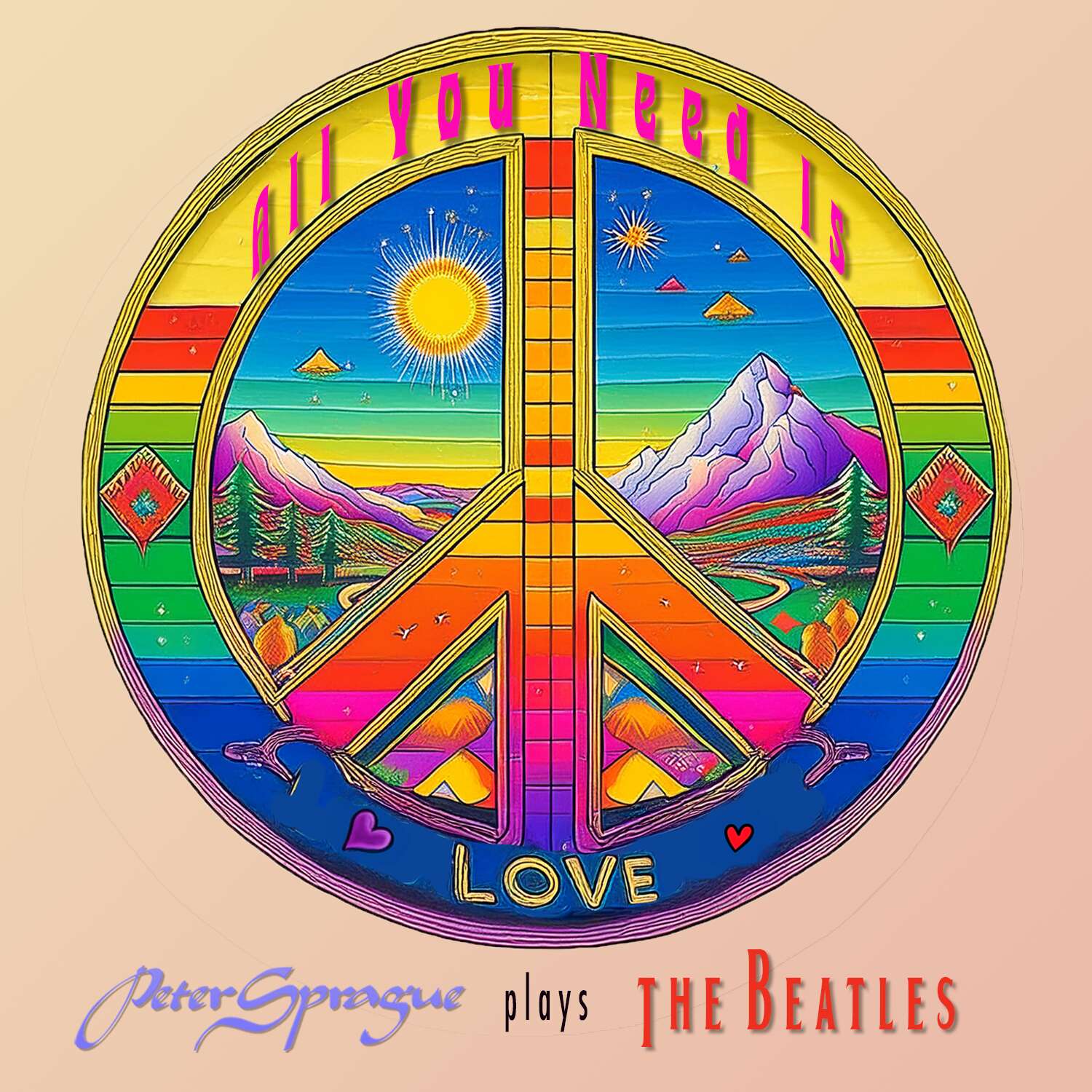
PETER SPRAGUE: All You Need Is Love—Peter Sprague Plays the Beatles

When your loyal correspondent was in third grade, the Beatles announced they were breaking up. My teacher was in her first year out of college, in her early 20s. I only remember any of this because I was stunned to see my teacher crying that morning. Through her tears, she told us that the greatest band in history had just broken up. She sent the A/V kid to the office to get a record player, and then she played “Let It Be” for the class of eight-year-olds.
For those of us of a certain age, the Beatles maintain an emotional hold the way that Little Richard and Elvis did our parents, and Sinatra and Count Basie our grandparents.
So, there is little surprise in guitarist Peter Sprague continuing to revisit the catalog of what he readily acknowledges was his favorite band growing up. The influences were always there, even in his straightest-ahead of his jazz playing.
What is a bit of a surprise—a continuing surprise—are the evocative vocals of Rebecca Jade in tackling the Beatles on Sprague’s projects, given that she was born a full decade after their demise.
Her inspired takes on their songs speaks to the stellar quality of many of the Beatles’ compositions—which is sometimes overlooked because they were also such great performers that it can be difficult for other artists to escape the shadow of the original versions of these songs.
But just as modern jazz singers keep returning to the Great American Songbook of the 1920s-1950s because the compositions offer the kind of complexity and depth that allow for a near-endless re-interpretation, so does Jade seemingly find similar inspiration in the works of the Beatles.
All You Need Is Love is Sprague’s second full-length dive into the Beatles in the last half-decade (following 2022’s Day Tripper), this time delivering a full 10 songs by the Lennon-McCartney songwriting team, plus a cover that anchored early Beatles’ sets and an original tribute to the band.
While Jade was the sole vocalist on Day Tripper, here she shares singing duties with longtime Sprague colleagues Allison Adams Tucker and Leonard Patton. On the tracks where Jade is featured, though, she picks up where Day Tripper left off—delivering performances of tremendous emotion and imagination, yet wholly embedded in a Beatles vibe.
“Got to Get You into My Life” kicks the album off with a pretty loyal opening, Tripp Sprague (sax) and Paul Seaforth (trumpet) laying down a horn chart fairly close to that on the 1966 original from Revolver. (It charted again when released as a single in 1976 to support the Beatles compilation Rock ‘n’ Roll Music.) Jade’s vocal is loyal to the original, but adds to it—bending notes, soaring far above Macca’s own range.
While the Beatles’ version featured a magnificent guitar break by George Harrison—a short but key passage that was emulated in purpose if not stylistically by Georg Wadenius on Blood, Sweat & Tears’ 1975 cover, and Al McKay on Earth Wind & Fire’s 1978 version—Sprague never takes a true solo, instead playing a short break after Tripp’s extended improvisation and then engaging in a running call and response with pianist Danny Green before Jade jumps back in to carry it to the close.
It is beguilingly lovely.
On “Nowhere Man,” Jade not only anchors the track with her rich vocals but provides a backing chorus that echoes the Fab Four’s own vocal harmonies. And on Chuck Berry’s “Roll Over Beethoven” (which the Beatles had covered when starting out), Sprague’s arrangement doesn’t even try to out-rock Berry, instead simmering just below boiling, Jade’s vocals bouncing along closer to a jump blues. And who knew Danny Green could channel Berry’s pianist Johnnie Johnson so completely?
Perhaps the most interesting track is “The Beatles, an homage Sprague co-wrote with local singer-songwriter Deborah Liv Johnson as the flip side of her 1988 single “Eight O’Clock Journey,” which Sprague produced and played on. This is at least the second time Sprague has revisited the track, having also recorded an instrumental version on his 2009 outing, The Peter Sprague String Consort. (Interestingly, in addition to Sprague, drummer Duncan Moore has played on all three versions.)
On this take, the arrangement hews close to the original, albeit with Sprague’s guitar intro slowed down considerably from the 1988 version. Jade’s vocal range is similar to that of Johnson—as is the tonal purity of her voice. Also, as on the original, Sprague adds in synthesized strings.
The gorgeous melody is a wondrous vehicle for Jade’s voice and Sprague’s guitar, and it’s nice to hear this overlooked local gem given another arrangement.
The title track closes out the album, again with Jade on vocals following another horn chart that is a knowing nod to that on the original. Here, Jade’s high-register vocals offer a different take from the Fab Four, and Peter’s stately solo on guitar matches Harrison’s original in pacing but doesn’t have the heavy distortions and effects Harrison employed. Too, his extrapolations are as imbued with jazz references as they are with the melodic theme. Tripp’s solo on sax is equally endearing
Tucker and Sprague’s previous collaborations have mostly skewed toward Brazilian jazz—and the arrangement for “You Won’t See Me” definitely has a bit of a bossa nova groove to it, with Tripp adding in another level of tropical warmth on flute.
Tucker’s high-end register on vocals is a perfect match for “Norwegian Wood,” which is approached in a pretty straight-ahead jazz vein. The slowly undulating arrangement on “You’ve Got to Hide Your Love Away” is another showcase for Tucker’s expressive singing.
Patton takes lead vocals on “Lucy in the Sky with Diamonds.” Largely eschewing the psychedelic overtones of both the original and Elton John’s hit cover, the opening third of the song is performed at a relaxed tempo before the first chorus hands the lead over to Tripp on synthesized reed (EWI). His extended solo adds in a bit of the out-there that so defined the original.
Patton and Tucker team up on vocals for “Getting Better,” engaging in both call and response and then deeply layered harmonies that are a treat all in themselves.
Sans voice, the stripped-down duet of “Blackbird” with only Sprague’s guitar and Mack Leighton on bass cuts right to the heart of the song. A similar effect is achieved with an instrumental quintet reading of “She’s Leaving Home.”
As mentioned above, many—if not most—attempts to tackle the Beatles’ songbook end up being eclipsed by the originals.
Sprague and his cohorts put their own stamp on the music with this outing, making clear that not only were the Beatles tremendous performers, but John Lennon and Paul McCartney were also uniquely gifted composers.

