




Ask Charlie...
Finding Magic…

Hello Troubadourians! Last month I started talking about chasing magic as it applies to my playing. I’d like to elaborate in a little more detail about it in this month’s column. I came up to speed fairly quickly when I was learning to play, and I also hit a frustration point much sooner than I expected to. I learned the standard chord shapes, including 9ths, Maj7ths, Sus4, Sus2, etc., and some of what would be considered jazz chords. I learned major scales, minor scales, pentatonic scales, and a few others that I rarely played, so I knew my way around the guitar. I also had excellent timing and could lock in to a groove. I was proficient as a player for many years and even made a living as a guitarist for several years… But I was also profoundly bored with my playing.I had started to listen to players like Larry Carlton and Robben Ford and wondered, “where do they find all of those cool notes and chords that I can’t find?” Sure, I read magazine articles where they described their thinking regarding constructing lines and chords, which scales they used and chord superimposition, but I still struggled to find any of that using the fretboard understanding I had at that time. It was around this time that I somehow conceived of my “middle four” concept—playing most leads on the middle four strings—that I mentioned last month and also in several previous columns. But that was just the beginning… One day I was preparing some basic lessons for a student (when I actually had time for that sort of thing), and it started with the chord shapes in first position. They are C, A, G, E, D…, which might look familiar to many of you as the CAGED system.
I don’t claim any actual knowledge of the details of that system, but I figured I could leverage the idea to serve my own needs and interest. While these chords are all in open position on a guitar, they are not all the same. C, E, and G are true first position chords. D and A are technically second position chords but due to the availability of complementary open strings, they can be played in first position. To help visualize this, put a capo on the second fret of a guitar and then play a C and G chord. They will sound as D and A respectively. Remove the capo and play the D and A open position chords. Notice the partial barre on the second fret for both chord shapes. The open strings now provide the complementary chord notes that were fingered with the capo on the second fret, just in a different order, or inversion. And this, my friends, is where the door opened for me. Everything about my approach to guitar was based on the (false) idea of an implied barre for every chord above first position and that only the notes above the barre were in the scope of what I would play. In hindsight, it all seems so obvious that I was limiting my choices that way, but its also surprising how much music I could get out of doing it “wrong.” The realization that I could play notes behind that implied barre opened my eyes and ears to what I was hearing in my head, and I started to hear professional guitarists in a new way. As this concept began to sink in, lead lines and melodic solos became more accessible and made more sense. Visually, I could see how to find—and play—lines along the fretboard, not just across it. Combining this new vision with my middle four concept, I was finding all of those elusive in between notes that had previously eluded me. The Magic was now accessible, I just had to work it out…
Interestingly, this helped with my ability to re-voice chords as well. Superimposing chord on chord actually made sense, and I was able to find and play what could be considered standard extended and altered chords and this, in turn, suggested some unique chord voicings of my own. Professional guitarists rarely use standard block and barre chords when playing accompanying parts. Certainly, we use standard chord shapes when we’re the only guitar player or when the music demands those voicings, but when playing with another guitarist we try to avoid duplicating parts that the other guitar is using. Reducing clutter in chord voicings helps the music to breathe and unlock the coolness…
Bonus discovery. I learned to use partial chords, two and three notes, to create in-between voicings and substitutions for both rhythm and lead parts. Playing basic chord patterns but only using two notes on the first and third, second and fourth, third and fifth, and fourth and sixth strings, and re-voicing the inversions every two frets, puts some very cool-sounding melodic ideas and chord-leading movement right under your fingers. This works with adjacent strings as well, but the partial chords stack from different positions and inversions than the previous example. These voicings are best visualized on the guitar and trying to explain in just words is difficult, but this might help as a start. Start with a G chord in first position. The next G chord is an E position barred at the third fret, followed by the D position barred at the fifth fret, followed by the C position barred at the seventh fret, followed by the A position barred at the tenth fret. And ultimately returning to the G position barred at the twelfth fret. Of course, you probably ran out of useful neck positions at the seventh fret, but you get the idea. Using partials of those chord positions you can create melodic lead lines and harmonized lines and fills anywhere on the neck. Pro Tip: extending the basic partial chord shapes above to include 7th and 6th intervals yield some very cool sounding licks.
Tying all this fretting hand information together with your picking hand, you can choose to cross-pick, hybrid pick, or just use fingers to achieve different effects. It really depends whether you want to split up the notes/chords or sound them together. Most of the time I use hybrid picking, which allows me to play more guitar-like or more piano-like and whether I want the part to be played clean or funky. Now it’s your turn to mind some magic in your playing…
Need to know? Just ask… Charlie (ask.charlie@hotmail.com)
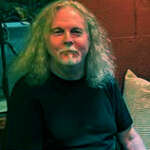
Charlie Loach has played guitar in the San Diego music scene for many years, primarily with the power-house original rock band the Wild Truth and the elegant Americana ensemble Folding Mister Lincoln, performing and recording several CDs with both bands. More recently, he has performed with the vocal trio the Outliers. Charlie is an accomplished session player who is well versed in multiple genres of music from bluegrass to rock to country, and his playing is both smooth and tasteful whether on electric or acoustic guitar.

