




Cover Story
Bug Guts: Folk Punk Is Not an Oxymoron

And when you can’t find your way home
’Cause the road is overgrown
Just take my hand and I’ll be your friend
We’re all just walking each other home again.
“Anne Frank’s Vision”
Bug Guts
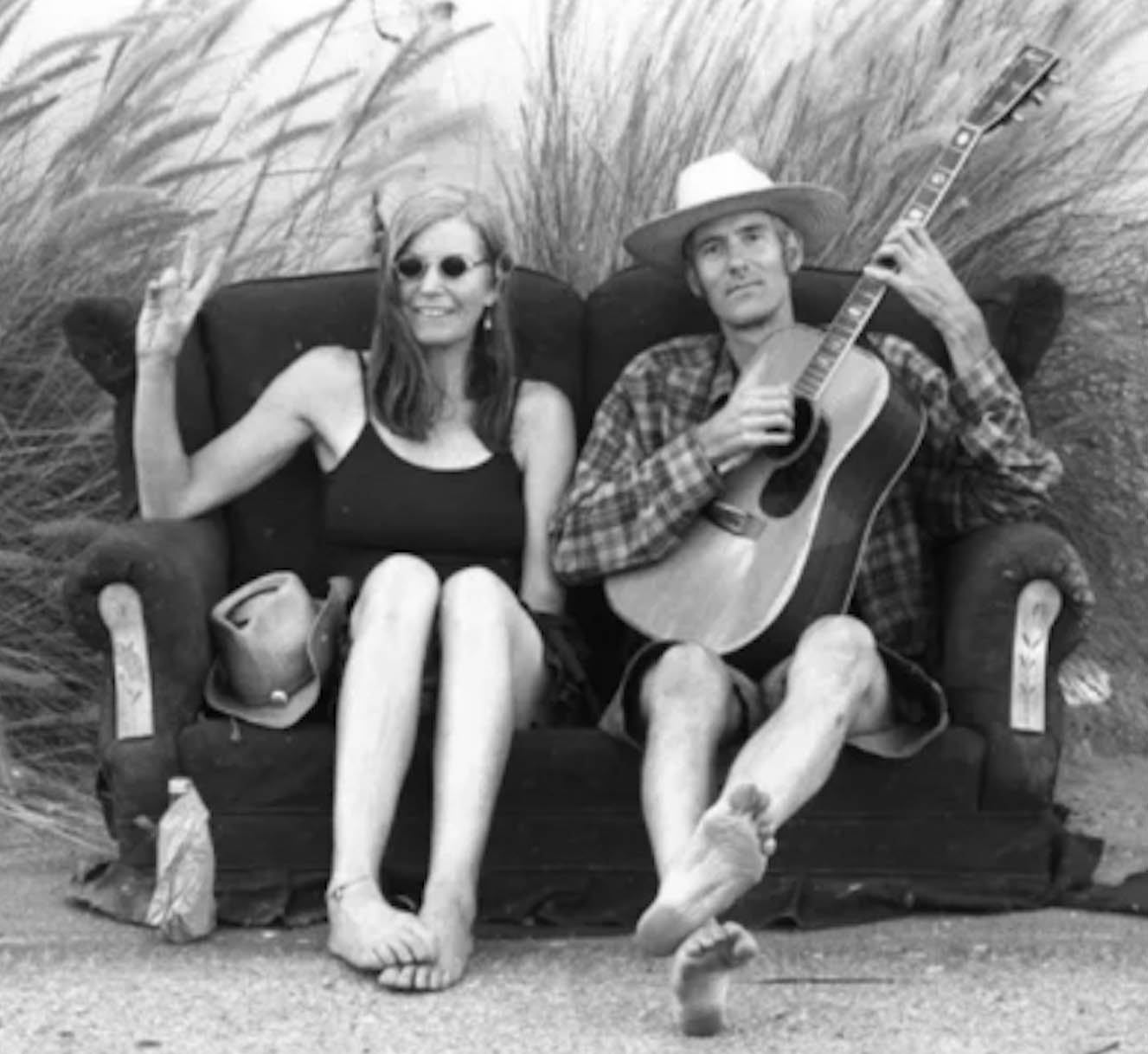
Rosebud and Scott Ireland are Bug Guts. Photo by Henry Diltz.
We’re at the Art Center in Ramona, and the duo known as Bug Guts has just taken the stage (well, the cleared space in front of a wall of paintings). Rosebud is wearing a shimmering leopard print top under a black blazer adorned with a pin that says “Unfuck the World.” Below it, she sports a black tutu over horizontally striped tights, like those of the Wicked Witch of the East sticking out from under the house. Scott’s sartorial choices are more muted—baggy tan pants and a flannel button-down over a t-shirt with a Spirograph pattern. But the most recognizable wardrobe item is Rosebud’s black trucker hat, which has the word LOVE bedazzled in the largest possible letters one could squeeze onto the front bill.
I don’t think I’ve ever seen her without that hat.
They launch into a set of provocative, poetic, and shockingly honest songs. One starts with the recitation of a poem: “The fly buzzing by is unzipping my mind.” Another song recognizes that “we’re all a weirdo to somebody else.” There’s a beautiful tribute called “Metamorphosis” that assures transgender children, “you’re almost all the way through.” There’s the crowd favorite “Parental Advisory” that instructs, “if you’re going to make a baby, please don’t let that little thing turn out to be an asshole.” And there’s the fearless and hilarious song “Fiber,” where they employ an extended round of orgasmic audio effects to mimic the sounds we make during . . . a different bodily function.
What genre of music is this? They’re both playing acoustic guitars. Their harmonies are so locked in, it sounds like they must sing them over breakfast every morning. Their message is unapologetically lefty and assures us that “love always wins.”
But this is not your three-chord, Woody Guthrie, strum-and-hum folk music. The tempo is often frenetic. The chord progressions can be unpredictable, flipping from major to minor while careening around a few bluesy corners. The vocals are animated and passionate. The melodies are catchy and sometimes haunting. And Scott frequently rips a guitar solo that sounds like what you’d hear if you were smoking an unfiltered cigarette outside CBGBs in the late ’70s.
Is this . . . folk punk?
Folk punk is a genre, commonly associated with artists like the Pogues and Billy Bragg. But it seems impossible to reconcile the raucous energy and tempestuousness of punk with the soothing kumbayah of folk. Can you imagine Pete Seeger sneering at the audience and flipping them the bird? Or the Sex Pistols delivering gentle acoustic harmonies while placing daisies in the gun barrels of the National Guard?
Oxymorons be damned—this is who Bug Guts is. “We both come from the love of acoustic folk, but the loud, angry stuff is necessary, too. Does that make us schizophrenic? I don’t think so. Musically, it’s just what we like to do,” Scott explains. “I think it’s been hard for people to say what we are or for us to fit in easily, which is okay with us. We’re misfits.”
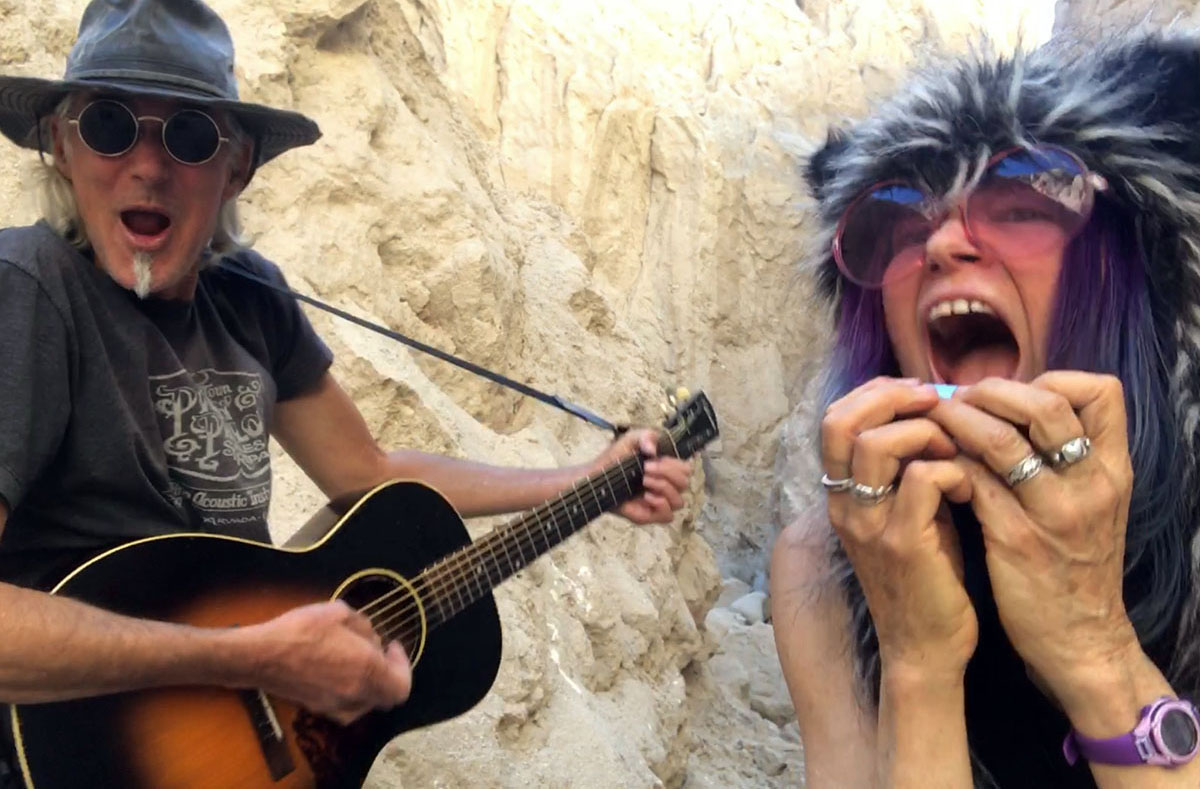
Their name reflects that, too. “Bug Guts” sprang partly from Rosebud’s early work as a biologist, where she researched what percentage of our food and everyday world is made up of insect parts. She found that “bug guts are everywhere. Literally. It’s where we’re all headed to.” They appreciate that the moniker is “playful, but also a little gross.” At least it preemptively weeds out the audience with no stomach for their material—they figure that “if you can handle the name, we’ll let you into the show.”
Theirs is a quintessential San Diego musicians’ love story. In the late ’80s, Scott showed up to audition for a punk band at a house on Voltaire Street in Ocean Beach where Rosebud was living with other musicians. Scott got the gig and started hanging out at the house, and one day they both got out their acoustic guitars and ended up writing five songs on the spot. As they remember it, “we were just bouncing off each others’ big sparks of creativity, and we felt a connection that we had something musically magical.”
They each played in a series of bands during the most fertile years of the San Diego punk era, most notably the Pull Toys and Night Soil Man. In fact, there’s a YouTube video of their respective bands playing at the iconic 924 Gilman Street club in Berkeley, widely considered a launching pad for the ’90s punk revival. In the video, Scott is shredding in front of a graffiti-scrawled wall while the bass player thrashes a full head of dirty blond hair in a spot-on James Hetfield impression. Rosebud is luminous, diving into a full-throated artistic trance of singing, strumming, screaming, and stomping. (Also, Rosebud—I kid you not—is wearing a leopard print bikini top and a flouncy black tutu that mirrors her Art Center outfit decades later). It’s feverish and wild and glorious and everything punk should be. As they put it, “there’s a ferocity you can definitely see there that was a big part of where we were at the time.”
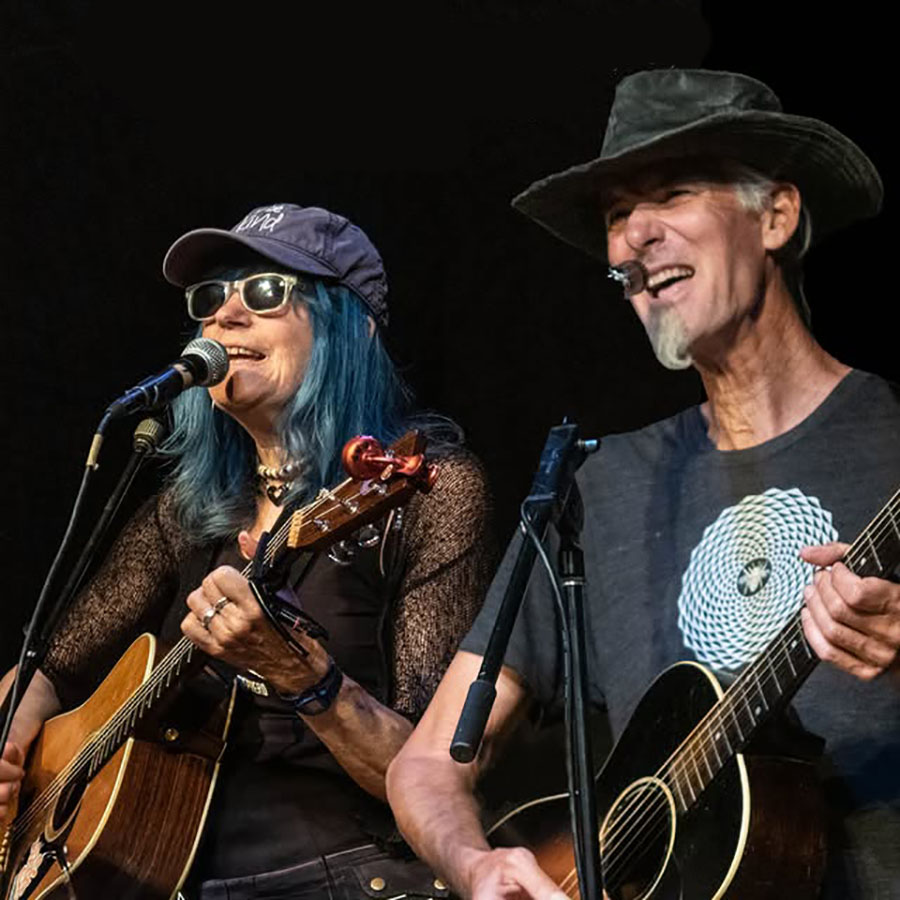
But maybe that ferocity isn’t diametrically opposed to folks’ sweet optimism. Maybe punk and folk come from the same deep well of hopeful idealism. It’s just that punk flipped course and grew outraged in response to life’s injustices. The kind of stuff Rosebud refers to as the “unpleasant shit.”
They’ve had their share of that, too.
In 1990, Scott was filming a music video that called for him to jump through a glass door. Someone used the wrong type of glass, and the stunt went horribly wrong. Scott hit the glass, fell down some stairs, shattered a vertebra, and was temporarily paralyzed. His doctor told him he’d never play guitar again.
Rosebud refused to accept this. Though they’d just begun dating, she moved into his hospital room, quit her band, and dedicated herself to his rehab. She even brought her Gibson electric guitar into the hospital, thinking the strings on it might be low enough for him to play. When it was too heavy for him, she held it while he strummed.
It took several years, but Scott managed to relearn the guitar, adopting new techniques to compensate for his injury. Listening to him in the Art Center, you’d never suspect anything had happened—his fingers coax effortless licks from the battered little dark-wood guitar. Some of his runs could easily pass as flat-picking breaks in an upper-level bluegrass jam. A decade or so after the accident, they recorded an album and sent it to the doctor who said he’d never play again. “It was a really cool letter to write,” Scott recounts, particularly when the doctor wrote back and said he was glad he’d been wrong. Even though he doesn’t have his Zoom camera on, I can hear the slight smile in Scott’s voice.
But the support went both ways. Before meeting Scott, Rosebud suffered a violent sexual assault and later learned that her attacker was the infamous Golden State Killer, a former police officer found guilty of killing 13 people and raping over 50 women. When he was finally prosecuted in 2020, Rosebud attended the proceedings in Sacramento, a process that “really knocked me out of orbit for a while.” But with Scott’s support, she endured, even writing and recording a song called “Sister Survivors” that brought a sense of healing to both herself and other victims. “And that’s really what we wanna do, right?” she muses. “Transform all that shit and cruelty and pain into compassion for others?”
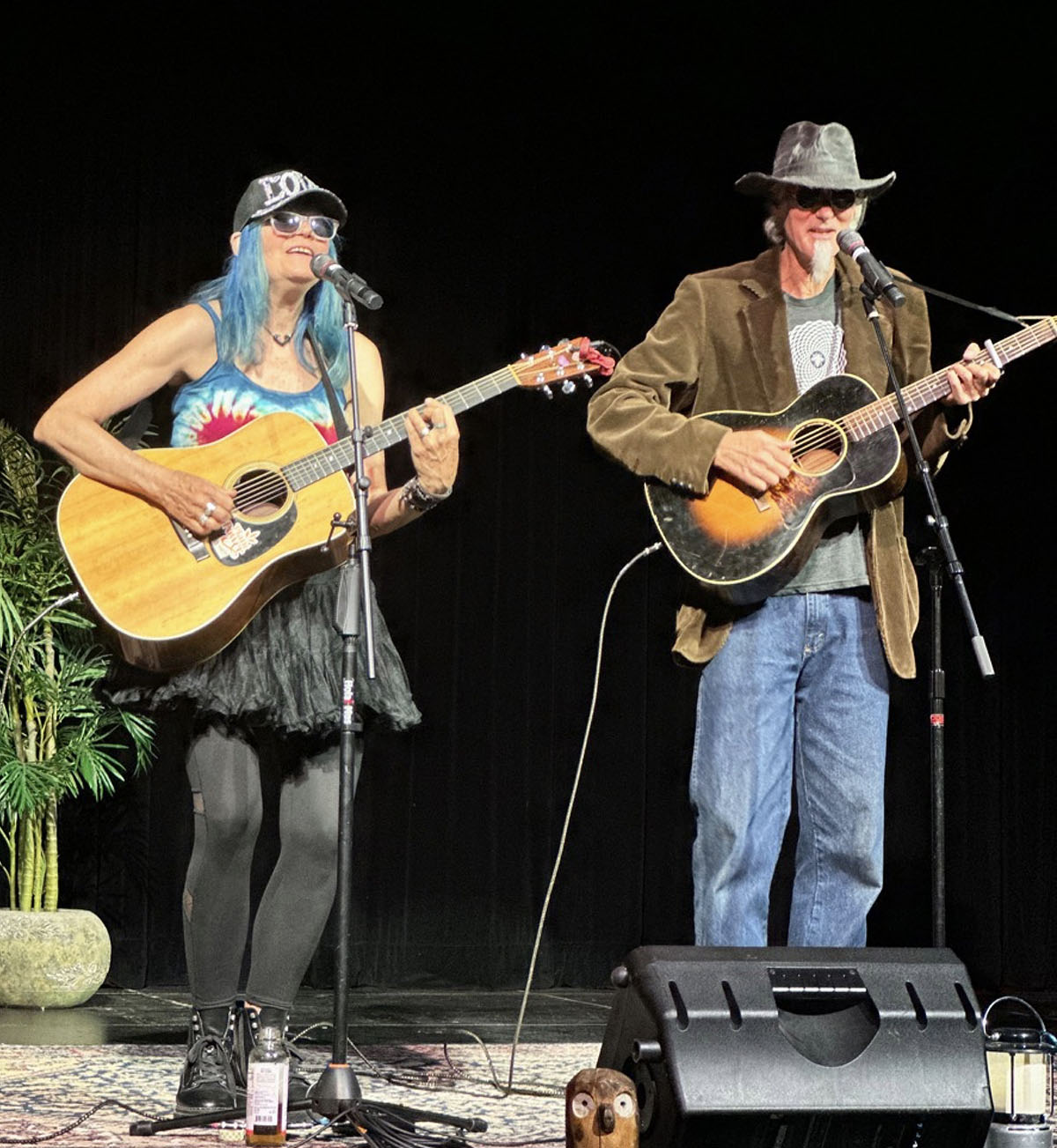
Also compassion for themselves. At the Art Center, if they forget a lyric or flub a guitar line, they don’t try to hide it, like many insecure musicians might. They laugh about it. Between songs, she smiles and rubs his arm.
Healing from their respective traumas didn’t come easy. After Scott’s accident, “we went out to the desert and just lived in the back of my pickup truck for two or three months. It was the best time ever. Just having that open schedule, nothing to do all day except eat, hike, and heal.” They’ve spent a good chunk of their lives in the wilderness since then, splitting their time between the deserts near San Diego and remote areas in northern California. When possible, they grow their own food, spend days backpacking and camping, and remain out of cell phone range for longer than most people feel comfortable. Scott calls it all “big medicine.”
The folk punk genre I’m ascribing to Bug Guts feels especially necessary right now—figuring out how to meet the world with love for humanity balanced with rage for the things done against it. When I ask how they’re responding to the current state of affairs, they refuse to finger point or identify enemies. “Even though some people are saying and doing some very fucked up things, we don’t hate on them because then we’re carrying that heavy weight that drags us down, ” Rosebud explains. “At the core of humanity,” Scott adds, “if we’re allowed to at least face each other and have a conversation with each other, we’re hardwired to work it out and cooperate.” And to get us there, they believe we need music now more than ever, since “art is really the most important part of any societal change.”
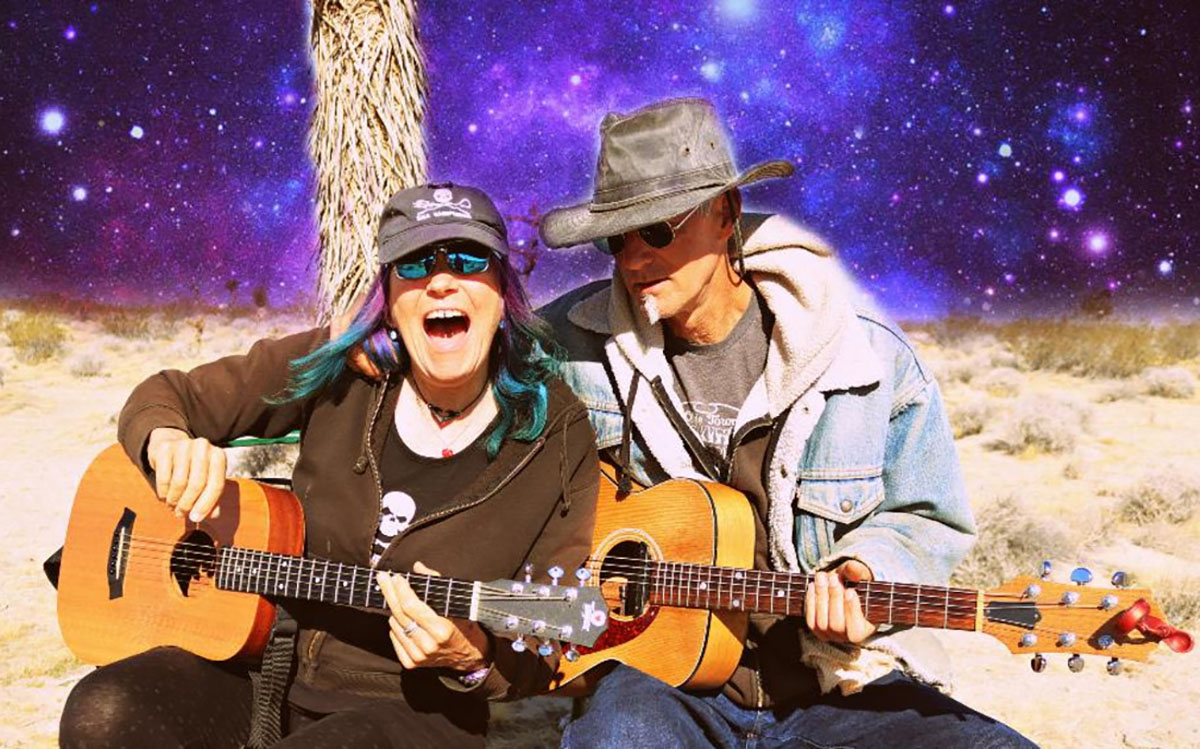
Maybe folk and punk don’t just spring from the same well of idealism—maybe they remain indelible parts of each other. After all, love without the sustaining ferocity of anger would be limp and ineffectual. Anger without the guiding principle of love would destroy more than it creates. And maybe it’s not even what we outwardly present to others—maybe it’s about finding peace within ourselves. As Rosebud explains with the deep wisdom of a sexual assault survivor, “what energy do you want to carry with you?”
In an era of division and antagonism—when the forces of cruelty, racism, xenophobia, misogyny, and homophobia seem to be closing in around us—what could be more radical than unconditional, anarchist, bedazzled LOVE?
And so, I forgive everyone who’s ever done an unkind thing to me.
‘Cause I wanna just amplify my joy til I have set us all so free.
“I Love You”
Bug Guts
Catch Bug Guts at the Duos Concert Series on March 8 at 2pm, at Living Room Concerts, Alpine (to reserve tickets email rchagnon1@cox.net) See them also at the Sun Valley Song Stage on April 11, First Congregational Church of Ramona, 404 8th St., Ramona

