Ask Charlie...
What Do I Need?
Hello Troubadourians! A while back, last November to be exact, I wrote about why I keep my guitars in their cases. A friend who read the column asked me about the part where I talked about living in a high fire-risk area and how some of the guitars have tags on their cases that say, “Save me first.” My friend went on to ask me, “What about your amps, effects, cables, and that stuff?” “What about your PA system?” “Would you save any of that?” Well, yeah, I would if I had time… and enough space in our vehicles for that and everything else that we need to take with us. I could go on about this; where would we be going with cars full of stuff and would it all have to stay in the car for an indeterminate period of time? While that isn’t the point of this column, the question got me thinking about which gear I consider to be essential for me to play live with a band or in a recording session. Some history first…

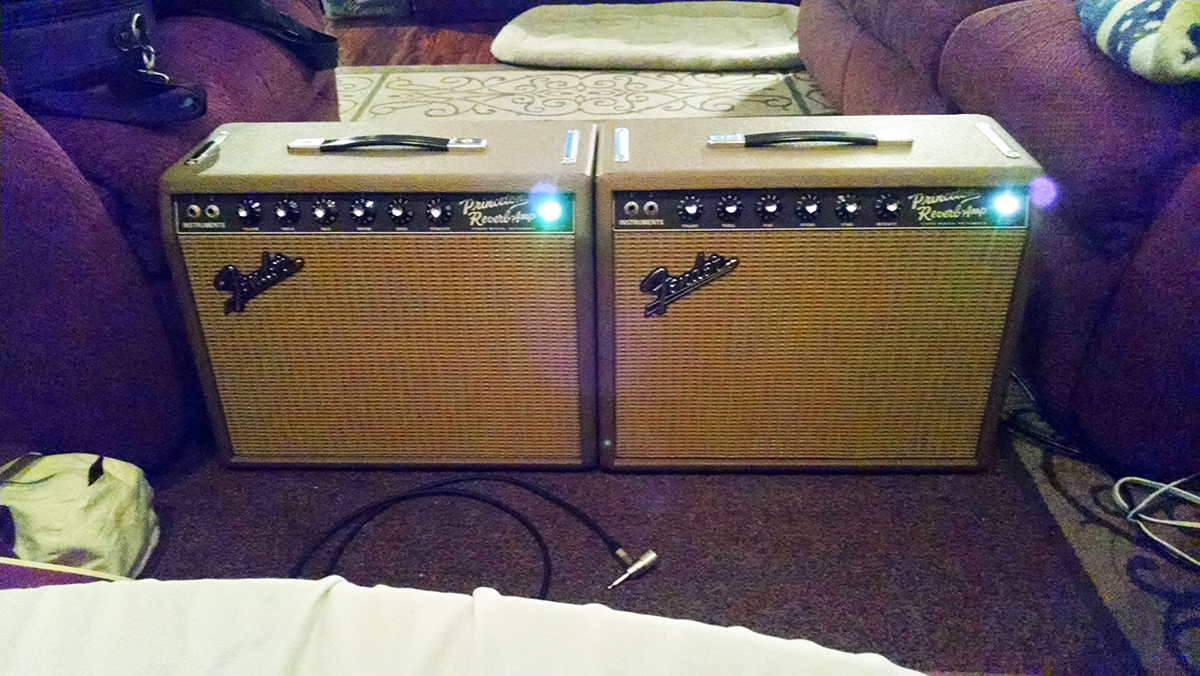
Princeton amps
When I played in the Wild Truth, I would often bring three guitars, two amplifiers, two pedal boards, and lots of parts, pieces, and tools for repairing things in case of a failure. I had a vehicle that would hold all of that stuff and which was secure enough to leave some of it in the vehicle as not all of it got loaded in at a gig. Excessive? Sure, but that was how my professional mentors and my personal experience taught me to be prepared. This was how a professional musician/sideman conducted business. Being prepared musically was only the beginning, you had to have your gear prepared, too. Needless to say, this was a lot of work and expense. And for someone who had a day job and didn’t need to pay his bills with gig money, it could have been seen as overkill, but my professional ethics wouldn’t let me just not do it. Not being prepared was never an option. So why, when, and what did I change?
Honestly, it just got to be too much. At that time, a lot of my gear was selected for use on larger stages and was “road ready,” meaning that it was touring-grade and had a road case for transport. This included a vintage Mesa/Boogie MKIV, a Marshall cabinet, and a rack unit with a wireless system. I also had a large PA system based around a vintage Studiomaster console, pro-level microphones, stands, cables, a 100’ “snake”, and several power amps and cabinets, all in road cases as well. Cool stuff… too cool to sell really, but too big—and loud—to use for the “next phase” in my journey. I committed to exchanging my big SUV for a smaller vehicle—a Mustang GT, which has a very small trunk capacity—to physically limit what I could transport. I actually gave up playing electric guitar for a few years and built a simple pedalboard for my acoustic guitar that was essentially just an EQ and a DI. I played only into the PA at the performance venues until a disastrous gig where I could barely hear myself in the monitors made me buy an acoustic amp. Eventually I started adding the electric guitar back into the music I was playing so I bought a Fender Princeton amplifier and built a limited pedal board to go with it. And this worked… for a while.
The Princeton was part of a limited edition of 200 amplifiers. I bought the first one locally from a dealer that was going out of business. It was so cool that I started looking for another one to go with it. I found another one at a store in Los Angeles that was ironically also going out of business. (No, they aren’t consecutive serial numbers, but how cool would that be?) I could get both Princetons, an electric guitar, an acoustic guitar, and my pedalboards and cables into the trunk of the Mustang. I thought I was set. But I soon found another Princeton that was a special-order configuration for Sweetwater, and I had to have that one too… I also acquired four more electric guitars and three baritone guitars. So much for limiting my gear. I remember playing a gig where I brought one acoustic guitar, two electric guitars, a baritone guitar, one Princeton, my acoustic amplifier, and two pedalboards. I had to put the acoustic guitar in the front seat and the baritone in the back seat. As I was loading my gear into the car after the gig, I realized I was right back where I started three years prior but with less room to carry things. This was stupid…
So, I recommitted to reduce the gear load to only the essentials for a particular gig or situation and take only the instruments that can serve as backups for each other. If I bring a specialty instrument for a particular song (or songs), I make sure that I still play the song on a regular guitar. I’ve never had more than three guitars at a gig since. Usually only two and occasionally only one (so risky…). For sessions, there are so many choices for digital amp models and effects available that are of excellent quality and realistic tonality, I’ve only used an amplifier in the studio on two occasions in almost seven years. Now I’m back to one—or two—guitars, one amp and a bag with cables, a tuner, and a Tech21 Fly Rig 5. With the Fly Rig, I have two distortion/gain options, a delay with or without modulation, a boost, and reverb. The Princeton has the basic clean tonal platform, standard spring reverb, and tremolo. That’s really all I need for playing live and covering a lot of musical ground.
About two years ago it became necessary to invest in my own PA system again. The technology has advanced exponentially since I bought my old PA, and this one is smaller, lighter, louder, with more features and high-fidelity sound that rivals my old vintage console. My daughter—who grew up assisting me at gigs—has a RAV4 and we can get the entire PA and my guitar rig into it with ease.
But back to the original question of “what about your amps, effects, cables, and that stuff?” “what about your PA system?” “would you save any of that?” Here’s the list of what I would take (assuming there is time…): One Princeton (the one from Sweetwater) and my cable bag. That’s it. The only reason to save these would be just because. Everything else—the limited edition Princetons excepted—can be easily replaced. In fact, I’d save ALL of the guitars before I’d save anything else. The vintage Boogie and console are very cool but are a distant memory at this point. More nostalgic than practical, and their road cases just might protect them. Maybe…
I love all my guitars and gear, and I use it as often as I can, so losing any of it forever would be heartbreaking, but there is a reason why three guitars have those “save me first” tags. But then there’s that first year of issue Music Man Stingray bass that I bought new in ‘77… Hmmm…
Need to know? Just ask… Charlie (ask.charlie@hotmail.com)

Charlie Loach has played guitar in the San Diego music scene for many years, primarily with the power-house original rock band the Wild Truth and the elegant Americana ensemble Folding Mister Lincoln, performing and recording several CDs with both bands. More recently, he has performed with the vocal trio the Outliers. Charlie is an accomplished session player who is well versed in multiple genres of music from bluegrass to rock to country, and his playing is both smooth and tasteful whether on electric or acoustic guitar.