Featured Stories
Still Going Strong: Bob Dylan at 85

Screenshot
What is the “real” version of a Bob Dylan song? Is “Blowin’ in the Wind” with us for his original acoustic performance vs. Peter, Paul & Mary spreading the gospel, or Stevie Wonder turning the song upside down?
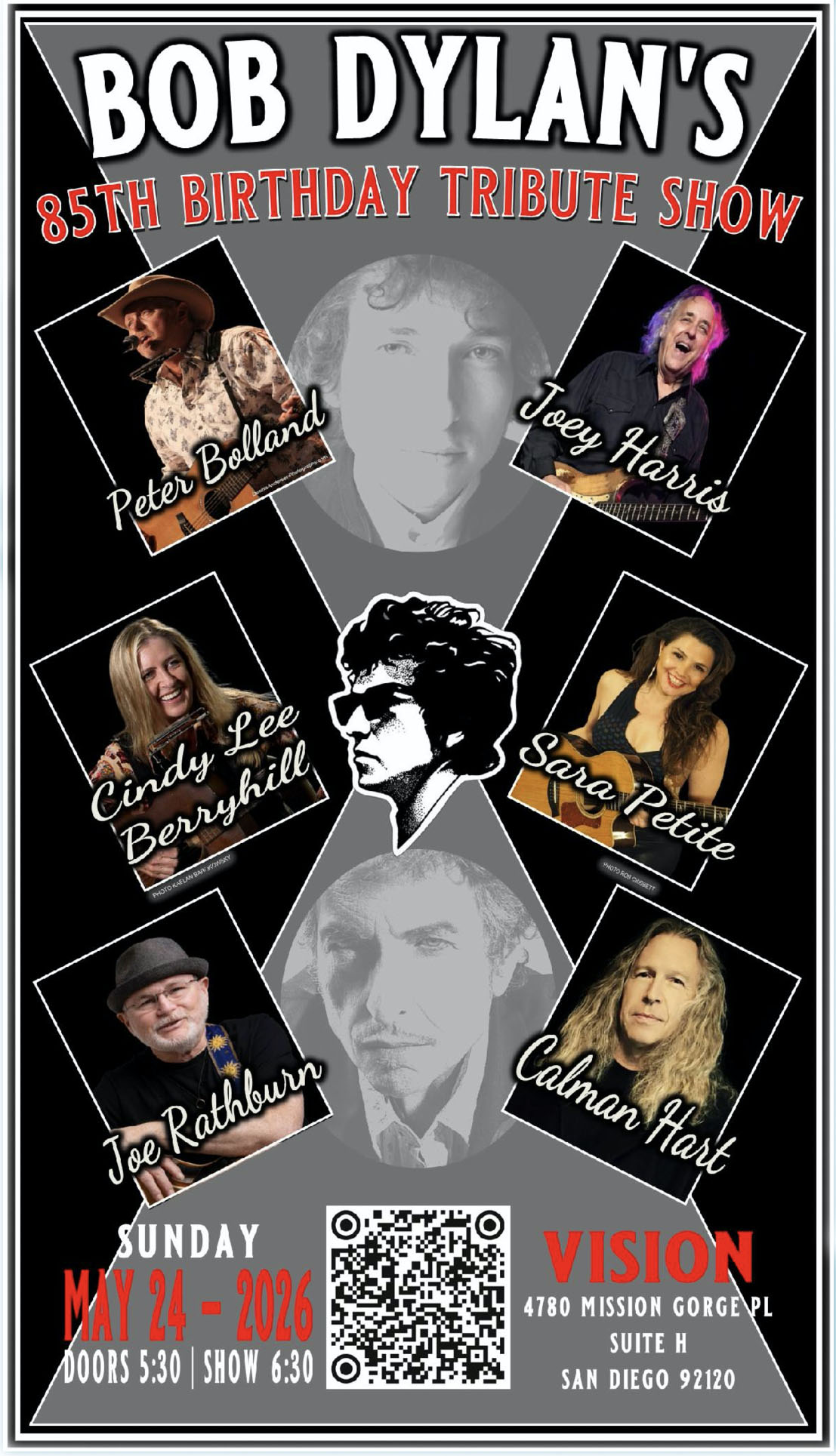
Dylan songs behave differently outside of Bob’s control. That’s what should be on display at an upcoming special celebration concert for Bob Dylan’s 85th birthday coming up on May 24 at VISION. A particular concert, in and of itself, isn’t necessarily newsworthy. What’s special about this evening of Dylan is that it’s more than a tribute show – it’s a living demonstration of how Bob Dylan songs behave when they’re in other people’s hands … and voices.
For any other source artist, the temptation in a cover song is to reproduce it. Yet when it comes to Dylan songs, there seems to be no end to the amount of possible reinterpretation.
Dylan’s Catalog
The lyrics in Bob Dylan’s legendary songs are obviously brilliant and sticky. When it comes to music, his original recordings are a little more basic—which results in them being scaffolding as much as blueprints for modern artists to cover.
We can all think of a typical Dylan song as “wide open.” He has some iconic recordings and while his iconic Bob-goes-electric ’60s records like Highway 61 Revisited and Blonde on Blonde have a specific, explosive sound—the norm is that his songs are under-produced in the studio.
Even when he invented his wild studio sound of “Maggie’s Farm” on the Bringing It All Back Home record just before the 1960s electric high point; songs like “Love Minus Zero / No Limit” and “Mr. Tambourine Man” are jangly guitar strummers. When Beck sampled a piece of “It’s All Over Now, Baby Blue” for his great Ode-Lay song “Jack-Ass”, he sampled Van Morrison’s cover of it, not Bob’s original. He is arguably the most cover-friendly artist in the history of music.
Birthday Tribute organizer and host, Joe Rathburn describes it, “You go through Bob Dylan’s catalog, and you’ll find a hundred gems. He probably has a thousand songs that you don’t care about, but you can easily find a hundred gems in it.”
Just counting studio work alone, Dylan has produced 40 albums. That’s a lot of material. Some recordings are legendary; Desire, Oh Mercy, Blood on the Tracks, and Infidels come to mind for each having their own sound. Even on his best studio work—nothing is untouchable for other artists to cover.
One aspect of why the songs are interpretation ready is that Bob’s vocal abilities aren’t intimidating. “It’s not even expected for you to try and sing like Bob Dylan; you can do it any way you want,” says Rathburn. Fidelity to the original is not expected. These brilliant songs are great songs and plug-and-play ready to be taken to a next level. It’s almost “open-source songwriting.”
The open-source analogy is apt; open-source code is made available to others, expressly for the purpose of having other programmers expand on that code and build something even better. That’s what can happen with Dylan songs in the right hands.
“All Along the Watchtower” and “Don’t Think Twice, It’s Alright” are both very moving Dylan acoustic recordings. But listen to Jimi Hendrix and Eric Clapton blow those songs up; the structure and bones of the song allow them to create a wholly new experience. And the direction of change doesn’t have to be always revving up an acoustic song to be a fuller electric experience. Check out Cassandra Wilson’s beautiful jazz downshift of “Shelter from the Storm” or Eel’s swapping “Girl from the North Country” choppy acoustic guitar out for quiet piano.
When Is Covering Too Far?
That said, there is a lot of leeway for singers covering Bob Dylan. But when is too much? When are people—to paraphrase George Costanza—be-bopping and scatting all over the place?
Obviously, William Shatner’s LSD-fueled “Mr. Tambourine Man” or Duran Duran’s “Lay Lady Lay” are a bridge too far.
Reinventing the structure is one thing in a cover, when you’re adding and creating a second, great new thing. But performing “Stuck Inside of Mobile with the Memphis Blues Again” over a Kraftwerk track is just demolishing the building.
Yes, a great performer can make a Dylan song their own on stage. But audiences still do know the recorded versions, and there’s a limit to how much the songs can be dismantled and reassembled. Even by Dylan himself, his amazing Live at Budokan album is a brave attempt to reimagine his biggest hits, but it was not well received.
The original recordings bring some basic expectations of performance. Joe Rathburn describes the feeling, “To have a whole show of songs that you fell in love with and then hear them completely dismantled and reassembled like a Picasso. It’s not what you’d go for.”
The Listening Environment
Local fans are in for a treat at the 85th birthday concert. It takes place at the 200-seat VISION Center, a community center with a listening-room-style event space. It’s acoustic-focused with great sound. It’s a much better environment for music fans who pay attention—a no-disturbance environment as opposed to a rumbling coffeehouse or a festival crowd.
There are six artists doing the Dylan interpreting. All of them are veteran, mainstay San Diego performers: Cindy Lee Berryhill, Peter Bolland, Joey Harris, Calman Hart, Sara Petite, and host Joe Rathburn.
It should be a great marriage of venue, audience, and performers. Not to be too dismissive of bar band crowds, but real music fans who love a real listening experience are exactly the kind of audience who appreciates musical tradition and experimentation.
All will be performing solo, and each singer will be doing three Bob Dylan songs. They selected three personal favorites on a “first come, first served” basis; they didn’t need to negotiate a draft to figure out who sings what. Again, with Bob Dylan’s catalog, it was never likely to be a problem.
The structure of the night is kind of like Dylan’s whole catalog: modular and flexible. One artist could do “All I Really Wanna Do,” “Hurricane,” and “Not Dark Yet,” and it would make as much sense as any other three songs. Any selection will be unmistakably Dylan. Yet, nobody can possibly be representative of his whole career.
Covering Ground
There aren’t many artist catalogs that would be this elastic, rich, and familiar. Rathburn agrees, “There are very few besides Dylan and Beatles that you can do that with.”
Unlike the Beatles, who never seemed to disappoint an audience (together and as solo performers), Bob Dylan was not always a believer of giving the fans what they wanted. Dylan could mumble his way through a set. He could be singing while looking down at the ground. He could mess with the audience through odd song selections. What’s even more frustrating about that is that on the occasions he was engaged and excited with a good band, he could be spectacular, even into his 80s.
In a strange way, just by nature of trying and looking an audience in the eye, these cover performers are doing more than Dylan himself to connect with the audience. The trusted singer/songwriters on tap for the evening have the excitement of discovery and creation going for them in an evening like this whereas Dylan has been battling audience expectations from the stage for the past 60 years.
Still, there’s a musical balancing act to bridge most audiences’ preference for recorded versions, yet reinterpretation is value and even expected with Dylan.
Joe Rathburn is a bit of a purist by stating, “I prefer it when they pay homage to the thing that you fell in love with in the first place.”
What to Expect
An evening that celebrates a great artist is not your typical nostalgia or tribute show. When the focus is on the song, these live cover performances are almost collaborations between the singer and Bob Dylan. Just as what happens with early 20th-century “standards,” there’s an ongoing authorship with new voices. It’s even better when these voices are trusted local performers, each with their own fans wanting to be part of a special night.
Dylan songs aren’t really “finished” when they’re recorded. They reboot whenever someone performs them differently. Think of the songs themselves as an instruction manual more than just sheet music.