CD Reviews
SPUD DAVENPORT: Assterisk*

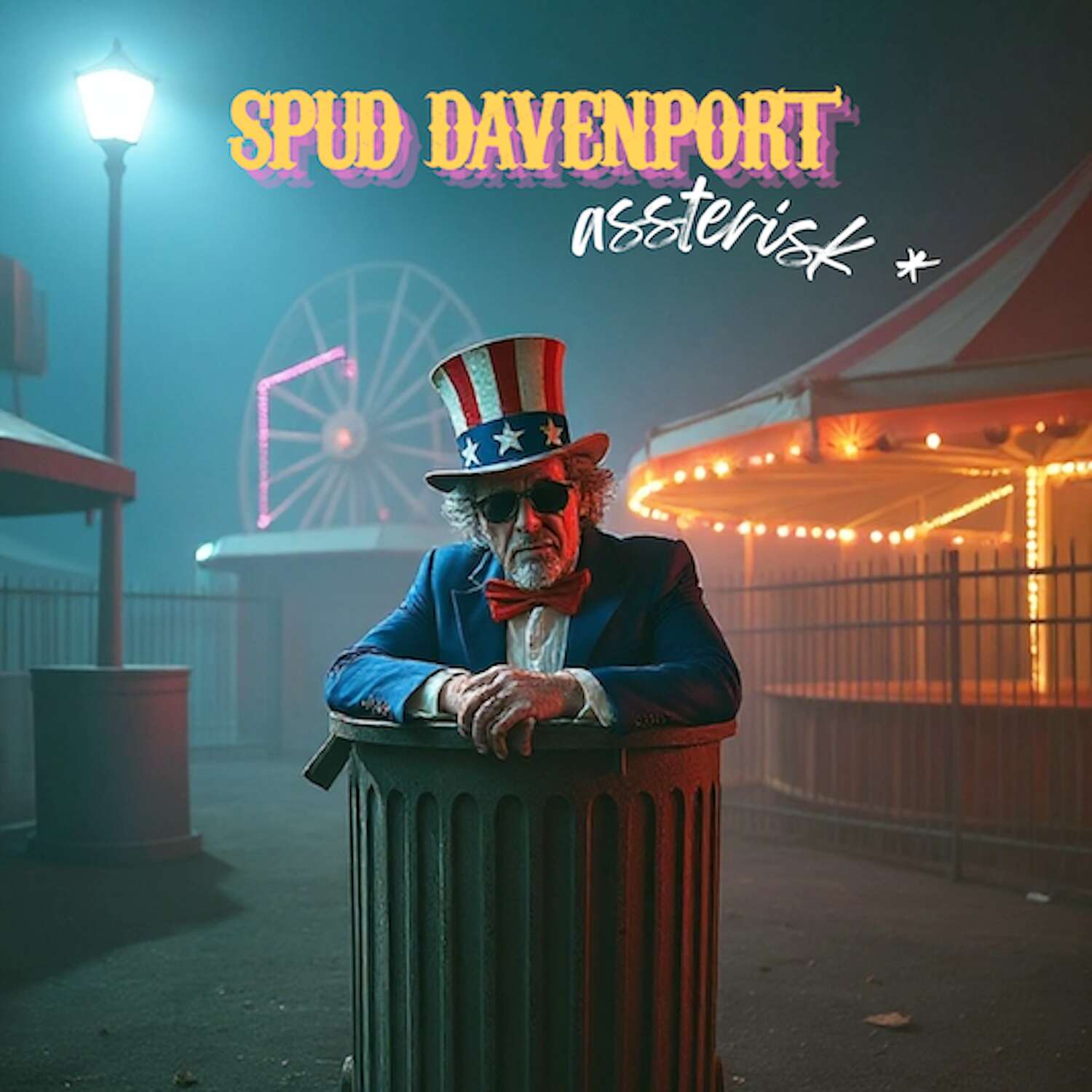
When it comes to biting social satire, So Cal singer-songwriter Spud Davenport doesn’t peer in from the outside. Instead, he plants himself knee deep in the toxic slag mound, plugs in his guitar, and cranks the volume well past the threshold.
On his new EP Assterisk*, produced by Davenport alongside Christopher Hoffee, the songwriter dives headfirst into his signature brand of Rock Satire—sharp, melodic songs that grin while everything quietly (or not so quietly) falls apart.
The project wastes no time establishing its tone. The opener, “Asshole,” kicks the door in with a straight-ahead four-on-the-floor groove, guitars blazing, vocals unapologetically front and center. There’s no needlessly winding labyrinth of metaphor here. Rather, the message is blunt: sometimes being a liar is easy. Effortless. Even enviable. The narrator almost marvels at the convenience of moral abandonment. It’s direct, uncomfortable, and undeniably catchy—straight talking over straight rocking.
“Man Baby” pivots from personal vice to cultural critique. A chugging, AC/DC–reminiscent riff drives the track forward, equal parts swagger and smirk. Lyrically, Davenport takes aim at fragile masculinity with a biting sense of humor, flipping the script on decades of chest-thumping rock bravado. The hook is pure earworm — the kind that lodges in your brain long after the guitars fade — but it’s the layered harmonies that sharpen the knife. Guest vocalist Carissa Renner’s presence in the chorus adds essential tension, pushing the satire to a jagged, almost theatrical edge. It grooves hard while quietly dismantling the posturing it mimics.
If “Man Baby” struts, “Sloganeer” preens. A whimsical, circusy whistle synth opens the track, joined by bouncy rhythms and synthetic horn stabs that feel almost intentionally artificial—though they are indeed real! The sonic palette evokes an old-timey snake-oil salesman—all grin, no substance. Imagine Ringo Starr’s alter ego Billy Shears from Sgt. Pepper’s Lonely Hearts Club Band getting by with a little help from his friends—if those friends were Karoline Leavitt and Mike Johnson. Even the trombone—played by Barry Dorr—slides in with a wink that feels half vaudeville, half warning siren. The production choice is deliberate: these are horns that sound like horns, but with distortion that almost makes them sound synthetic in a compelling way. That layer of artifice mirrors the song’s lyrical target, a world of polished slogans and slick messaging where style eclipses sincerity. Davenport leans into the absurdity without losing control of the hook, balancing theatrical flair with tight songwriting.
“Happy as Hell” channels a nostalgic, rebellious energy—thunderous drums, chugging bass, rip-roaring guitars—but beneath the adrenaline lies something more complicated. The song explores the act of masking real struggle behind a polished smile. “Happy as Hell” becomes less a declaration than a dare. Just how happy can hell be? The irony lands because the track genuinely rips; the tension between sound and subject gives it weight.
The closing track, “Zoo America,” broadens the lens. Layered guitars shimmer over a danceable, grounded groove as Davenport delivers one of the EPs sharpest observations: loving a place doesn’t mean ignoring its chaos. “This place I love is a zoo” captures the duality at the heart of Assterisk*—affection tangled up with disillusionment. The track’s lineage is fittingly expansive, co-written with Christopher Hoffee and drawing from the writing of John Kay and Jerry Edmonton, grounding its social commentary in rock history while keeping its eyes fixed firmly on the present.
Throughout the record, Davenport proves himself more than a front man. He handles vocals, drums, percussion, acoustic guitar, piano, and keyboards, while Hoffee supplies electric guitars, bass, and backing vocals—even percussion by way of BBQ tongs. It’s a tight creative partnership, wrapped in the DIY ethos of PuppyNoPlay Records, with cover art designed by Davenport himself.
In some ways, Davenport’s approach feels like an inversion of Spinal Tap. Where that legendary mock band turned its razor inward—lampooning rock stars, industry excess, and the hollow theatrics of arena grandeur—Davenport raids those same dusty catacombs of self-important rock tradition and points the blade outward. He embraces a style that flirts dangerously close to its expiration date, guitars puffed up with bravado and choruses built for fists-in-the-air catharsis—but it’s all intentional. The swagger isn’t naïve; it’s weaponized.
On Assterisk*, the bombast becomes the delivery system. Davenport takes a genre that once sold certainty and repurposes it as a precision instrument, firing sharp, current, and darkly accurate shots at the ailments of contemporary American culture. The result is satire that doesn’t wink from the sidelines—it straps on a Les Paul, steps into the spotlight, and lets the amp hum while the truth rings out.