Unsolicited Advice
Reflections on a Pot of Water
This month’s column begins and ends with a pot of boiling water.

The first one was decades ago, in a small apartment in Rego Park, New York. A tiny silver pot burbles with the liquid my father will soon add to a cup of instant coffee. Everyone else in my family uses tea kettles for this. Yet, as long as I’ve known my father—which is my entire six years of life at this point—he has made his coffee in that little metal pot.
He, too, knows of the existence of tea kettles. I mean, first of all it’s not unlikely I’ve made him sing the “Teapot” song with me at some point by that time. So at the very least we’d agree in theory on their existence. But more than that, I can almost swear to you that there was one on the stove, right next to the pot. At the very least, I do know he owned one. Yet, almost out of stubbornness, he stuck to the quaint metal pot, even when there was a more practical way *right there.*
Dad had his own way of doing things, for sure. My parents were divorced, so time with him—and for him with me—was a rare and precious commodity. From his side, that meant he didn’t have a bunch of kid-related rituals or activities incorporated into his life. So, instead, he incorporated me into his and had to make that fun. So, everything was a game. From the potato monster who used to steal my French fries when I wasn’t looking, to the rapid-fire word-play we would “compete” with each other with (a New York Jewish version of a cutting contest!), to the ever-present afternoons and evenings in barrooms where I was given a handful of quarters to run the jukebox for the place with, time with dad was, from my side, an exotic adventure very different from the rest of my young life.
I didn’t know much about my father’s childhood. He was cagey and inconsistent, and it was an unsettling open question in my young brain. On mom’s side, I knew grandparents and aunts and uncles and cousins and great-aunts and great-uncles and whatever term that made their kids.
But on dad’s side, it was foggier. I knew his parents both died when he was young, and he was sent to an abusive uncle, while his brother was sent to a rich aunt, and that they’d had decades of enmity between them over it. I knew dad ended up as a street-kid who read obsessively. Even in adulthood, he remained in some ways a warm but difficult old cuss who was also undeniably the smartest person in whatever room he was in.
Over the years, as I tried to get my head around the details of his parents’ death and what happened next, the story always seemed slippery against the last telling. At one point I am positive that he even said his father died after a bowling ball fell on his head. As a child, the physics and mechanics of that never took hold. Why was the bowling ball above his head in the first place? I either remember or invented that maybe he was on a ladder when it happened, or perhaps the ladder was one of the other versions of the story. Or maybe mom was on the ladder…?
My father died young without ever sharing the real details of his early life. Decades later, as his brother, my uncle, began suffering from cancer (as dad had years before), I asked if I could talk to him about their childhood. Only then did I find out anything approaching a real truth.
First, of course there were no bowling balls and no ladders. Their father died of TB, and their mother was subsequently sent to a psychiatric hospital, likely suffering depression and written off as unstable for reasons of early-20th-century misogyny. She eventually died in that facility—decades later—of stomach cancer. That meant she was alive while the family of three children was made wards of the state and sent off to the various caretakers, and the children knew it.
The kids were young—something like 12, 10, and 8. (The boys lost touch with their older sister after childhood.) Dad really did get sent to a shithole uncle—and really did stay mostly on the streets, since anything there was better than what was at home. His brother was sent to a stable lower-middle class home, which, to my father, must have seemed like paradise. But dad was a voracious reader and came by his smartest-guy-in-the-room reputation honestly.
The real discovery for me, though, was just how poor they were when the family was still together. It was a family of five. They lived in a single room and slept crowded together. The parents both worked, so the kids cooked, cleaned, and took themselves to and from school. (This is the Bronx, a borough of New York City, so no “uphill both ways.” Just, “outside and down the block.”) They could afford one meal for each child each day, so they had to decide which meal that would be. I believe they usually chose breakfast because there was an afternoon snack at school. My uncle described his memories of that young stage of childhood involving just how hungry they all were all the time.
This was a revelation to me. I’d known my dad was poor, but not that poor. When I heard that, the first place my mind went was to that metal pot of boiling water. It wasn’t stubbornness or unawareness. It was ritual. They were nearly penniless. Teapots were for the rich. And even though my father could certainly afford (and owned) a teapot by the time I knew him, I think the pot stood for something else. That one-room apartment was the last time his life had been normal, before the shock of a broken family and the abusive uncle and the lost siblings. I think that boiling his water the “inefficient” way in the metal pot was a dose of comforting nostalgia for him. It was time travel of sorts. It was a crooked path to coffee, but was the straightest line to a better time, even if that time was itself difficult.
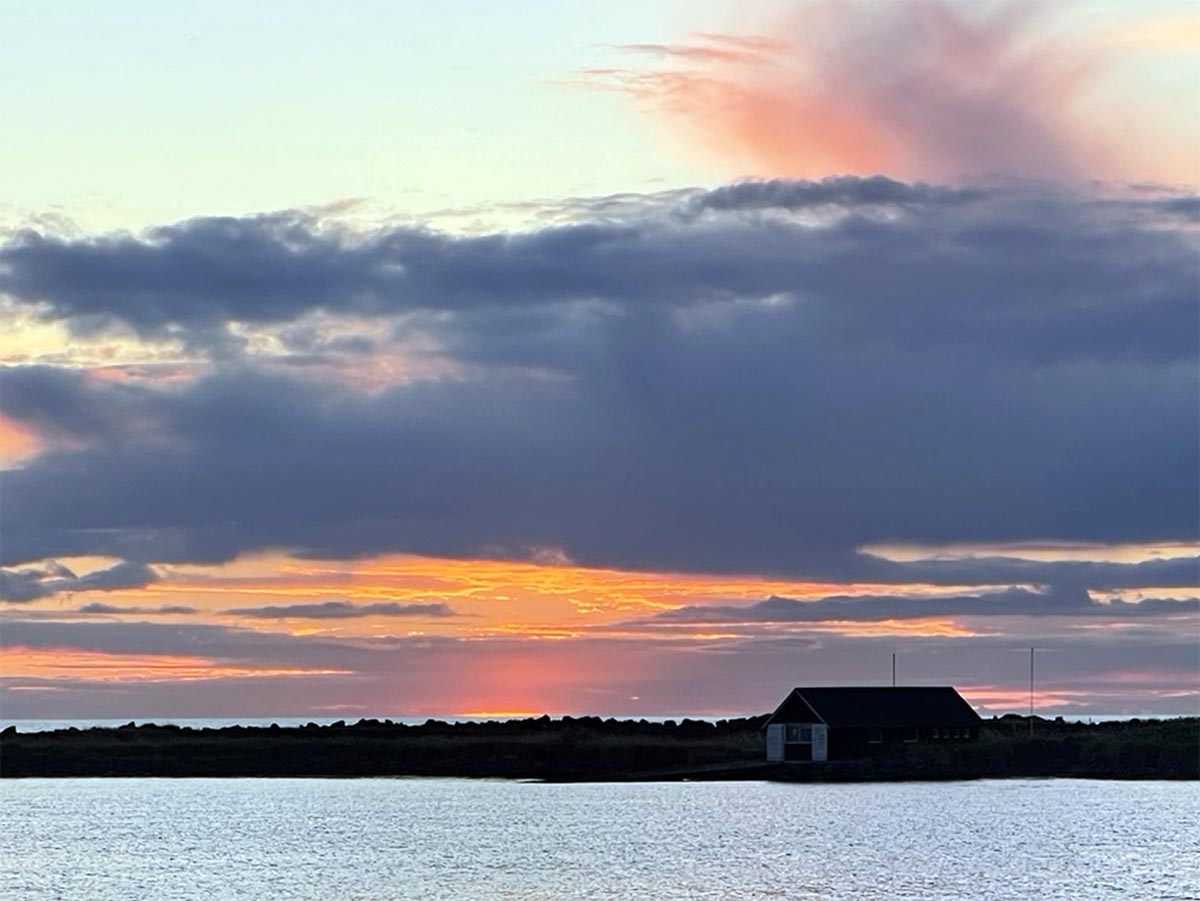
Now we, too, are going to time travel. We are going to jump forward five decades to this past week. It’s been almost as long since dad died as I had with him alive. I am somewhere sort of unbelievable: Iceland! The second of my two children has graduated high school, and this trip is my present to her; our last hurrah before the nest empties. I too am divorced, so this is just me and my daughter, at the top of the world, on the kind of trip I could barely have even known anyone did when I was a kid, let alone imagined going by myself, let alone considered taking a child there.
Dad never knew me when I was married, never met my kids, didn’t even know I’d gone back to music full time after a side-trip into quasi-corporate oblivion. Didn’t know I got a Ph.D! Never heard my records. Never saw me perform (as an adult). In a way, I’ve felt unmoored ever since he died. But I have taken epic comfort and peace in the supreme honor and adventure of being a dad, and getting to be dad to my kids in particular.
For better or worse, I have had my own periods of almost desperate poverty in my life. Until the moment I am typing this, almost no one on the planet has known just how menacingly the specter of homelessness has loomed over me and parts of my kids’ childhood. My kids themselves have never known, and, unless they read this column some day, they never will. But a change in living situation would have potentially meant a change in custody, and I was never going to even consider that. So we powered on, often in secret turmoil, even as my power was sometimes turned off.
In fact, there are a host of facets to my divorce that I’ve told nicer stories out loud about, or let stories be held onto by others, so the kids can have their childhood without the often cruel hidden crags of marriage and divorce.
I am proud of that latter part. Without realizing it was a lesson learned from dad, I’ve tried to ensure that my kids’ childhood was fun and interesting, even when adulting was not. (My mother taught us this one too, on the other side. We were pretty poor for many years, but we kids never knew it until much later.)
So, the mere fact of being able to bring my daughter to a fantasy land at the top of the world, is symbolic enough.
But I promised you a second pot of boiling water, so here it is.
I got us an AirBnB near Reykjavik. Our first evening there, I went to the store and stocked up a bit, including some instant coffee.
The next morning comes, and I look around for a tea kettle or coffee-maker. All I can find in the otherwise well-appointed kitchen is a small metal pot in a drawer with other pots. I fill it with water and turn on the fancy electric stove.
As the water is boiling, I realize: duh… there’s a microwave. There’s a better way *right there.*
And boom. Like a mental version of the Northern Lights (which we also saw!), it hits me in a flash. I think of dad, and his metal pot. I am in a condo with a daughter he never met. A luxury apartment in the capital city of the world’s second most expensive country. My children’s childhood formally coming to an end. The wartime battles and scars of divorce and its attendant struggles for empathy and fairness and protection and compassion and kindness and the ever-present fragility and vulnerability that comes with the soul-deep molecular embodiment of parental love, both giving and receiving, at its literal boiling point in that moment. And there, on the stove, is dad’s little metal pot, heating water for shitty instant coffee even though there is a more efficient means within arms reach.
And in that moment, the boiling-point instant, every step of the crooked and craggy path to now seems exactly how it should have been. And sure, sometimes parents stay together and kids live easy lives and the stories told on the outside match those on the inside. But also, sometimes families split up and sometimes kids grow up harder and sometimes the tales we tell out loud are not lies but a way to ensure that the ones we keep to ourselves remain our own. Sometimes the straightest line to now is through whatever your “then” was, and the shortest distance between those we’ve lost and those we have is through ourselves.
Sometimes, just sometimes, you boil water not for the coffee, but for the pot.
Go conquer the world, kids. I’ve loved every crooked-path second of this ride with you.
Dad


Josh Weinstein is an SDMA-winning songwriter, arranger, producer, and pianist/organist/keyboard player originally from New York. He holds a Ph.D. in music and teaches college and private lessons across a variety of disciplines. His dog is way cooler than he is.