Cover Story
Cara Cormier: The Revolution Will Be Funny

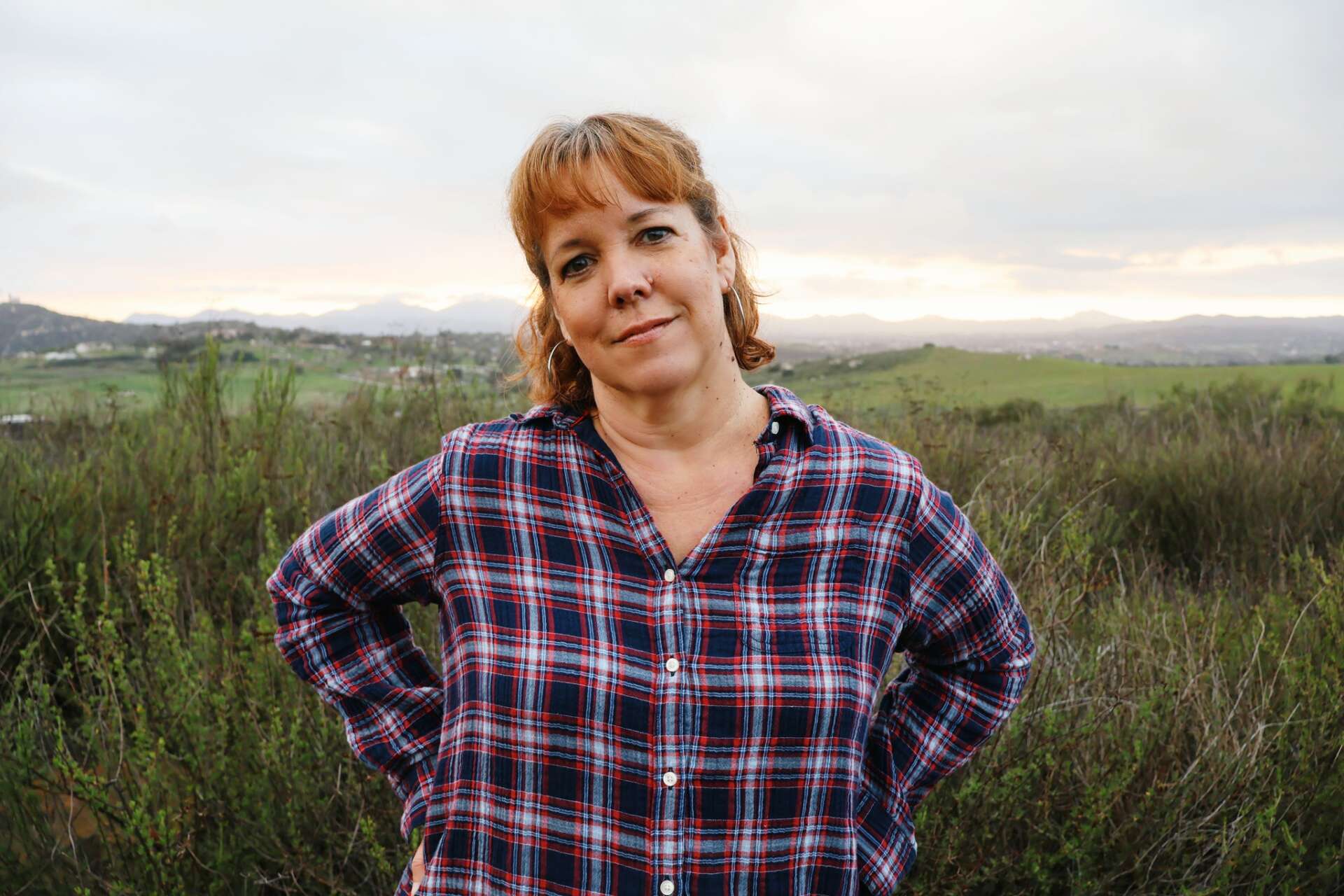
Cara Cormier. Photo by Cathryn Beeks.
Cara Cormier walks on stage like someone you could sit next to at a house show: warm, quick to laugh, loves a white wine. Then she sings about clown porn or Mennonites gone rogue, and the room shifts. People laugh, then they think, and sometimes they walk out a little shaken. That’s exactly what she wants.
“Keep myself sane, make people laugh, create a more just and compassionate society.” She started writing as a way to stay sane. “I probably started moving more into the third one,” she says of how her songwriting goals evolved. Her legal job was crushing: “I kind of almost had a nervous breakdown at one point,” she tells me. Music began as escape, then it became a way to process the work she does defending people caught in ugly systems.
She grew up on a sheep farm in rural Kansas in a Mennonite family with Amish roots. That background gave her two lasting gifts: a fierce sense of community and an ethic of social justice. “One of the things that came out of that which I very, very much appreciate to this day is a sense of community,” she says. “There was a lot of social justice in the Mennonite church… a lot of emphasis on how to make the world better.” But it also came with judgment. “The stuff that I was not grateful for is a lot of misogyny, transphobia, gay phobia. There’s just so much downplaying [the messaging of ] ‘you are a sinner.’” That theology left scars she still writes about.

The funny, sharp songs are a direct line from her theater training. She studied playwriting with an MFA from the University of Iowa. She learned to build scenes and arcs. She grew up on four-part a cappella harmonies and musical theater, so she thinks in choreography and timing. “One of the best compliments I ever got was, ‘your songs are funny, but they have a deeper meaning,’” she says. That’s the trick she tries to pull off: entertainment that edges into something honest.
Mennonite Gone Bad, the 11-song album’s title that started as a bartender’s joke, nails that mix of tender love songs, political justice anthems, and flat-out hilarious pieces. “They named a cocktail after me called Mennonite Gone Bad,” she says, amused. The phrase fits a theme: a woman raised to be good who wants to be bad only to find the conditioning runs deep. “I really wanted to be a bad girl,” she admits. “But when those values are so burned in your brain… I was trying to rebel, and it was just lying in the back.” Her idea of “bad” is often mundane and funny (“a little bit hung over the next morning”) and that distance lets her point to actual cruelty without preaching.

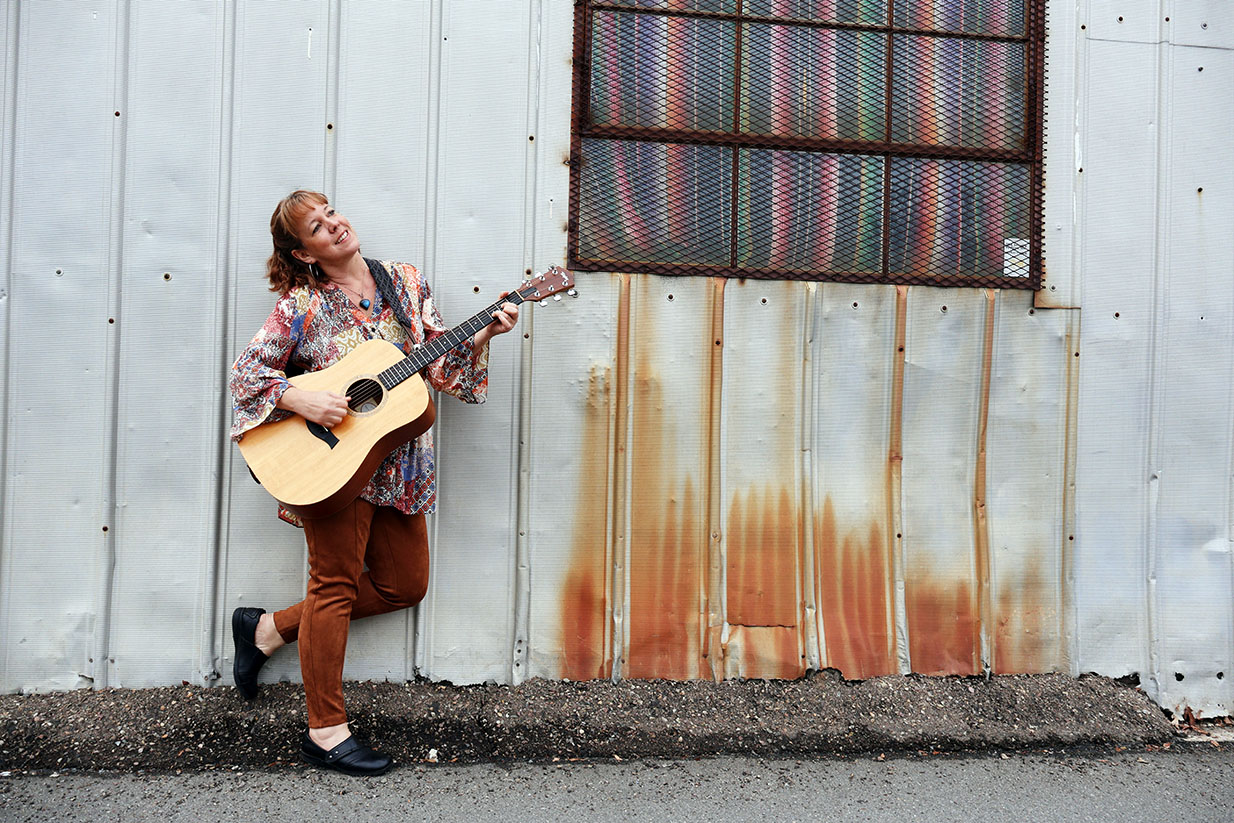
Photo by Cathryn Beeks
Plenty of her humor lands. Some of it deliberately flirts with wrongness. “Red Nose Rendezvous” became a local legend and a conversation starter. She laughs. “I’ve had so many people come up to me around town and be like are you the clown porn girl?!” She also remembers gigs where she didn’t read the room and egged-on discomfort: “That was more my fault because I was not reading the room.” She knows when a joke is pushed too far and when the awkwardness is worth it.
Humor is tactical for her. “That’s the point,” she says when I ask if making people laugh softens the message. She believes comedy opens people up: it lowers defenses and invites reflection. She points to films that work exactly that way. You make them laugh to disarm, then sneak attack with the message.
There’s a contrast at the center of her life that few songwriters have: by day she’s an appellate attorney working on federal cases, often dealing with immigration detention and abuse stories. She visits Otay Mesa and hears people’s histories: “They’re the most horrific, heartbreaking stories… gang rape and torture from all over the world,” she says. Then she files habeas petitions to try to get people released. It’s emotionally brutal work. “You’re doing good work but it’s frustrating because it’s like we shouldn’t have to do this,” she says. The legal work feeds the songs that are raw and bare. She’s recorded a song called “Defeated” that she hasn’t released because it’s so naked about burnout in justice work. “That is probably the stuff that’s the most vulnerable to me and why I hardly ever perform that song,” she admits.
Those are the songs that sit hardest with her. They have no tidy endings. “It’s not a happy ending song,” she says. “The world sucks and I am raw and vulnerable when we’re all hearing it.” She understands the toll of performing such music. She’s read about how performing Joni Mitchell’s “Blue” wore Mitchell down, but she also believes repetition helps. The more you play a painful song, the less it wounds you. “It’s exposure,” she says.
Her writing process is practical. Sometimes a hook shows up as a five-word idea and she builds verses and chords around it; other times she steals a chord progression she likes and writes from there. “Every time I hear a song, I’m like, ‘oh, I want that chord progression,’ and I’ll just put it on the list,” she says. Lately she’s trying the reverse: start with a riff rather than words. It’s a discipline for someone who’s always been “a word person.”


Photo by Cathryn Beeks
The songs aim to make listeners feel seen, but in a new way. “I hope they hear something they haven’t heard before,” she says. “If there’s one thing I try to challenge myself to do, it is to say something that people recognize in a way they haven’t heard it said before.” Novelty plus recognition. Now that’s the sweet spot.
Cormier’s stagecraft borrows from theater: she plans peaks and valleys, letting a comical tune ease into something tougher. But she relies on the San Diego songwriting community to test and lift her material. She remembers her first time performing at Writers Round San Diego. She was terrified and shaking. But she also remembers how the warmth she found there made her keep going. “I don’t think I would be anywhere without it. I’ve done two albums since then,” she says. “There’s not any possibility that I would have been that prolific if I weren’t surrounded by this community.”
The community she left had also been a safety net; giving that up meant building a new one. “I’m jealous of people who say their family are their best friends. That’s not always been the case for me,” she says. Leaving her childhood church cost her family closeness. She found it in San Diego’s music circles, at work, and in her marriage. “Sébastien, the guy I’m married to now,” she says triumphantly. “He’s the best.”
Her exit from faith was neither sudden nor scandalous; it was a series of disappointments and shocks. She remembers a moment as a college junior on a Mennonite touring troupe that clarified everything. They had been set to perform a drama at a youth conference where a member of their group had lost a brother to AIDS. The church leadership expected a confession of sin rather than empathy. “They called us in… they were basically like, ‘we kept expecting you to come around and be like, yeah because he was a sinner,’” she recalls. She was in a bathroom, crying, surrounded by women who looked at her as if she were the problem. Then the janitor, Rosie, offered comfort. Someone outside the church circle. “She’s the only one that gave me comfort that day,” she says. “That was when I was like, this world is not the way everyone told me it was.” It was a defining break.

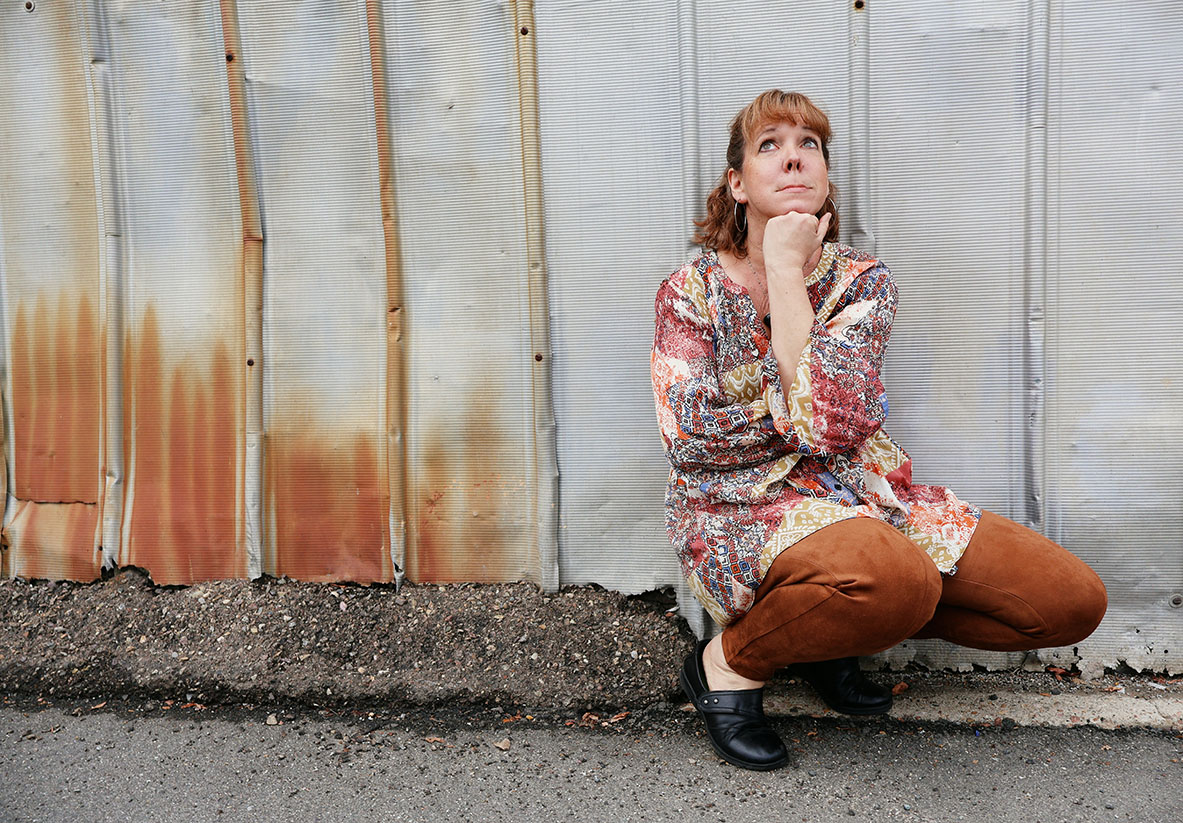
Photo by Cathryn Beeks
There’s also a practical politics to her leaving. College “opened my mind up,” she says. She saw contradictions, messages of charity fused with moral condemnation. She chose a different life.
Recently, a string of short, sharp TikTok videos—cheeky riffs on Bible stories and blunt takes on religious hypocrisy caught fire on TikTok, earning Cormier a burst of viral attention and sparking some lively debate online. Cormier is not indifferent to online reaction. She knows that posting edgier material online invites pushback. “Online you’re always going to get someone who’s fucking crazy,” she says. But she’d be worried if no one reacted; provocation means people are listening.
On stage, she tries to guide an audience gently. A set needs shape: start funny, dip into something low, climb back up. Her theater instincts help, but she also trusts the room. “You kind of have to call it as you feel it,” she says. Read the crowd, adjust the set. That fluidity keeps her shows alive and human.
What does she want to leave in the room when people go home? Not a sermon, not a neat political argument. She wants them to feel recognized and nudged. “I hope they feel like they are seen but they hear that in different phrases or analogies or words,” she says. Small revelations, not megaphone melodrama. That’s the revolution she’s after: quiet, persistent, persuasive.
In her life, that’s already happening in small ways. In courtrooms she presses the law to protect people it too often abandons. On social feeds she makes strangers laugh and then reconsider. In bars and small venues she tells stories that land soft at first and then leave a bruise. It’s not flashy. It’s not necessarily viral. It’s durable.

“Do you ever worry you’re being too soft?” I ask. She shrugs. “When I see art that makes me laugh and then think…I mean that’s how you do it,” she says. She compares it to witnessing the Banksy exhibit. She wasn’t struck with instant conviction, it was the whimsy of it all, the humor that struck first. Then the reality of the message set in. “If you can do that, you’re going to be much more successful.”
Cara Cormier is not out to shock for its own sake. She’s a songwriter who learned to make people laugh and learned how laughter opens doors. She defends people in court and then brings us songs that let us laugh at our own small hypocrisies and, if we let them, feel them. Her revolution is not a march with cardboard signs. It’s a room full of people who came for a joke and left thinking about other people’s stories. That is the essence of folk music, after all.

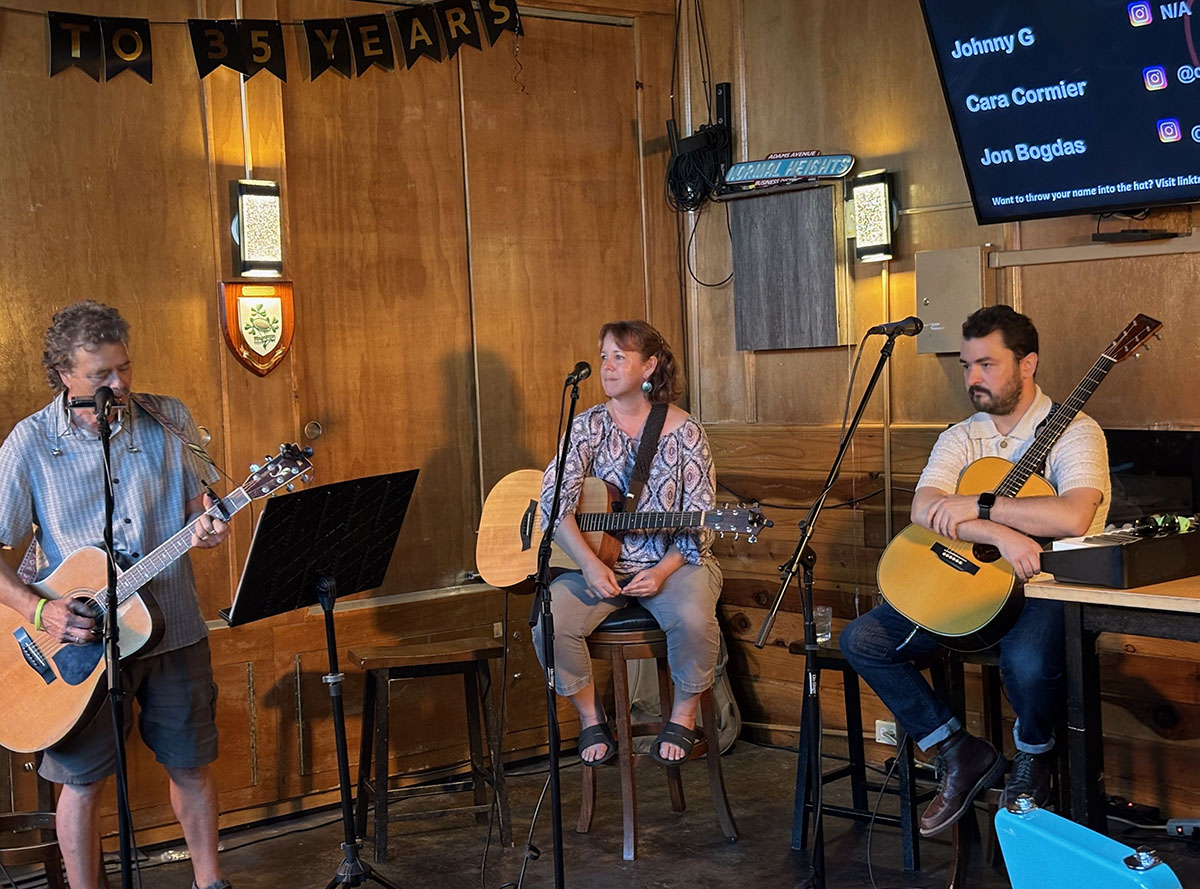
Cara at Writers Round. Photo by Liz Abbott.
That, to her, is enough. Keep yourself sane. Make people laugh. Do the work you can. That’s the kind of quiet uprising that actually changes things. Cara Cormier will keep singing, and the Revolution Will Be Funny. If someone is brave enough, listen to Cara Cormier’s “Samuel Moore” and “Red Nose Rendevous” back to back and report that you weren’t moved to tears. One will be from laughter, and one from rage, but I think it’s discernable which one is which.
Once, in a time of frustration and despair, she asked herself, “What would it take to make me happy?” She listed four things: community, a partner, social justice work, and an artistic outlet. Today, she has all four. “Now I look at my life and I’m like, oh my god, I have all four,” she says. “What could be better? That’s a really good life. Little Cara would probably be pretty happy with this.” Cara has what she wants, and we are all better for it.