Featured Stories
Art of the Upsurge: San Diego State’s Jazz Program
Brian Levy strives to take SDSU jazz program to another level

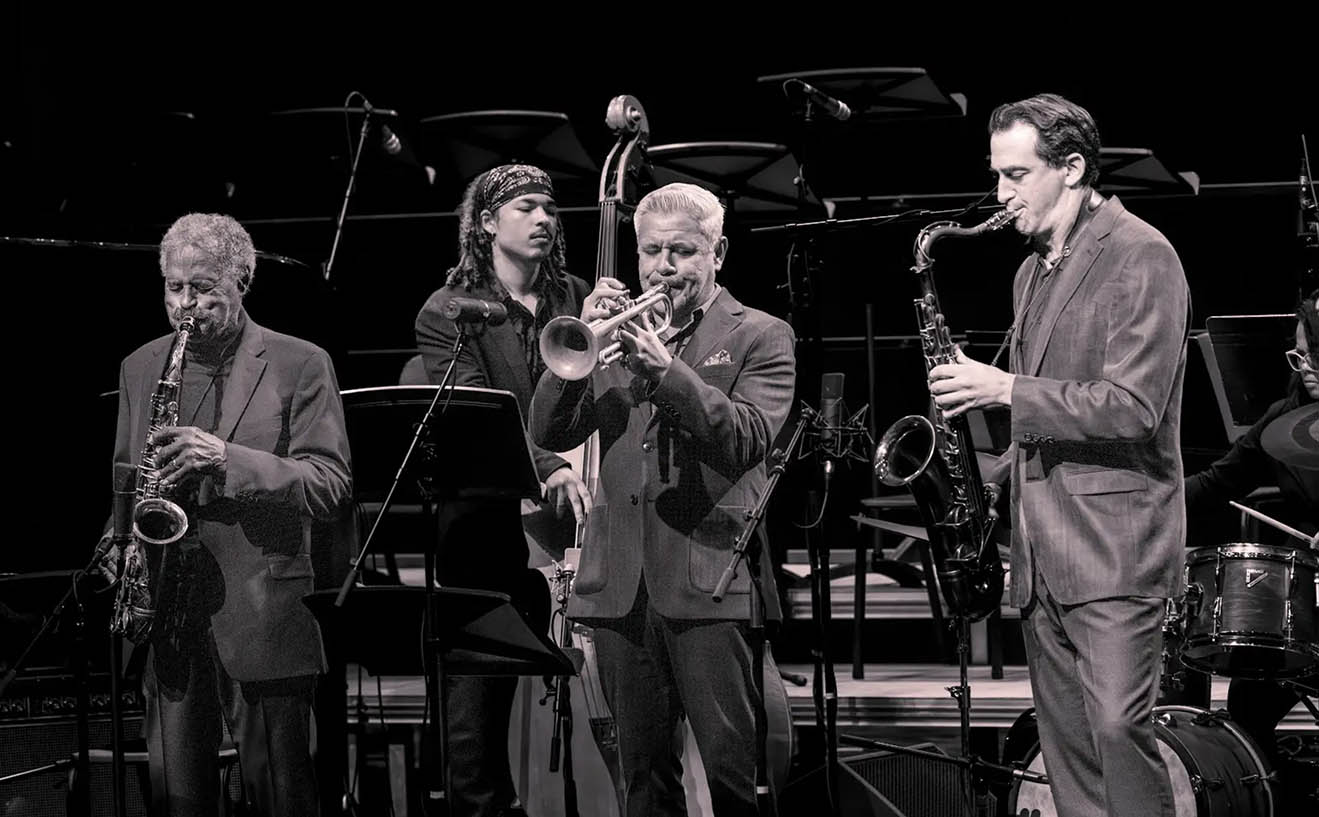
Charles McPherson with SDSU Faculty Gilbert Castellanos, Brian Levy, and SDSU Student Luke Little. Photo by Gabriel Anthony Patteron.
On a recent afternoon in a rehearsal space at San Diego State University, Jazz Studies Director Brian Levy emphasized to the precocious students of his Combo class the importance of “upsurge” in their improvisations.
Upsurge consists of a sequence of notes and rhythmic accentuations that escalate the energy of a solo. As an example, his recently released book, Chasin’ the Sound (cowritten with Keith Waters) cites Charlie Parker’s outbursts on trumpet sidekick Dizzy Gillespie’s “Groovin’ High” as heard on Live at the Royal Roost, recorded in 1949.
“There are about 30 upsurges in it,” Levy notes. “The break begins with one. They are the fast triplet and 16th note ascending gestures.”
The term is an apt metaphor for the direction the university’s jazz studies program is experiencing under Levy’s leadership since he was hired in 2023.
“It was exactly what was needed,” said bandleader, saxophonist, and keyboardist Dylan Soto, who studied under Levy en route to a master’s degree in 2025. “I think he brought with him positive changes that didn’t completely throw everything out that existed before.”
Levy was raised in San Diego and began studying music at an early age, including a stint as a saxophone student under reed master Joe Marillo. He migrated to the East Coast to further his studies, earning a bachelor’s degree from William Paterson University in New Jersey, a master’s from the Manhattan School of Music, a doctorate in musical arts from the New England Conservatory of Music, and a PhD in musicology from Brandeis University. He taught full-time at the New England Conservatory of Music in Boston from 2012 to 2023, when he took the SDSU position.
“My theme at SDSU is to turn the program into a conservatory-style experience within a university curriculum,” Levy said. “I guess the model for me—I call it ‘Willy P. West.’
“William Paterson University is a state school in New Jersey that is known for being a top jazz program out of the East, but it’s a public university. So, it’s not 60 or 70 grand a year to go to school. I’m trying to make SDSU more of a destination program.”
After taking the job on the Montezuma Mesa, Levy said he was surprised that there were only a handful of students signing on as jazz majors per year. That did not include students enrolled in classes and ensembles as non-majors.
“But this year, we had 28 new jazz majors,” Levy said. “In my first year, they had eight jazz majors and the year after it was 17, and now it’s up to 28.”


SDSU Students Ryan Kupsh, Christian Florendo, William Brumbach. Photo by Esteban Marin.
He attributes that to several factors. “The first one would be faculty,” he said. “Since I started here, we brought in four new faculty members who are all amazing performers and have the kind of hands-on experience I really want to build the program around.”
Those members include San Diego-based trumpeter, band leader and educator Gilbert Castellanos, who teaches combos and private lessons at the university.
Levy plays tenor saxophone in Castellanos’ New Latin Jazz Sextet, the most recent group among his extensive resume of performance credits. Levy was also a featured soloist in Castellanos’ recent tribute at the Jacob Music Center to the seminal Blue Trane album by John Coltrane, saxophone hero to both Levy and Soto.
From Los Angeles, Levy brought in Luca Alemanno to teach bass and coach combos.
“He’s amazing,” Levy said. “Every week, he’s in another part of the world playing with all the biggest names in jazz.”
Guitarist Steve Cotter teaches guitar combo and individual students.
Perhaps most amazing of all, Levy was able to bring on board world-renowned vocalist Jane Monheit. Her presence punctuates Levy’s initiative to bring vocalists into the SDSU jazz program.
“That was one of the things I thought we really needed to have fixed,” Levy said. “We needed to have vocals. We had something like 18 or 20 vocalists who auditioned to be in a combo this year and now we have several jazz majors who are vocalists starting this year.”
The new faculty members augment an already robust roster of instructors, such as guitarist Fred Benedetti, trumpeter Derek Cannon, percussionist Gregory Cohen, and alto saxophonist Christopher Hollyday, among many others.
Another thrust has been an increase in the number of guest artists per semester, and an altered focus. Whereas in the past most guest artists were featured within the context of a large ensemble, such as the traditional big band, Levy has the guests performing with the program’s small groups, including jam sessions, in addition to the typical master class seminars.

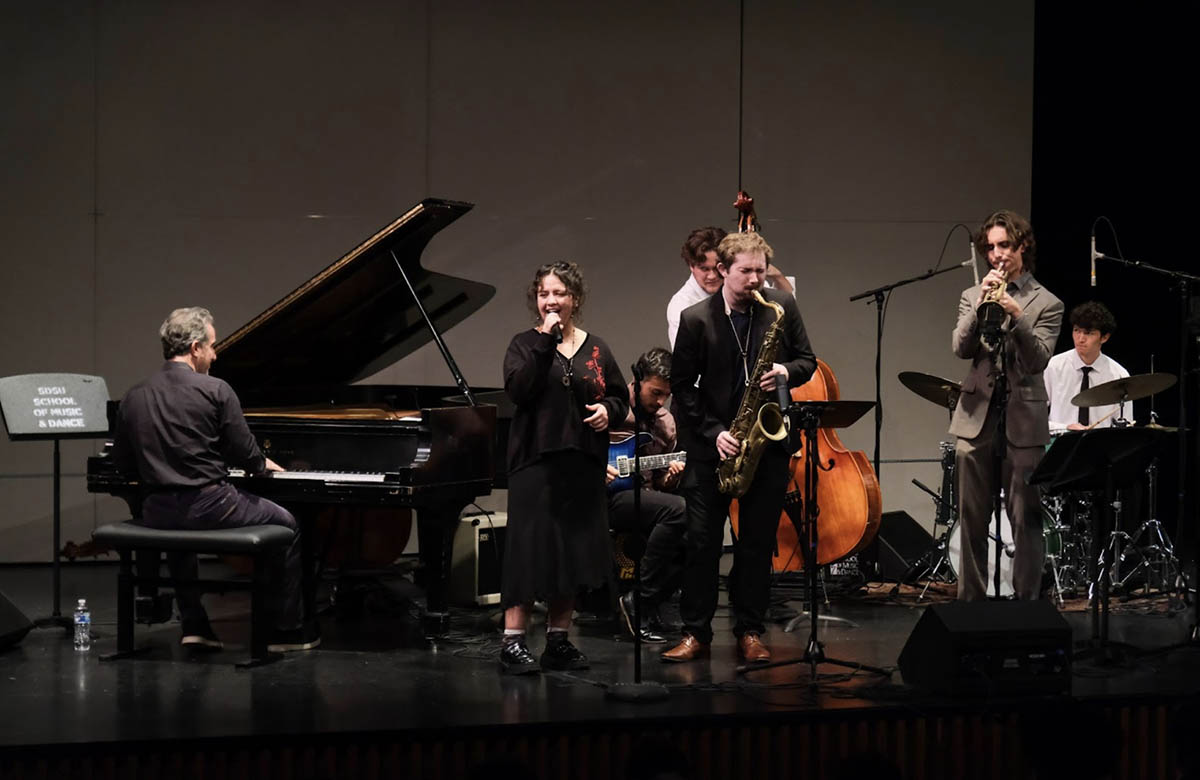
Aaron Goldberg with SDSU Students Emily Broughton, Ed Spillane, Rudy Marquez, Reese Willis, Henry Aufmann, and Jameson Powell-Espiritu. Photo by Esteban Marin.
The most recent of the guest artist appearances was pianist Aaron Goldberg. Before that, guests included such luminaries as percussionist Ignacio Berroa, drummer Joe Farnsworth, guitarist Peter Bernstein, bassist John Clayton, and San Diego-based alto saxophonist legend and former SDSU instructor Charles McPherson.
“It’s kind of an awesome opportunity for students with these guest artist visits,” Levy said. “We have many of them and they’re kind of more intimate interactions than you would find at many other schools for jazz, even though we don’t have the same kind of resources as maybe Julliard or Berklee or some of those famous programs.”
While Levy is intent on ramping up San Diego State’s jazz footprint, the university’s music program has a long history of nurturing musicians within the idiom pioneered by African-Americans from the late 1800s.
Bassist Gunnar Biggs said his father, the head of State’s music program in the 1970s and ’80s, hired his son and colleague, pianist Butch Lacy, to teach jazz classes around 1980.
Also during that period, Eddie S. Meadows taught jazz history at the university.
Biggs and Lacy went on to lead various ensembles. In the early 1980s, the department hired trombonist and educator Bob Holtz to oversee the jazz direction and lead a big band. Also, trombonist Hal Crook arrived on campus to teach and lead groups.

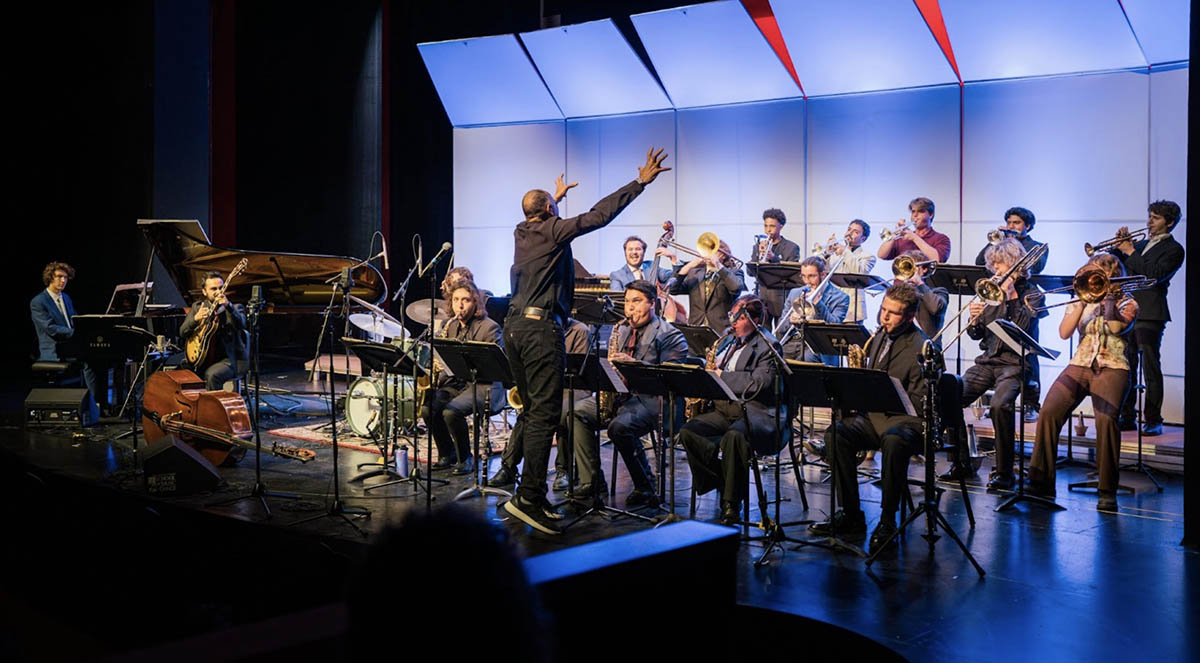
John Clayton conducting the SDSU Jazz Ensemble. Photo by Andrew Troxell.
A sea change occurred in 1985 when bandleader, educator, and trombone player Bill Yeager was brought on board to oversee jazz studies. Yeager and Biggs knew each other from being part of North Texas State’s legendary jazz program.
“Here’s the thing about Bill Yeager,” Biggs said. “He had damn near perfect pitch. He could sight-read fly shit at 100 paces. You could give him a Charlie Parker solo and he could sight-sing it perfectly note for note.”
Biggs credits Yeager with building jazz studies, especially by bringing in Rick Helzer as associate director.
“Rick developed a program of jazz elements, which was jazz theory, analysis and arranging—all of the classes that became the core curriculum for the degree that actually had a lot of academic merit.”
Yeager said in an interview that he heard about SDSU through Biggs, but it was Meadows who interested him in going for the job.
When he applied, the university wanted to hire Yeager as an assistant rather than associate professor. So, he initially was prepared to turn it down until he interviewed with the provost vice president.
“So, I go over to his office and he’s looking at my resume—that I played on Bob Hope shows and Dean Martin shows, and toured with Frank and Ella and others that Les Brown would back up.
“‘The provost was older and he says, ‘Les Brown was my favorite leader in the Big Band era!’ He said, ‘What’s it going to take to get you here, and I said ‘associate professor.’ Then he gave me what I’m asking for.”
Yeager headed the jazz studies program until 2023, when he retired and turned over the reins on an interim basis to Karl Soukup.
“If you go through all the musicians in San Diego, the guys who are playing the jobs, I’d say almost 90 percent of them have come through my program,” Yeager said. “That’s exciting. When I adjudicate the various high school jazz festivals in Southern California, I’d say the majority of the directors came through San Diego State.”
Biggs said that in contrast with the emphasis at the University of California San Diego on experimental and computerized music, SDSU has focused on utility.
“We were there to give them a working knowledge of the art form, technically and emotionally, so that when they came out of that thing, they could go on the bandstands and know all the bebop tunes and play their asses off.”


SDSU Students Eva Baffone, Max Weinzimmer, Alejandro Juarez, Luke Little, Gannon Reed, Andrew Bayani, and Paul Rosette. Photo by Esteban Marin.
Soto, the Oceanside musician, wound up entering the SDSU program during Yeager’s last years, more or less on a lark. He had intended to attend Columbia University in New York. But when that didn’t work out, he returned io North County and pondered his options.
“I didn’t know what to do or where to turn,” Soto said. “I applied to San Diego State not out of desperation, but more so out of an uncertainty about what my next step would be. That decision was really very much a leap of faith. It was something I had little or no understanding of what direction it would take me. I didn’t I know what to expect. I knew that this wasn’t originally what I wanted, but I was going to see where it would go and I did it.”
Soto credits Levy with a much-needed boost to the program as he pursued his master’s along with his partner and drummer Johanna Sy. Both earned their master’s degrees in jazz studies in 2025.
“I think he brought with him positive changes that didn’t completely throw everything out that existed before,” Soto said of Levy.
“I couldn’t say enough good things about it. Everybody who talks about wanting to go to SDSU or is thinking about where to study jazz, I’ve encouraged them to do it…. I’m happy to do that because I really had a great experience.”